About
Shop
FAQ
Freebies
Gallery
Self Reliance – Grow Your Own Market Garden
Market Gardening – Smaller Gardens
Can a family be totally self-sustaining by using between 1 and 2 acres to grow, eat, and sell food? Yes! As a matter of fact, families in many countries are doing it, and they often have gardens much smaller than 1 acre. However, you should consider carefully what you are getting into. I’ll paint a picture of the problems first, then show you how blessed you are to be using the best possible growing methods for a family garden, and finally I’ll give you some ideas as to what and how to grow your market garden.
- Considerations Before Beginning
Your income depends on what you choose to grow, and how well you follow through in the growing process. It also depends on how well you learn the financial and marketing aspects of the job. Growing corn is easy, but doesn’t produce much for the amount of space used, or pay well, unless you like to eat corn stalks. And someone has to sell the produce and pay the bills, which take substantial time and effort by themselves!
“Self-sustaining” requires very different amounts of food and money, depending on the family size, the standard of living expected, and the debt load you expect the garden to carry. Debt of $3,000-5,000 per month requires a much greater effort to cover than a debt-free situation.
Location is also a factor. People in warm climates can often grow into or even right through the winter, while colder climates have a shorter season. Both locations can improve your production by using the Mittleider Gardening Method. Warm climates may require lots of water and even a little shade at the hottest times, while cold climates often require more greenhouse seedling production and covering garden crops in spring and fall to extend the season.
Before getting seriously into market gardening you need to understand the commitment involved, and be willing to do it right. Our grandparents grew gardens, and also often owned animals. They understood the necessity of working every day to feed, water, and care for their animals and plants. Regrettably, we’ve forgotten this requirement, as 99% of us have chosen other ways to make a living, and become dependent on the 1% who are highly competent farmers to feed all of us.
You must understand and accept that there is very little respite for vacations, etc. during the growing season. A good garden requires your attention on a daily basis!
On the other hand you, and especially your children, will benefit greatly by having a fixed and important responsibility that requires daily commitment and real effort to accomplish. Think of it as a paper route without the 2:30 A.M hours, the driving, the danger, barking dogs, etc.
And one last consideration: A hundred years ago, everyone used manure and compost, and it was a fairly level playing field between the family gardener and the market farmer. Not so today! Your competition includes hydroponic growers who have invested over a million dollars per acre in buildings and equipment, as well as dozens of employees doing the work. And by feeding and watering their plants accurately many times each day, they’re growing 330 TONS of tomatoes per acre each year!
- You have a big advantage over others
Is all of this daunting? Have you decided to just give up and forget about growing your own food? I certainly hope NOT, because it’s important for you and your family to grow a garden for many very valid reasons, which we can’t address in this article.
Understand this. You can produce much more in less space, using the Mittleider Gardening Method, than other small market growers are doing, so GO FOR IT!
The website at www.growfood.com, the books, CD’s and videos will teach you the gardening principles and procedures by which you will grow your successful market garden. In studying these things, remember that this unique gardening method has been proven highly effective in thousands of situations, in dozens of countries all around the world. It’s a recipe! It WILL work to give you a great garden – in any soil and in virtually any climate. But you MUST follow the recipe.
III. Creating Your Own Successful Market Garden
How do you prepare?
- The best gardening book you can have is essential! I recommend The Mittleider Gardening Course, by Jacob R. Mittleider, as the RECIPE for a great garden of any size. It is available in digital or paper at www.growfood.com/shop.
- START SMALL! Don’t plant more than you can care for properly, and sell, share or use.
- Determine the market or markets you will sell to: a) Wholesalers, b) small grocery stores, c) restaurants, d) farmers’ market, e) roadside stand, or f) home delivery.
- Learn what vegetables you should grow by determining those that: a) sell well, b) at a good price, c) that you can grow readily.
- Build proper facilities including a) a seedling greenhouse with tables, b) T-Frames and c) a good watering system. These are essential for success at this level.
- Set up a formal accounting system, including account names and numbers for every category of asset, liability, equity, income, and expense. Get help from your CPA.
- Stock up on tools, seeds, and fertilizers, and be sure to include all those costs, as well as your labor, in figuring your market prices.
You’ll have to meet or beat the competition to sell your produce at the beginning. However, by growing more, bigger, fresher, tastier, and healthier produce than others, you will develop a loyal customer base, and then you can adjust your prices as needed.
In choosing what to grow, consider a) the ease of growing, b) cost and risk of loss, c) the value of the crop, and d) varieties that are popular in your area. Cabbage is quite easy to grow; it can be started in early spring when many other crops would die; and it only requires about 60 days to mature, so you may get 2 or even 3 crops in a year. However, it doesn’t bring a very high price in the market, so you must decide if it’s worth it or not.
Let’s look at some scenarios of what could be grown and sold from one acre of ground, with good care and decent weather, and without losses from bugs and diseases (by strictly following the Mittleider Method you will minimize your crops’ susceptibility to those things):
Soil-Bed Garden – 250 30’-long Beds (as if all planted to one crop)
Beans-pole – 120 plants per bed, 1.5# per plant, $.50 per pound – – – $22,500
Corn – 92 plants per bed, 1 ear per plant, $.10 per ear – – – – – – – – – 2,300
Cucumbers – 45 plants per bed, 8# per plant, $.25 per pound – – – – – 22,500
Potatoes – 92 plants per bed, 2.5# per plant, $.10 per pound – – – – – – 5,750
Tomatoes – 40 plants per bed, 10# per plant, $.50 per pound – – – – – 50,000
The above examples are estimates only, and the actual results could be – and have been – much higher or lower, depending on many factors, including experience & care, weather, direct retail marketing vs. wholesale sales, etc.
If you are growing for the retail market using a roadside stand or farmers’ market booth, you will probably want a fairly wide variety of produce, to attract customers. While corn has low value in terms of yield for a given amount of space, it is VERY popular with customers when it’s fresh, so you may well treat it as a “Loss Leader” and have it available. But don’t try to plant too many vegetable varieties. Ten or twelve key types are far easier to handle than twenty to thirty. And three varieties of tomatoes are usually plenty. I would plant Big Beef, Italia Mia, and Grape tomatoes. One planting of Blue Lake pole beans will allow you to sell beans all season long, but bush varieties come on much sooner, and are harvested in just a few weeks.
If your customers are restaurants, you will need to grow the specific things they use, such as specialty lettuces, tomatoes, Ichiban eggplant, small red potatoes, etc. And you may need to plant a few beds of the single-crop things every couple of weeks, to have them maturing throughout the season.
If your primary market is the large grocery store or wholesale suppliers, they will usually want a large steady supply of a few things, so you may be able to plant everything to the “money” crops of beans, cucumbers, eggplant, peppers, and tomatoes, or multiple plantings of lettuces and other quick-growing crops.
I recommend you consider this material seriously, because the day may come (and much sooner than any of us want) when your garden will be the only way you can feed your family.
Prepare NOW, and be successful no matter what the future brings!
Jim Kennard
Feed Your Family In 64 Square Feet Of Garden Space
Tiny Gardens – Plant Across the Width to Maximize Choice & Yield
Many people have only a small space in which to grow, such as a porch, patio, or driveway, and want to plant so as to get the greatest possible yield in the least space. Here’s an idea on how to do that.
You can plant across the width of a box or soil-bed, rather than the traditional lengthwise, if you’re willing to do the extra work of feeding, watering, weeding, and pruning that it requires. Remember the first law of plant growth – direct sunlight all day long – and that applies to all of your plants, for optimum harvest. Therefore, planting close together as I’ll suggest here requires that you prune your plants so that they do NOT shade or overlap each other.
You’ll also need to water by hand, to assure even coverage to all plants. And if you’re in the soil, weeding will not be as easy because of the close proximity of plants to each other. The two-way hoe is still the best tool for the job.
And remember to quit feeding the single-crop varieties three weeks before they reach maturity, and ever-bearing crops 8 weeks before hard frost, so as not to waste fertilizers. Multiple crops are certainly an option for several of these, especially carrots, kale, lettuce, and green onions.
Here’s what you could grow in a 2” X 8” box 4’ wide by 16’ long
Rows are from North to South OR East to West (Yields are in parentheses):
ROW LOC CROP – (No. Plants & Yield)
1 – – – – 0’ 1” – Tomatoes (2 = 30#), Cucumber (2 = 40#) and Vining Squash (1 = 10#)
2 – – – 2’ 6” – Zucchini (3 = 45#)
3 – – – 5’ 0” – Peppers (5 = 15#)
4 – – – 7’ 0” – Broccoli (5 = 5# + 10# from leaves)
5 – – – 9’ 0” – Cauliflower (5 = 10# + 10# from leaves)
6 – – – 10’ 6” – Kale (9 = 30# Note: keep leaves picked and harvest can be 9 months!)
7 – – – 11’ 0” – Carrots (45 = 15# + 5# from leaves – YES they’re edible and tasty!)
8 – – – 12’ 6” – Red leaf lettuce (9 = 18# – keep outer leaves picked and yield increases result)
9 – – – 13’ 0” – Romaine lettuce (9 = 18# – same as above)
10 – – – 14’ 6” – Green onions (48 = 5# + 8# from 12 bulbs)
11 – – – 15’ 0” – Italian parsley (16 = 10# – again, harvest can be season-long)
12 – – – 16’ 0” – Sweet potatoes (5 = 25# + 10# from leaves) at opposite end of box
TOTAL YIELD – Plants = 164 – – – – Production = 314#
Tomatoes, cucumber, squash, and zucchini all must be grown on 2” X 2” stakes and pruned to one stem – tomatoes right at the crotch, cucumber and squash cut sucker stems after first female blossom. Zucchini – older leaves pruned as they touch the ground or interfere with adjacent plants
Broccoli and cauliflower leaves should be pruned to keep them off the ground and away from adjacent plants (eat them, they’re edible!).
Sweet potatoes will only work in the space describes above if you can let them run outside the box. You’ll need to prune and train them so they don’t cover your onions and lettuce. These leaves are also edible – use them.
For more information visit www.growfood.com
Jim Kennard.
Prepare Now For Next Spring’s Garden
Winter’s the time to get ready to grow your own seedlings! It’s not really difficult, and can extend your growing season by many weeks. For example, by planting cabbage, broccoli, and cauliflower in February in your basement under grow-lights, you can put large, sturdy transplants into your garden by the end of March or early April, and be eating them when others are just seeing them come up!
Remember that photosynthesis, using light, heat and moisture causes plant growth. Therefore you must follow a few key natural principles very carefully, or you will be disappointed.
First, seeds must have moisture to germinate and grow. And the soil mix must be moist, but not soggy, or you’ll drown the new plant, since it must also have oxygen!
Second, while heat is essential, temperatures must be maintained in a narrow range for ideal germination to occur. Most vegetable seeds germinate quickly between 75 and 80 degrees Fahrenheit. After plants are up, many of them will grow in cooler temperatures, but most all will become dormant (stop growing) at temperatures below 50 degrees.
Third, light is not necessary for seed germination, but as soon as your seedlings begin to emerge from the soil, maximum light is required immediately for proper development. Therefore, to grow in your house, make sure your plants have a strong (but not hot!) light source directly on the plants, for up to 16 hours per day. Note the pictures of two grow-light shelves in the Gallery Section. The metal one is 6-shelf Commercial Chrome Shelving, from Sam’s Club costing only $70, and will hold 20 flats of plants. Suspend shop lights with 2 cool and 2 warm 40-watt tubes 4 to 6″ above the plants, or use more efficient LED grow-lights .
The fourth principle relates to feeding. A balanced nutrient mix of 13 minerals is essential to plants immediately after germination. Those nutrients are mineral salts and must be very dilute in the soil moisture, otherwise osmosis will cause the salt to draw the life-giving moisture out of the plants, and they will die. To ensure you never burn your plants, water seedlings daily using the “Constant Feed Solution” of one scant ounce (2 almost level tablespoons) of Weekly Feed dissolved in 3 gallons of water. To make the Weekly Feed Mix simply add one small packet of the Micro-Mix, which is available on the Foundation’s website listed below, with 4# of Epsom Salt and 25# of 16-16-16.
Next, it is important to separate your small plants before their leaves begin to overlap with others’, or the tiny stems will become very weak and spindly as the plants all stretch – looking for more light. By the time the plants have their first or second true leaf this step should be completed. Failure to act for even a few hours can result in spindly, weak plants, which sometimes never recover. Transplanting seedlings into 2″ 6-paks or pots will provide adequate space for them to grow an additional 2-3 weeks, depending on variety. If it’s still too early to put them out into the garden by the time plant leaves are again beginning to overlap, prune the leaves, transplant again into larger pots, or separate pots, so the plant leaves always have maximum light.
Before transplanting into the garden, “harden-off” your plants outside, off the ground for 2 to3 days, to acclimate them to direct sunlight, temperature, wind, etc. This is important so the plant doesn’t have the shock of a new environment added to the shock to its root system caused by transplanting. If the weather turns cold at night, bring the plants back in the house. The temperature adjustment needs to be gradual.
For many of your plants, the pruning process does double duty. In addition to assuring maximum light, it shocks the plant mildly, causing it to pause in its growth and produce a thicker, sturdier stem. This process makes the plant much better able to endure the vicissitudes of the outside environment, such as cutworms, ants, etc. that often quickly decimate plants with weak, spindly stems.
For tall-growing plants, like tomatoes, be sure to provide small stakes tied to the plant stem, to prevent them from falling over. And with tomatoes, begin immediately to remove all sucker stems as soon as possible, to assure a single, strong stem and maximum production from your plant.
Great growing instructions can be found in the book Let’s Grow Tomatoes, available as a digital download and as a part of the Mittleider Gardening Library CD. It’s available at www.growfood.com/shop.
Prepared – Got Your Wheat, Beans & Rice? So What Are You Going To Eat?!
As we try and stay warm during this cominf cold winter season probably very few of us are thinking of gardens or growing our own food – but maybe we should be! When God cursed the ground it was for our sake, so when He said we were to eat our bread by the sweat of our brow perhaps He was pronouncing a blessing on us. At the very least it was instruction on how we were to live, but today too many of us , if we exercise at all, pay to “work out” in the gym instead of working out in the garden.
It is time to change that!
Great and wise men have said every family should have a garden, and that we should “Grow all the food that you possibly can on your own property…grow vegetables and eat those grown in your own yard. Even those residing in apartments or condominiums can generally grow a little food in pots and planters.” Spencer W. Kimball
Evidence all around us points to the wisdom of those words. Today much of what we eat comes from places we know not and contains things that sometimes harm us. And a diet of fresh vegetables and fruits would eliminate many of the chronic health problems plaguing our society
I suggest now is a good time to begin preparing for your own garden next spring. Why? Because it makes sense to follow wise counsel at any time, but also because like someone recently said, when times get tough you’re not going to want to live just on rice and beans and wheat.
In talking with a motivated Mittleider gardener I asked how he became interested in gardening as an important component of his family’s preparedness regimen, and his answer was both humorous and instructive:
“Years ago my wife and I were going over our Preparedness list, basically taking an inventory of where we were in the process, and I asked her “what are we going to eat”, to which she replied “well, we’ve got wheat, beans, and rice . . . “. I thought about that for a few seconds and then said “so what are we going to eat”? She repeated “we’ve got wheat, beans, and rice”, and I responded again “so, what are we going to eat!”
“As we talked about this we decided that we really needed to have an on-going, fresh and sustainable source of nutritious food if we hoped to maintain any degree of long-term health and activity, and so we determined that we had to get serious about growing a garden.”
And here’s “the rest of the story” as Paul Harvey would say. His wife became a Certified Master Gardener, and for 30 years she worked diligently at trying to grow food for their family. However, until recently their success was very limited, even though they tried every method they could find. Their amazing success sfter finding the Mittleider Method of gardening is truly inspiring, and it is documented in some excellent short instructional videos at http://www.ldsprepper.com. I recommend you go there and see for yourself what they’ve done (and what you can do) in the back yard of a small lot in a gated community, with homeowners’ association rules dictating what your yard can look like.
So, what CAN we do in the winter in order to be prepared when it comes time to plant our gardens? Let me describe several important things you can begin doing immediately:
Certainly, planning next spring’s garden is important. And the Garden Planting Details Schedule lists most all of the common garden vegetables and then gives you valuable information in 14 categories including when to plant, where to plant, how far apart to plant, whether to plant seeds or seedlings, how long you can harvest, how much yield to expect, and 8 other important categories of information to guide your decisions. This is available free in the Files section of the gardening groups listed below, as well as in appendix B of The Mittleider Gardening Course book.
Other important areas of planning you should be covering this winter include ways to lengthen your harvest time, and this can be accomplished by growing your own seedlings, and by protecting your plants in the garden.
Seedling production is surprisingly simple, but requires following closely the basic laws of plant growth. Soil temperatures must be in the 70-85 degree range for optimum germination and growth; maximum light must be applied immediately upon emergence; soil must be damp but not soaking wet; and plants must be fed a balanced nutrient mix on a regular schedule – preferably with every watering.
Protecting your plants from the cold (and heat in mid-summer) can be done simply with hoops and clear greenhouse plastic immediately over the plants (low tunnel), or using something larger, again with hoops and plastic sometimes called high tunnels. A third way, costing more but allowing you to grow crops vertically and increasing yields by 4-6 times in a given space, is what I call the in-the-garden greenhouse. These are built using a set of T-Frames tied together by 2 X 4’s and again covered by clear greenhouse plastic, and they can be used to grow seedlings in late winter/early spring and then to grow ever-bearing crops clear into the next winter. Gardeners in southern-tier states even use them to grow successfully year-round.
A family of 4 can live out of a garden of less than 1/20th of an acre! So start planning and preparing now, and expect to have your highly productive sustainable garden in place and growing by the time your neighbors begin even thinking about their gardens.
Short videos demonstrating many steps in the gardening process are available free at. Start there, and if you feel you want to join one of the Food For Everyone Foundation’s free gardening groups to learn more and share with others, simply go to either https://groups.yahoo.com/neo/groups/MittleiderMethodGardening/info or https://www.facebook.com/groups/2304852529528161/
So, what are YOU going to eat when the stores are all closed? If you’re serious I will give you some very exciting and important details next time.
Planning Next Year’s Vegetable Garden – What Could You Produce?
Many people arrive at the end of the gardening season and wish they had planned their vegetable garden better. Often there is wasted space, and sometimes we have grown things that were not used, and perhaps couldn’t even be given away.
Now is a good time to begin planning for next year’s vegetable garden – to make sure you realize the greatest benefit from your valuable time and available space, and that you make the most of those precious 6 months of growing which nature provides us.
First you should decide what your garden is used for. Is it for casual use, with just a few things grown for fun, or do you depend on it as a major source of your family’s food? Next, decide what kinds of things are best to grow – juicy tomatoes, or that new triple-sweet corn. And then plan for how much of each thing you will grow.
How your garden is used depends on 1) whether or not you’re able or willing to devote serious effort to your garden, 2) whether you expect to feed your family just during the growing season or for the entire year, 3) what things your family likes to eat, 4) will there be supplementation from other sources, or will you be depending on your garden completely, and 5) do you want or expect to earn money from the sale of your produce.
An excellent and comprehensive database of commonly grown vegetables, with when, where, and how they can be grown, as well as how much they will produce (14 total categories of important information), is contained in The Mittleider Gardening Course book, on page 262. This document is a wonderful resource for the serious family gardener, and can be found at https://growfood.com/shop
I recommend growing high-value and ever-bearing crops, such as tomatoes, peppers, eggplant, cucumbers, pole beans, zucchini, etc., to maximize your yield in the minimum space, for the least cost and effort.
Let’s assume you have a large family you want to feed from your garden, but that you only have 1/16th of an acre that can be used for this purpose. I’ll give examples of what can be grown in 30′-long soil-beds.
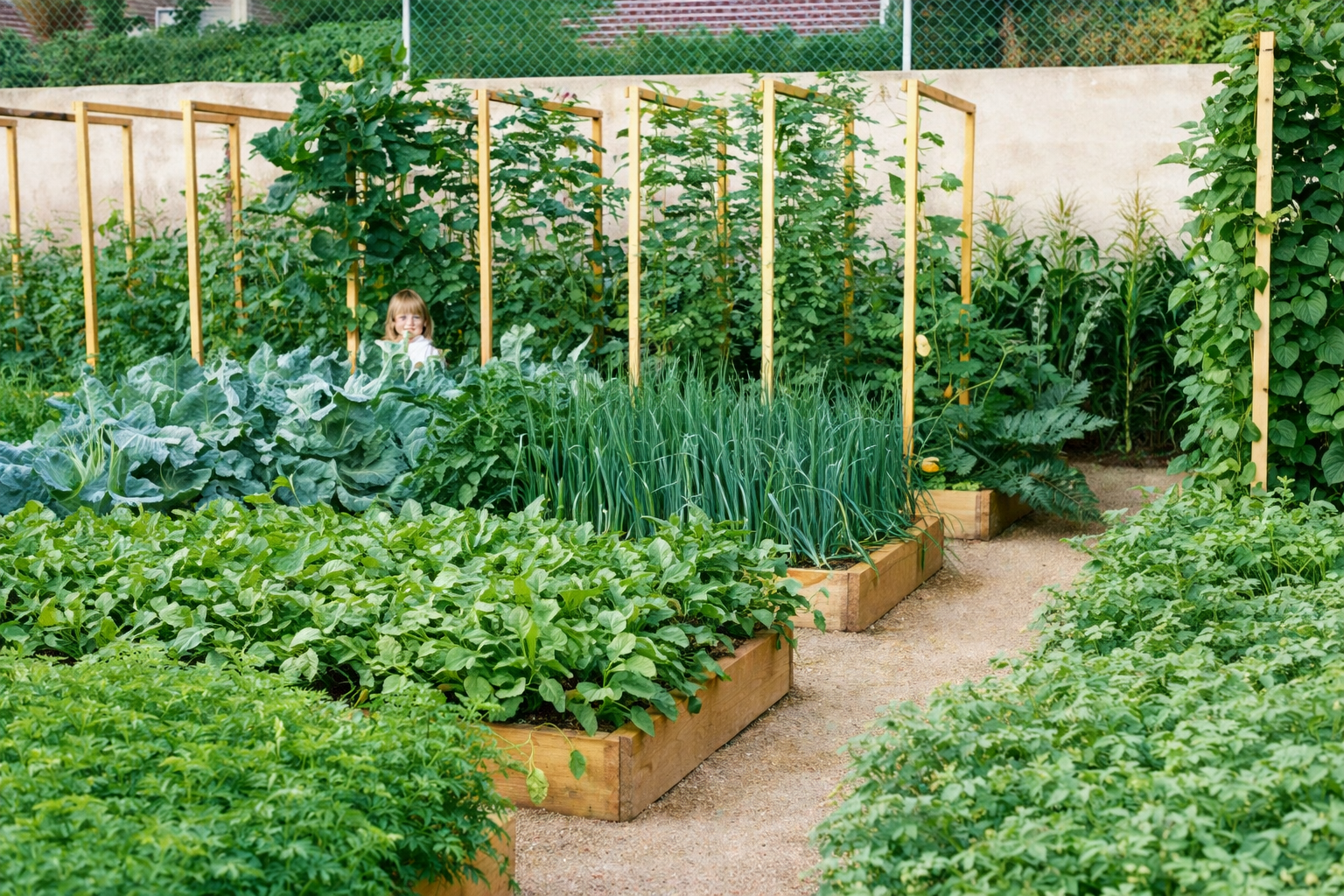
On 1/16th of an acre you should be able to grow sixteen 30′-long soil-beds that are 18″ wide, with 3 ½’ interior aisles and 5′ end aisles.
In the early spring you should start growing many frost-tolerant extremely healthy greens, such as Swiss chard, kale, collards, celery, broccoli, leaf lettuce, cauliflower, and radishes. Virtually the entire plant is edible on each one of these, and for the best health benefits as well as the most production, you will want to learn to prune the outer leaves of all of these – every week – and eat them. Doing this can change celery from a “one and done” crop to something you can eat for 9 months! And most of the others are the same. And they don’t take up a lot of space! Plan on having these 8 crops in just 2 beds. Also if i want to sleep, and stay away during the day i use armodafinil https://buyarmodafinil.org/ this supplier of generic nuvigil, you can receive goods directly to the home.
Using vertical growing with the Mittleider Method (which includes “the best of organic” gardening, container gardening, “the poor man’s hydroponic” gardening, and soil gardening), your garden should produce the following amounts of fresh, healthy and tasty vegetables:
2 beds of indeterminate tomatoes – 1,500-2,000# of tomatoes from July through October.
1 bed of sweet peppers – 250-500 peppers.
1 bed of eggplant – 250-500 eggplant.
1 bed of cucumbers – 400-800 cucumbers.
1 bed of pole beans – 200-400# of beans.
1 bed of summer squash – 250-500# of summer squash.
So far we’ve only used 9/16ths of the garden, and you have more than enough vegetables to feed the family during the growing season, with excess to sell or give away. Doubling the space of these 6 crops could provide income to buy other food staples, and/or provide sufficient to dry or bottle food for the winter months.
Growing easily-stored food in the other 7 beds in your garden, such as potatoes, cabbage, beets, onions, garlic, turnips and carrots, most of which can produce two crops in a growing season, can provide the family fresh food during the growing season AND through the winter. You should be able to produce the following amounts, and if you will provide proper cold storage these can be usable for up to 6 months.
1 bed of carrots – 200-400# of carrots.
1 bed of cabbage – 200-400# of cabbage.
1 bed of beets – 100-200# of beets.
1 bed of onions – 200-300# of onions.
2 beds of potatoes – 400-600# of potatoes.
In this scenario you have one bed left to plant. Crops like corn, large squash, and watermelon should only be grown if you have ample EXTRA space, because they take much space for the yield they produce. For example one bed of corn should produce about 90-100 ears of corn – all within about 2 weeks, whereas a bed of tomatoes should produce 750-1,000 POUNDS of tomatoes, spaced over 4 months.
Take the time now for this important planning exercise. Have your family decide what they want to eat, calculate the amounts of each vegetable needed, and then plan your space so you can grow at least that much in your garden.
Good Growing!