About
Shop
FAQ
Freebies
Gallery
Manure from Feed Lots – Environmental & Human Health Impact – Dr. Mercola
What Happens When Thousands of Animals are Raised in One Small Space?
While the implications for the animals are obvious, the impact on the environment is very well concealed from public view. When you raise thousands of animals, you’re left with a lot of waste.
In a small farm setting, that waste is used to naturally fertilize the land, and in that way, it becomes quite healthy (at least useful – JK).
In a factory farm setting, however, there is no way you can use millions of gallons of animal waste in a “healthy” way. So, large “lagoons” are created to hold the waste, or excessive amounts of the waste are sprayed onto crops in the area.
It is not at all unusual for this waste to leach into groundwater or runoff into surface waters. At Farm Sanctuary, a farm animal protection organization, they explain what this means for the future of the environment:
“The quantity of waste produced by farm animals in the U.S. is more than 130 times greater than that produced by humans. Agricultural runoff has killed millions of fish, and is the main reason why 60% of America’s rivers and streams are “impaired.”
In states with concentrated animal agriculture, the waterways have become rife with Pfiesteria bacteria. In addition to killing fish, Pfiesteria causes open sores, nausea, memory loss, fatigue and disorientation in humans.”
Manure or Minerals – A Comparison
Some have expressed concern about using chemicals to feed their plants, wanting to stay away from “synthetic” materials. Others don’t know how much to use. Let’s review some basics!
Suppose you have a garden 20′ X 30′ and you want to have a good yield of healthy tomatoes. A common practice is to work 2-3″ of composted horse or cow manure into the soil in the plot before planting. Is that a reasonable supposition? That’s 20′ X 30′ X 1/6′, – 100 cubic feet, or about 3 1/2 cubic yards of manure. A yard of clay soil weighs about 3,000#, may we assume composted manure weighs a third as much? that would mean we have applied about 3,500# of manure to our garden.
If the manure is 1% nitrogen (a general assumption – plus roughly comparable amounts of P and K and smaller amounts of several other salts, often including table salt from the animals’ salt licks), then we have applied 35# of actual “chemical” nitrogen to the garden – all at once – at the beginning of the growing season. And total chemical salts you’ve applied amount to between 150# & 175# (let’s say 150# or 2,400 ounces)!
When you think you don’t use chemicals, you’re only fooling yourself. Everything in this world is a chemical! And your plants can’t use that nitrogen – or anything else until it has decomposed from the organic state and become a water-soluble mineral.
Now, please remember also, there’s something called the nitrogen cycle. Nitrogen is volatile, and doesn’t stick around long – especially in warm weather, so how long do you suppose you have the benefit of those 35#’s of nitrogen applied all at once at the beginning of the growing season?
A Mittleider gardener uses a 13-8-13 mix (that’s percentages of each N, P, and K nutrient). Is that scary – using such a highly concentrated material? Let’s compare the actual amount of nitrogen we’re applying to that 20′ X 30′ garden. First off, we only apply fertilizers to the root zone of the plants, not the entire garden.
Each week – 4 times for lettuce, 5 times for bush beans, 6 times for corn, and 12+ times for indeterminate tomatoes – we apply 8 OUNCES of nitrogen, 8 OUNCES potash, and 5 OUNCES phosphate, along with much smaller amounts of the other 10 elements, for a total of about 25 ounces. That’s for the entire 20′ X 30′ garden! So I am actually applying only 1/96th (2400/25) as much mineral nutrients to my garden at any one time as the organic gardener – but doing it several times over the growing season. Which is better?
So, how much nitrogen do I use in total? It obviously depends on the crop, but let’s compare. If I planted the entire garden in one crop here is the total nitrogen I’d use:
Lettuce – 2# – less than 1/17th the amount applied using manure.
Bush beans – 2 1/2# – less than 1/14th the amount applied using manure.
Corn – 3# – 1/12th the amount applied using manure.
Tomatoes – 7# – 1/5th as much as is applied using manure.
And I give my plants very small amounts on a regular basis, and apply it 4″ from the plant stems (far enough so as not to burn them) and water it in so that it’s immediately available. Doesn’t that make sense?
So, what is the cost? Between $25 and $40 for the growing season. How much work is it to apply it all those times? Less than one hour over the growing season. What is the result, or yield? At least double that achieved using manure, and most often 5 to 10 times. And I’ll match size, looks, taste, and any other measure you’d care to make. after all. “THE PLANT CAN’T TELL THE DIFFERENCE BETWEEN NITROGEN FROM A LEAF AND THAT FROM A FERTILIZER BAG” (J. I. Rodale – Organic Gardening magazine).
Please also consider another factor in this equation. How many people have access to 3,500# of manure to use on their garden – (and remember I’m describing a very small garden!)? In rural areas it may be relatively
plentiful for the few who care enough to use it. But just suppose everyone had to depend on it!! There is not enough manure available to satisfy even 5% of the people if everyone had to grow a garden and live off it’s bounty.
Is a loving and all-knowing God going to arrange things so that 95%+ of the people can’t get “the only true” fertilizer?? I don’t think so! He has made concentrated deposits of all the necessary mineral (rock) plant nutrients (which are also humans’ essential nutrients!!), and man has learned how to grind them up and mix them in the ratios they’re needed, and how to accurately apply them to the soil to grow healthy plants.
So, let’s do it!! :o) You can get the essential Micro-Nutrients and instructions on how to make the perfect natural mineral fertilizer, at www.growfood.com/shop
Natural vs Synthetically Produced Fertilizers
What does “Natural” mean, and what does “Synthetic” mean? And exactly what makes commercially (synthetically?) produced fertilizers any worse for your garden than naturally produced ones? This is one area in which a lot of baloney gets thrown around – and regrettably too often believed by many good people.
The simplest and most natural of the “commercial” fertilizers may be lime. The world has an inexhaustible supply of limestone (calcium carbonate), and it’s simply ground to powder in powerful rock crushers, bagged, and sold to the public. We even receive much of our magnesium from the same process, when the raw material is dolomitic limestone.
All twelve of the other nutrients man can control are also mined from the earth. However, we have learned over time how to:
1) remove impurities, such as heavy metals,
2) increase the concentration of the individual nutrients, and
3) make the nutrient percentages exact, by running them through a simple concentration process. This is often a sulfuric acid bath, which leaves us with a much higher concentration of the original nutrient in compound with sulfur, which is itself a very important nutrient.
So, we benefit by getting a much higher concentration of the nutrient we want, plus sulfur, with no heavy metals, and it costs MUCH less to ship and handle, because it weighs only a fraction of the original raw material. And we are able to apply measured amounts to provide exactly what is needed, with no waste.
Are those fertilizers synthetically produced? I don’t think so, but perhaps they are by some peoples’ definition.
Even nitrogen is mined out of the ground! This may surprise many people, but it actually is – in South America – where huge mines of sodium nitrate exist. But can you imagine the cost to get it to the USA?!
Thank goodness we have found a better, more efficient, and therefore far less costly way to produce nitrogen fertilizers.
About 100 years ago two German scientists, Fritz Haber and Karl Bosch, discovered and commercialized the process by which nitrogen could be separated from other elements in different compounds and made available as fertilizer. These discoveries arguably served as the single most important component leading to exponential global agricultural growth, and the Haber-Bosch process is still used today.
I believe we owe much of what we have today to the use of nitrogen that’s produced by the Haber-Bosch process, and whether or not it’s synthetic to me is no more relevant than if God’s separation of nitrogen from those same elements by the use of lightning is synthetic.
Meanwhile some passionate organic advocates even say the use of chemicals is terrible, not even adding the “synthetic” epithet. This really just shows an ignorance of the laws of nature, because everything in this world is chemical! What the geologist calls mineral, and the farmer calls manure, the chemist calls chemical, but they’re all talking about the same thing. Even J. I. Rodale, the “father” of the organic movement as the publisher of Organic Magazine, said “A plant can’t tell the difference between nitrogen from a leaf and that from a fertilizer bag.”
If there is a valid and important argument against the synthetic production of chemicals having to do with the garden, I believe it should be limited to pesticides and herbicides.
Let’s address the issue of nitrogen fertilizer again from a slightly different angle. Nitrogen is the only nutrient we use that is usually not mined from the earth, and the most common sources are the air itself, and organic material. How so?
Most everyone knows about the animal sources called blood and bone meal, and the vegetable sources called manure and compost. Those are not very efficient sources, however, with the best containing only 5-10% nitrogen, and the most commonly used (manure & compost) containing only about 1% nitrogen.
I believe in using nitrogen from the best sources available, and those are God’s free air and His Compost Piles. What? Where does it come from you ask? Our greatest source of nitrogen is from the air (76% nitrogen!), and lightning causes it to combine with rain, providing many millions of tons of it all over the world.
As I mentioned earlier the German scientists Haber & Bosch, back around 1913, learned how to extract nitrogen from the air, as anhydrous ammonia, and fertilizer from ammonia is credited with sustaining 1/3rd of the world’s population!
In addition, massive deposits of earth’s first land plants – vegetable organic materials that lie deep underground all over the world, and which over millennia have been compressed into coal – are dug out and then processed into coke, with ammonium sulfate nitrogen as an important by-product!
And urea (46-0-0), one compound made from anhydrous ammonia, is actually classed as an organic material because it includes carbon, although it is not as readily available to plants, and therefore not as good in the garden as ammonium nitrate (34-0-0), and sometimes even ammonium sulfate (21-0-0).
I say, don’t be afraid of these nitrogen compounds! Long after mankind has stopped using gasoline and gone on to use the hydrogen from air as fuel, we will most likely still be using the nitrogen from air and from earth’s first organic compost piles to feed our garden plants. I believe that’s the way God intended it, and He’s a much better composter than even the best of us.
Problems with Using Manure in the Vegetable Garden
I.The nutrient value is unknown:
A. Nutritional adequacy and balance in the original plants is unknown
B. Much is lost before it reaches your plants:
a. Animal which ate the plant received a substantial amount
b. About half of remaining nutrition is lost in urine.
c. Some of remaining nutrition is lost to leaching during composting
d. Nitrogen is lost into the air due to volatility
e. More nutrition is lost during decomposition – see III below
II. Not clean because very rarely composted with sufficient heat (140 degrees F for 3 weeks) to remove:
A. Weed seeds
B. Diseases – plant and/or human
C. Bugs
III. Organic nutrients are not water-soluble and available to plants. They must be changed from organic to water-soluble inorganic minerals through decomposition in the soil.
A. Takes time, so plants do not receive immediate benefit
B. Some nutrition lost to:
a. Micro-organisms, worms, etc.
b. Leaching,
c. Fixation in the soil
IV. Availability is very limited. There is only enough manure for a very small percentage of people to grow gardens, especially in urban areas, where most people live. And during crisis situations, there will likely be much less.
V. Cannot easily be stored for later use due to:
A. Bulk,
B. Cost
C. Smell
D. Pests and diseases
VI. Common practice (required for Certified Organic Growers) of applying large amounts before planting the garden:
A. Puts 10-20 times more mineral salts into the soil than plants need
B. Often burns and kills emerging seedlings
C. Excess salts are leached into the groundwater, killing life downstream and damaging water supplies
D. Nutrition is gone by early-mid summer, and ever-bearing plants stop producing right at their peak.
VII. To ensure clean crops, restrictions on manure use are applied:
A. “Certified” organic growers must cease feeding with manure 120 days before harvest with plants where edible parts touch the soil, and 90 days before harvest with plants where edible parts do not touch the ground.
B. Nutrient deficiencies are virtually guaranteed in that time frame.
C. Salmonella, e-coli, etc. problems occur when non-sterilized manure is used.
One Family’s Experience Growing a Mittleider Garden
Q. My wife told me about your free seminars here in Mesa 3 years ago and I attended both of them. It completely changed the way I garden, and I love it. I learned more about plants and how to meet their needs in one afternoon from you than I had learned from my whole life of “recreational” gardening.
You shared so many simple, time and energy-saving “tricks” in the garden that I have been having a hard time trying to come up with any improvements on them.
I now garden for yield and my feelings about Arizona have really changed. We have an amazing growing season here. With all our sunshine you can really get a small amount of space to produce!.
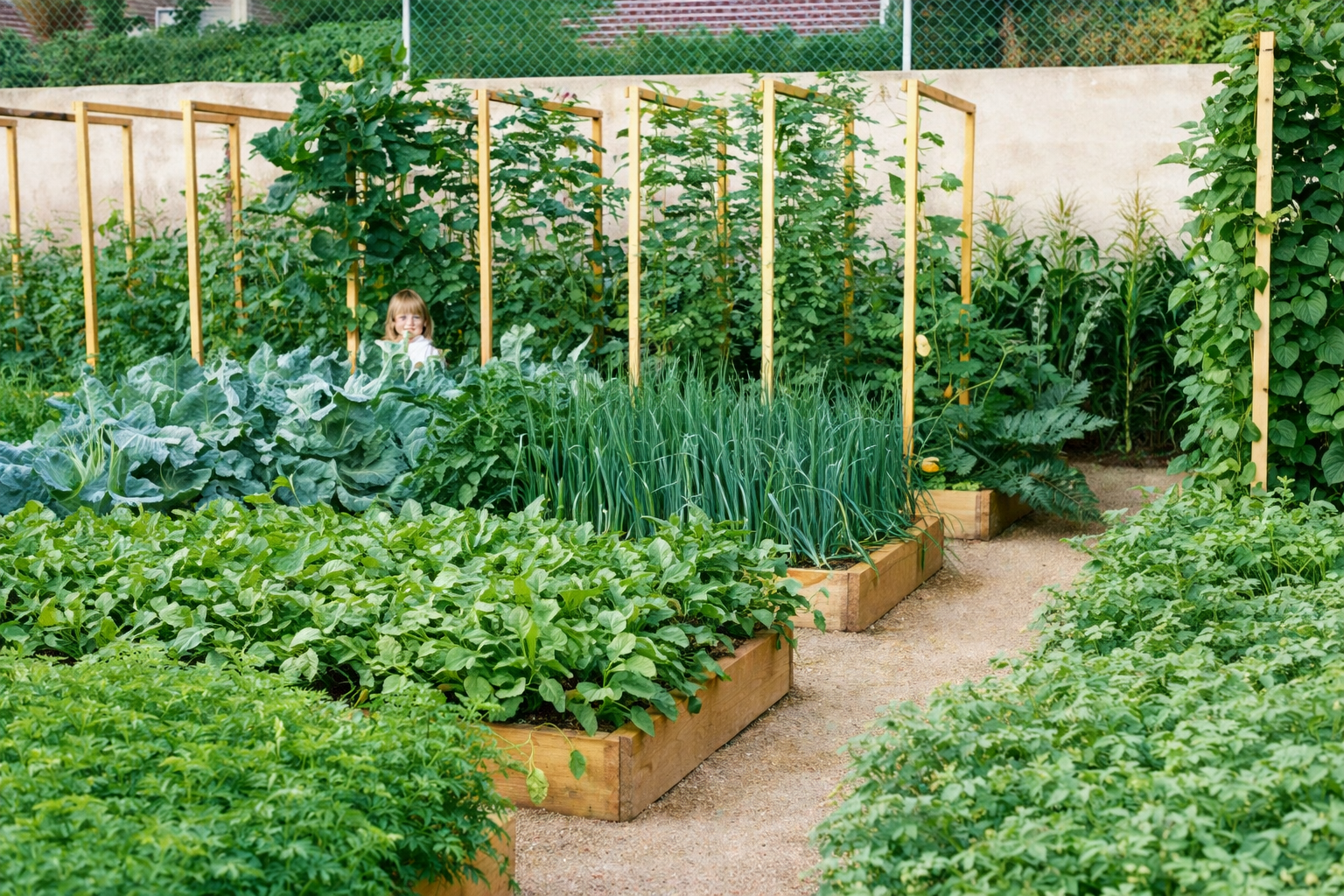
I have a total of 10 beds ranging from a small 10′ one next to the house to two 30′ ones with the t-frame trellis over them. Last year the two trellis beds produced over 500 lbs each of Armenian cucumbers. I was supplying 5 different farmer’s markets, giving them away at work and taking an apple box full each week to church. I also made some good money selling fresh okra to an east India market that was willing to take all I could grow. I am learning what crops do well here in the desert heat.
I see you will be teaching again here in AZ next week. I’d love to have you stop by and check out my garden if you have some time. It should be an inspiration for the wonderful work you are doing. I’ve probably had a dozen friends come by to see it because I describe the yields I am able to get using the Mittleider Method. I’m hoping to reclaim another section from the Bermuda grass lawn and add another pair of 30′ beds in the next year.
While you are in the area, if you need ANYTHING, please contact me. I feel I owe you a great debt. To show my gratitude I’d like to support you in the work you do that has benefited my life and the lives of my family and friends. I’m sure I’ll get to at least one of your classes while you are in the state, so I’ll be able to thank you personally and watch the way you work that 12″ rake.
Bill Oliphant
Thank you Bill! I hope others can benefit from the seminars this time, and I invite everyone reading this to organize FREE group gardening seminars in your own areas. Although it requires some work, it an change the future for your community’s families. If you are serious about hosting a seminar email me at info@foodforeveryone.org
Humans – Carnivore, Herbivore, or Omnivore, by John Coleman
John Coleman: Comparative Anatomy & Taxonomy
Comparative anatomy works on the simple and demonstrable fact that the biological form usually defines function. Human is closest to frugivore animals (fruit eaters), from the anatomic and taxonomic point of view.
Comparative Anatomy & Taxonomy
Comparative anatomy works on the simple and demonstrable fact that the biological form usually defines function. Individual features, or species may break the rules, but a look at many factors will reveal a species true biological role. Certainly science does not really validate the typical vegan diet, as this serves cultural imperatives. Science provides us with an indicator of human nutrition which was not established by culture, but is certainly that of a herbivore or frugivore and not a carnivore or omnivore.
|
Feature |
Carnivore |
Herbivore |
Omnivore |
Human |
|
Facial Muscles |
Reduced to allow wide mouth gape |
Well-developed |
Reduced |
Well-developed |
|
Jaw Type |
Angle not expanded |
Expanded angle |
Angle not expanded |
Expanded angle |
|
Jaw Joint Location |
On same plane as molar teeth |
Above the plane of the molars |
On same plane as molar teeth |
Above the plane of the molars |
|
Jaw Motion |
Shearing; |
No shear; |
Shearing; |
No shear; |
|
Major Jaw Muscles |
Temporalis |
Masseter and pterygoids |
Temporalis |
Masseter and pterygoids |
|
Mouth Opening vs. Head Size |
Large |
Small |
Large |
Small |
|
Teeth: Incisors |
Short and pointed |
Broad, flattened and spade shaped |
Short and pointed |
Broad, flattened and spade shaped |
|
Teeth: Canines |
Long, sharp and curved |
Dull and short or long (for defense), or none |
Long, sharp and curved |
Short and blunted |
|
Teeth: Molars |
Sharp, jagged and blade shaped |
Flattened with cusps vs complex surface |
Sharp blades and/or flattened |
Flattened with nodular cusps |
|
Feature |
Carnivore |
Herbivore |
Omnivore |
Human |
|
Chewing |
None; swallows food whole |
Extensive chewing necessary |
Swallows food whole and/or simple crushing |
Extensive chewing necessary |
|
Saliva |
No digestive enzymes |
Carbohydrate digesting enzymes |
No digestive enzymes |
Carbohydrate digesting enzymes |
|
Stomach Type |
Simple |
Simple or multiple chambers |
Simple |
Simple |
|
Stomach Acidity |
Less than or equal to pH 1 with food in stomach |
pH 4 to 5 with food in stomach |
Less than or equal to pH 1 with food in stomach |
pH 4 to 5 with food in stomach |
|
Stomach Capacity |
60% to 70% of total volume of digestive tract |
Less than 30% of total volume of digestive tract |
60% to 70% of total volume of digestive tract |
21% to 27% of total volume of digestive tract |
|
Length of Small Intestine |
3 to 6 times body length |
10 to more than 12 times body length |
4 to 6 times body length |
10 to 11 times body length |
|
Colon |
Simple, short and smooth, |
Long, complex; may be sacculated, may ferment |
Simple, short and smooth, |
Long, sacculated, |
|
Liver |
Can detoxify vitamin A |
Cannot detoxify vitamin A |
Can detoxify vitamin A |
Cannot detoxify vitamin A |
|
Kidney |
Extremely concentrated urine |
Moderately concentrated urine |
Extremely concentrated urine |
Moderately concentrated urine |
|
Nails |
Sharp claws |
Flattened nails or blunt hooves |
Sharp claws |
Flattened nails |
|
Thermostasis |
Hyperventilation |
Perspiration |
Hyperventilation |
Perspiration |
Adapted from The Comparative Anatomy of Eating by Milton R. Mills
Soil Tests for the Family Garden – Necessity or a Waste?
The question is often asked if the family gardener should pay for a soil test before planting his garden. Our advice is to not pay for a soil test. However, a few students have discovered a statement by Dr. Jacob Mittleider in the book Food For Everyone (P 137) wherein he states that “The soil test is the beginning of operations…”. Following is my response.
The book Food For Everyone was written in 1972, and at that time Dr. Mittleider was having soil tests done wherever he went, including numerous developing countries. However, over the ensuing years, he learned enough that by the time most of his GARDENING books were published Jacob no longer used nor recommended soil tests, and here’s why.
Two reasons for soil tests were (1) to determine the soil pH, because plants are best able to take nutrients from the soil and use them when the pH is between 6.5 and 7, and (2) to determine any nutrient deficiencies in the soil.
Through long experience and field testing in gardens all over the world, Jacob learned that whenever annual rainfall is 20″ or more the soil pH is below 7 (acidic), and the simple solution is to use lime – to raise the pH and to supply essential calcium.
When annual rainfall is 18″ or below the soil pH is above 7 (alkaline) and the solution is to use gypsum as the calcium source. It will not raise pH because it contains almost equal parts calcium (raises pH) and sulfur (lowers pH). And Jacob learned that this was usually all that was necessary to grow successfully in high pH soils.
If the high pH in the soil continues to be a problem simply apply sulfur to lower the pH.
Furthermore, Jacob’s long experience with soil tests taught him that they often did not accurately predict the availability of the nutrients to the plants. The natural state of the many mineral compounds in the soil is to be “fixed” or adhered to the soil particles, and in order for the plants to use them the minerals must be water-soluble and pass in the soil water into the plant through the root hairs. That availability changes quickly, and a test taken last month, even if accurate at the time, may not be accurate today or tomorrow.
Jacob also learned that soils throughout the world were almost universally low in available nutrients, and he created a balanced formula containing all 13 essential plant nutrients that he applied everywhere in the world with great success. And they are applied weekly throughout the growing season so that they are available to the plants as needed.
This knowledge allowed Dr. Mittleider to eliminate the need for soil testing, thus saving time and costs for everyone. This is a tremendous boon, especially for the family gardener, because they have neither the time, the money, the knowledge, nor the patience to order and wait for soil tests.
Jacob Mittleider – The Garden Doctor – Has Traveled the World Teaching Gardening – by Dennis Lythgoe, Deseret News
THE GARDEN DOCTOR: UTAHN HAS TRAVELED THE WORLD TEACHING PEOPLE HOW TO GROW CROPS IN ANY SOIL, CLIMATE OR CIRCUMSTANCES.
By Dennis Lythgoe, Staff Writer
Published: April 6, 1995 12:00 am
JACOB MITTLEIDER is an Idaho baker turned agricultural wizard. For 30 years, he has specialized in turning “devil land” into genuinely productive crops that will feed families many times over.
His is a single-minded effort to help people all over the world to become self-sufficient. A Utahn for almost 20 years, he grew up in California (raised in Idaho and lived for many years in California – JK) but has spent extended periods in such underdeveloped countries as Ethiopia, India, Lebanon, Tonga, Fiji, Samoa, New Guinea and several African countries teaching people how to grow crops that will never disappoint, whatever the climate, materials or circumstances.
He is best known for his “grow-box garden,” which is known for the elimination of weeds and the production of a large crop in a small space. The old grow-box garden was planted in raised beds in open wood frames and filled with custom-made soil.
The beds were usually about 30 feet long, 5 feet wide and 8 inches high, and the nutrients were mixed in. The soil was a mixture of sawdust and sand. The boxes were purposely bottomless so the roots could penetrate the subsoil.
The “garden doctor” has learned a lot since he introduced grow-box gardening and now believes in a more refined system with even greater simplicity.
The irony is that Mittleider has never liked farming.
“I grew up on a farm, but I never could understand why we could have so many bad patches in a corn field. I remember asking my father, `Why can’t we grow it all the same?’ He said, `The ground makes the difference.’ But it just didn’t make sense to me.”
Even though he became a baker, then spent 20 years in the nursery business – growing flowers and vegetables commercially, he never forgot that conversation with his father. He was unsure of his future when some agricultural specialists at the Seventh-day Adventist Church’s Loma Linda University approached him about taking a trip.
Mittleider’s nursery was located near the university. Besides, he is a devoted Adventist and had taught gardening classes there.
“I had never taken any education in agriculture, but they said, `We’d like to have a disinterested party give us a report on why the yields in these underdeveloped countries are declining.’ ”
Mittleider talked it over with his wife, Mildred, and they decided to do it. “We spent 41/2 months in 1963 in 24 developing countries, and I was never so shocked in all my life with what I saw. I said to myself, `There is absolutely no excuse for people to be going hungry, and why doesn’t some-body do something about it?’ ”
When he returned, the Australasian division of the Seventh-day Adventist Church questioned him about what he found. He was typically blunt. “You get the sunshine, the rain and the land free, and you waste all three.” Their wise response was to challenge him to spend two years in New Guinea demonstrating how to make the best use of natural resources.
Mittleider immediately remembered a simple statement about farming he had memorized years earlier: “The narrow plans, the little effort put forth, the little study as to the best methods call loudly for reform. If any of them do not wish you to speak to them of advanced ideas, let the lessons be given silently. Keep up the culture of your own land. Let the harvest be eloquent in favor of right methods. Demonstrate what can be done with the land when properly worked.”
That statement was “as loud as loud can be” in his head. He knew he could never convince anyone unless he was willing to make a demonstration, even though there was no money to underwrite the project. “Even today the same thing exists. You can find money for anything, but you can’t find it for agriculture.”
He proposed that a scientific method of agricultural production be simply taught to people in a variety of countries, and they could then care for their needs. So he went to New Guinea, where they had a plethora of weeds and did not get 2 percent off the land. He used a shovel and a rake, plus a tractor, to plow the land. Then he made a seedbed, planted and finally added nitrogen, phosphate and potassium for fertilizer. It’s called NPK.
“They hadn’t fertilized, so they got nothing. I won’t let the plants die. I can’t just look at it and forget it. I want healthy plants.”
The 110-acre farm he started is still operating today – and continues to make a profit every year. After his stay in New Guinea, Mittleider went to Fiji, where he transformed more wasteland into a successful modern farm.
After spending years teaching people to grow gardens in every imaginable circumstance, including Monument Valley in Utah, he was convinced anyone could do it. “I don’t care what kind of ground it is. You can grow the same kind of crops that you can on what is called `good ground.’ ”
Mittleider’s method is synonymous with simplicity. He says it is easy, eliminates guesswork and guarantees success anywhere. It is based on maximum utilization of space, time and resources. His crops tend to be large because the plants are placed close together, nourished by supplemental feedings of mineral nutrients. No special equipment is required.
“When people are sick, they go to the doctor and he takes a blood sample. And if they need potassium, he fills them up with potassium – and they go home and they’re well. With the stresses of the nursery business, I lost part of my stomach, and because of that I have to take iron now every day or I’m sick. We do the same for animals – but we have never told people that with a plant it’s just as easy to do it as it is for people and animals.”
It is Mittleider’s claim that anyone can look at an animal or a person and tell if either is healthy. “We don’t have to carry a sign saying we’re healthy. But when we look at vegetables, most of the organic produce you see is discolored, small, woody – and we say that is food we should eat.”
Mittleider has seen all the extremes of weather and circumstance in his long career – “heat, cold, wet, dry, all kinds of soil – and we grow the same kinds of crops.”
The secret is fertilizer.
Mittleider remembers being snickered at when he went to the old Soviet Union to teach his methods. “One of these guys admitted they didn’t put the fertilizer on the land. They dumped it in the creek. So they thought the fertilizer from the land killed the fish. In the collective farm days, they got paid 200 rubles a month whether they did anything or not.”
Today Mittleider maintains manure or compost are not needed to grow successful crops. “I’m not against manure or composts, but how are you gonna feed people if they don’t have it? The fact is you don’t need it. That’s what I’ve demonstrated now for 30 years. We’ll take ground as hard as this floor, but we’ll prepare a seedbed, plant, water, feed and harvest – that’s all. We don’t care what kind of ground it is.”
According to Mittleider, “The plant is going to fight, if you give it half a chance. We’ve been doing this since 1964, and we’ve never had a crop failure. We feed regularly and watch for signs of the plant’s nutrition. If it needs boron, we give it to them. If it needs more calcium, we give it to them. Plant nutrition is the key. You need 13 nutrients. This whole thing is very simple. You can’t run an automobile unless you put gas in the tank.”
So Mittleider watches his plants very closely, and if a deficiency becomes apparent in any of the 13 nutrients – whether nitrogen, phosphorus, potassium, calcium, chlorine, magnesium, manganese, sulfur, copper, zinc, iron, boron or molybdenum, he treats them accordingly.
Mittleider’s analogies trip off the tongue. “There is a bank on many corners. I lean against the bank on the corner with 10 cents in my pocket. In the bank vault, there is a million dollars. How much of that million dollars and 10 cents can I spend? 10 cents. That’s the way the ground is. Man doesn’t have the ability to loosen these things up and make them water-soluble. Osmosis is the key to what I’m doing. These inorganic soils are loaded with nutrients.”
If anyone is critical of Mittleider, it is likely to be because of his conviction that chemical or inorganic fertilizer is acceptable – as opposed to organic fertilizer. He notes that organic materials are often characterized as natural, such as leaves, grass, compost, animal manure, and other decayed materials. Yet such “natural” materials can be deficient in important nutrients.
In fact, Mittleider believes the most important function organic materials provide is loosening soil and adding fiber to absorb and hold moisture.
On the other hand, some people assume that because inorganic mineral fertilizers are commercially prepared and packaged, they’re unnatural and not good for plants or those who eat them.
Mittleider says, “The organic material has to rot to such a state of decomposition that it reverts to inorganic solution. Plants use nothing in the organic form. Everything a plant uses is inorganic. It’s converted to organic material in our bodies.”
Mittleider has written 10 books, the most recent of which is “6 Steps to Successful Gardening,” a quick-read paperback guide to simple, dependable gardening. In it he says, “Soils are soils and vary surprisingly little in fertility, regardless of the area or country. Even though specific minerals may vary from place to place, water-soluble minerals (those that plants require) nearly always are deficient. Thus the same type and amount of balanced, essential nutrients can be fed to all garden varieties.”
Among his other books are “More Food From Your Garden,” “Grow-Bed Gardening,” “Let’s Grow Tomatoes,” “Gardening by the Foot” and a three-volume set titled “The Garden Doctor.”
Because he is “way into” his 70s, Mittleider and his wife do not plan to travel as extensively in the future to teach gardening techniques. His friend Jim Kennard has prevailed upon him to assist in planting a piece of property he owns adjacent to Hogle Zoo, near the giraffes.
When the numerous zoo patrons look at the giraffes, they are likely to get a good glimpse of the new garden. “Jim wants to put in a showcase, and I’m going to support him. If I fail, it’ll be the first time.”
Over the years, Mittleider has worked tirelessly with various groups, including Catholics, Baptists, Apostolics, Mormons and his own Seventh-day Adventist Church, teaching the tricks of the trade. He is convinced that his work is more spiritual than practical as he dedicates himself “to the Lord.” The key to his success in teaching others his theories is that he always insists on demonstrating rather than talking.
“I’ve been to about 30 countries, and I often have several projects going at once. If I have to travel 229 miles a day to keep the gardens growing, I’ll to it. I won’t let them fail.”
And remember this – he’ll do it in the worst possible soil.