Nine Reasons To Choose Natural Minerals Over Organic Fertilizers

Reasons to Choose Natural Minerals over Organic Fertilizers

There are SO many reasons for choosing the Mittleider system of growing over Certified Organic!

1  Let’s start with the MACRO “argument”.    There is not enough compost/manure in the world to feed 10% of the population, if even that much.  Before “ground-up rocks” as commercial fertilizers – and especially before man learned to create usable nitrogen the way lightning does it (see Haber/Bosch Method) – there were about 1 billion people on the planet.  Take commercial fertilizers away and 6 out of 7 would die, and the world population would shrink to that size again. 

And during crisis situations, or in the event of a breakdown in the fragile, interconnected and interdependent civilization in which we live (think supply chain disruptions), there will be much LESS organic material available because the animals will die or be eaten. 

The great intelligence that rules the universe would not create a world in which the large majority of people were consigned to ill health and even starvation.  And sure enough, the earth contains inexhaustible supplies of the 13 essential mineral nutrients plants require.  These are mined and then concentrated to remove impurities, heavy metals, etc., and give exact percentages of the nutrients.  This also makes them much less expensive to ship to distant locations.

2  The actual nutritional benefits of organic fertilizers are unknown.

   a. The nutritional composition of the original plants is unknown.

   b. The horse or cow kept some;

   c.  About half of the remaining nutrition is lost in the urine; 

   d. Some was lost to leaching in the compost pile, before it was applied to the garden soil;

   e. Nitrogen is lost into the air due to its volatility, and

   f. Because compost must be applied all at once before planting, much more is lost in the weeks and months before the plant takes it up and uses it.

3  While natural mineral nutrients can be balanced between Macro-nutrients, Secondary nutrients, and Micro-nutrients to give just the right amounts of each, organic fertilizersnutrient composition is unknown, unknowable, and can therefore not be “balanced” and thereby improved.

4  Plants cannot take in and use organic nutrients because of their particle size and structure, and therefore the compost must decompose, break down, and revert to its inorganic water-soluble mineral state before the next generation of plants can use it.  This requires time and soil organisms.

5  Doing this composting is almost never done aerobically (with oxygen), which produces heat of 140 degrees for about 3 weeks, and in the composting process kills the weed seeds, bugs, and diseases

Ninety nine percent of the time – at least in the family garden – composting is done anaerobically, or without oxygen, and consequently without heat.  This of course does NOT eliminate the 3 bad elements, and instead encourages bugs, weeds, diseases, bad smells, AND rodents.

6  Harmful diseases such as e-coli, salmonella, and listeria are sometimes carried by organic fertilizers such that people get sick and sometimes even die after ingesting the food grown in them.  This is why Certified organic fertilizers MUST, by the laws administered by the USDA, be applied to the soil 120 days before harvest if the edible part of the plant comes in contact with the soil, and 90 days before harvest if the edible part of the plant does not touch the ground.

7  Because the fertilizer for the entire crop must be applied all at once before planting. large amounts of salts are applied to the soil all at once.  This often causes a condition called salinity – too much salt – and causes reverse osmosis, with the saline moisture in the soil drawing the moisture out of the plants and injuring or even killing the plants.  Also, the excess salts are leached into the ground water, streams and rivers, killing fish, etc., and fouling the water supply.  Meanwhile, by mid-season the nutrition is gone and plants stop producing.

8  Cost of organic fertilizers is often, at least in large population centers, more than that of mineral nutrients.  And storage presents an entirely new set of problems.  Compost takes up a great deal of space, smells, nutrition leaches out if stored outside, and invites problems as described above. Mineral fertilizers are without bad odors, do NOT attract bugs and diseases, take up MUCH less space, and store indefinitely without losing potency.

9  And finally the piece of the equation that has many people calling The Mittleider Method “the best of organic”. The laws established by the USDA, which governs organic growing, specify that a Certified Organic grower must plant using only organic fertilizers. Then, when they observe deficiency symptoms they must get soil tests.  After documenting which nutrients are deficient the organic grower is permitted to use inorganic (mineral) nutrients, including the very same ones we use in the Mittleider Method from the beginning.

The average person never hears about the fact that the big organic growers actually use commercial bagged mineral fertilizers, and the family gardener has neither the time, the money, nor the expertise to go through all those steps that are necessary to grow healthy and productive crops organically, and so they suffer with poor production and much less nutritious garden produce.

Dr. Mittleider chose to feed his crops very small amounts of all of the natural mineral nutrients plants require for fast healthy growth, in the right amounts and as and when they need them, avoiding all of the problems associated with organic fertilizers, including weed seeds, bugs and diseases, salinity, higher cost and availability issues, and time and dependence on soil organisms to change the organic materials into water-soluble minerals that plants can use.

©  Jim Kennard – 9/26/2024


Is Organic Really Better Than Conventional ?

Is organic really better for the environment than conventional (industrial) agriculture?

Our World in Data presents the empirical evidence on global development in entries dedicated to specific topics. 

This blog post draws on data and research discussed in our entries on Crop YieldsLand Use, and Fertilizers and Pesticides.

This post was first published on October 19th 2017, and was extended on December 19th 2017.

As the total global population continues to rise and economic growth drives a transition towards more resource-intensive diets, a growing number of consumers are concerned with how to reduce the environmental impact of their dietary choices. Consumers often see organic food as an effective way to reduce their impact: surveys reveal that regardless of geographic location, the primary motivations for organic food purchases are health and environmental concerns. Furthermore, consumers are often willing to pay more for organic products – some studies indicate a willingness-to-pay of up to 100 percent above standard prices. But is this a wise choice? Is going organic really the best way to reduce the environmental impact of our diets?

Before we explore the relative impacts of organic vs. conventional agriculture, it is worth clarifying their definitions. Organic agriculture refers to the farming of crops or livestock without the use of synthetic inputs, including synthetic fertilizers, pesticides, plant growth regulators, nanomaterials and genetically-modified organisms (GMOs). Note that organic does not necessitate ‘chemical-free’ or ‘pesticide-free’; chemicals are often used in organic farming, however these cannot be synthetically manufactured, with the exception of a small number which have been approved by the National Organic Standards Board. Conventional (sometimes termed ‘industrial’) farming is therefore any agricultural system which uses one or more of the above synthetic inputs.

The methods applied for weed and pest control in conventional and organic systems can also impact on choices of planting and tillage techniques. Conventional farming often utilises synthetic herbicides for the control of weeds; this approach is typically more conducive to low- or no-till management techniques. Since herbicide applications cannot be widely adopted in organic farming (with some approved exceptions), options for no-till farming can be more limited and places greater emphasis on approaches such as mechanical controls and/or mulching.

In arable farming (which concerns the production of crops), nutrients can be added to the soil in the form of organic matter, such as green compost, animal manure (human sewage sludge is typically prohibited), or bone meal. For livestock, organic methods mean animals must be fed organically-certified feed (or graze on land with no synthetic chemical inputs), and antibiotics cannot be used throughout their lifetime (except in emergency cases such as disease or infection outbreak). In conventional livestock production, there are no constraints on feed certification and antibiotics or growth hormones are often used. Animal welfare standards for organic certification can vary by country, however for many, livestock must be raised with access to the outdoors (i.e. caged hens are not permitted). Conventional livestock farming covers a range of production methods: they can be produced in either ‘free range’ or ‘caged’ conditions. These are typically monitored and labelled as such on product packaging.

In this post, we present the empirical evidence comparing organic to conventional agriculture in terms of environmental impact. Despite strong public perception of organic agriculture producing better environmental outcomes, we show that conventional agriculture often performs better on environmental measures including land use, greenhouse gas emissions, and pollution of water bodies. There are, however, some contexts where organic agriculture may be considered appropriate.


Organic vs. conventional: what are the relative impacts?

When aiming to provide a comparison of the relative impacts of organic and conventional agriculture, it can often be misleading and misrepresentative to rely on the results of a single comparative study: there will always be single, localised examples where the environmental impacts of a conventional farm are lower than that of a proximate organic farm, and vice versa. In order to provide a global and cross-cutting overview of this comparison, Clark and Tilman (2017) published a meta-analysis of results of published organic-conventional comparisons across 742 agricultural systems over 90 unique foods.

Their analysis reviewed relative impacts across the range of food types – cereals, pulses and oilcrops, fruits, vegetables, dairy and eggs, and meat – and across a range of environmental impact categories – greenhouse gas emissions, land use, acidification potential, eutrophication potential, and energy use. ‘Eutrophication’ refers to the over-enrichment or pollution of surface waters with nutrients such as nitrogen & phosphorous. Although eutrophication can also occur naturally, the runoff of fertilizer and manure from agricultural land is a dominant source of nutrients. This disaggregation of food types and environmental impacts is important: there is no reason to suggest that the optimal agricultural system for cereal production is the same as for fruits; and there are often trade-offs in terms of environmental impact – one system can prove better in terms of greenhouse gas emissions but higher in land use, for example.

Food systems are made up of many phases – ranging from pre-farm activities, crop production, animal feed production, and harvesting, to transportation, distribution, and cooking. To fully and consistently account for the various stages of production, a process called life-cycle analysis (LCA) is used. LCAs attempt to quantify the combined impacts across several stages of production by considering all inputs and outputs in the complete process. The key in comparing LCAs between products is ensuring that the same number of stages of the supply chain are included in all analyses. For this meta-analysis, Clark & Tilman (2017) compared 164 LCAs which account for inputs pre-farm and on-farm (up until the food leaves the farm).

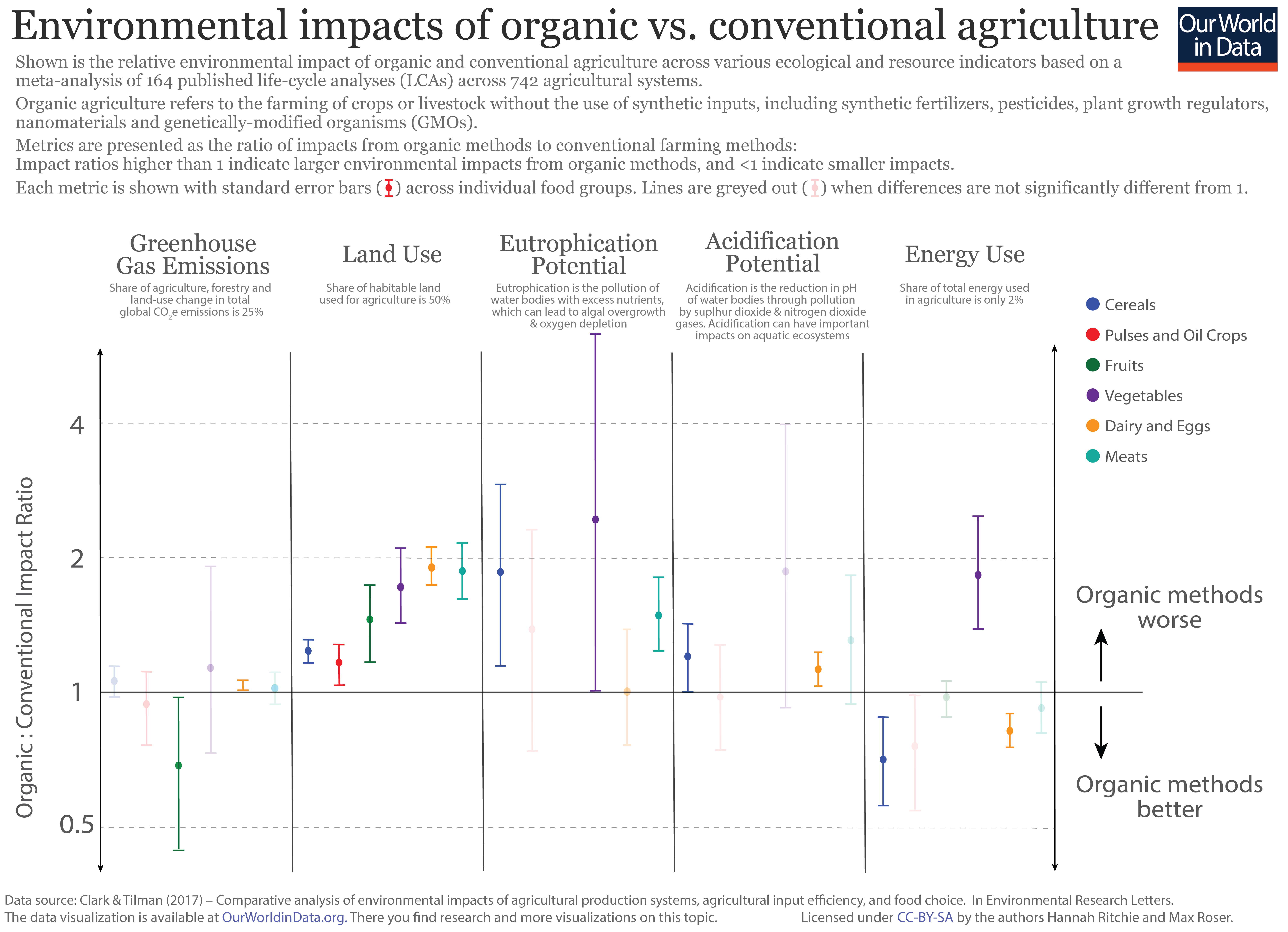
The aggregated results of Clark & Tilman’s study is shown in the chart below. This comparison measures the relative impact ratio of organic to conventional agriculture, whereby a value of 1.0 means the impact of both systems are the same; values greater than 1.0 mean the impacts of organic systems are higher (worse) (for example, a value of 2.0 would mean organic impacts were twice as high as conventional); and values less than 1.0 mean conventional systems are worse (a value of 0.5 means conventional impacts are twice as high). We see these relative impacts measured by food type across our range of environmental impacts with averages and standard error ranges shown.

We see large differences in impact patterns across environmental categories and food types. For some impacts, one system is consistently better than the alternative; whilst for others, results are mixed depending on crop type and the local agricultural context. The clearest results are for land and energy use. Organic systems consistently perform worse in terms of land use, regardless of food type. As we explore in detail in our entry on Yield and Land Use in Agriculture, the world has achieved large gains in productivity and gains in yield over the past half-century in particular, largely as a result of the availability and intensification of inputs such as fertilizer and pesticides. As a result, the majority of conventional systems achieve a significantly higher yield as compared to organic systems. Therefore, to produce the same quantity of food, organic systems require a larger land area.

This produces the inverse result for energy use. The industrial production of chemical inputs such as fertilizers and pesticides is an energy-intensive process. The absence of synthetic chemical inputs in organic systems therefore means that their energy use is predominantly lower than in intensive conventional agriculture. The exception to this result is vegetables, for which energy use in organic systems tends to be higher. Some of this additional energy use is explained by the use of alternative methods of weed and pest control in organic vegetable farming; a technique widely applied as an alternative to synthetic pesticide application is the use of ‘propane-fueled flame weeding’. The process of propane production and machinery used in its application can add energy costs – especially for vegetable crops.

Acidification and eutrophication potential are more mixed, but tend to be higher in organic systems; average values across all food types are higher for organic, although there are likely to be some exceptions in particular contexts. Why are organic systems typically worse in these measures? The supply of nutrients in conventional and organic systems are very different; nitrogen supply in conventional agriculture is supplied with the application of synthetic fertilizers, whereas organic farms source their nitrogen from manure application. The timing of nutrient release in these systems is different: fertilizers release nutrients in response to crop demands, meaning nitrogen is released when required by the crops, whereas nitrogen released from manure is more dependent on environmental conditions, such as weather conditions, soil moisture and temperature.

Nutrient-release from manure is therefore not always matched with crop requirements – excess nutrients which are released but not taken up by crops can run off farmland into waterways such as rivers and lakes. As a consequence, the pollution of ecosystems with nutrients from organic farms are often higher than conventional farms, leading to higher eutrophication and acidification potential.

Across all food types, there is no clear winner when it comes to greenhouse gas emissions. Results vary strongly depending on food type, although most lie close to a ratio of one (where differences in impact between the systems are relatively small). Based on average values, we might conclude that to reduce greenhouse gas emissions, we should buy organic pulses and fruits, and conventional cereals, vegetables, and animal products. In general, the greenhouse gas emission sources of organic and conventional systems tend to cancel each other out. Conventional systems produce greenhouse gases through synthetic fertilizer production and application, which is largely balanced by the higher emissions of nitrous oxide (a strong greenhouse gas) from manure application.

Organic vs. conventional impacts final 01

Should we treat environmental impacts equally?

Organic agriculture proves better for some environmental impacts, and conventional agriculture for others. These trade-offs can make it difficult to decide which we should be choosing. But should we be considering all environmental impacts equally? Should some have higher importance than others?

To evaluate these trade-offs we have to consider a key question: how important is agriculture’s contribution to global greenhouse gas emissions, land use, acidification and eutrophication potential, and energy use? Agriculture’s role in land use, greenhouse gas emissions, and energy use is summarised in the three charts below:

  • The first chart shows that agriculture, forestry and other land use (AFOLU) is the dominant land user, consuming half of the world’s habitable land;
  • The second chart shows that it accounts for approximately one-quarter of greenhouse gas emissions;
  • The third chart shows that it accounts for only two percent of energy use;
  • The contribution of AFOLU to acidification and eutrophication is more difficult to quantify, however it is widely considered to be the dominant source of nutrient input to aquatic ecosystems.

We might therefore conclude that energy use – the only category in which organic agriculture has a clear advantage – is comparatively substantially less important than other impacts.

Global land use graphic

Greenhouse gas emissions by sector, World

Breakdown of total greenhouse gas emissions by sector, measured in tonnes of carbon-dioxide
equivalents (CO₂e). Carbon dioxide equivalents measures the total greenhouse gas potential of the full
combination of gases, weighted by their relative warming impacts.

  •  

1990199520002005201020160 t10 billion t20 billion t30 billion t40 billion tOther fuelcombustionWasteBuildingsIndustryFugitive emissionsLand-Use Changeand ForestryAgricultureManufacturing/constructionTransportElectricity & Heat


Source: UN Food and Agricultural Organization (FAO)

Share of total energy used in agriculture and forestry, 1971 to 2009

The share of energy consumed within the agricultural and forestry sectors, measured as the percentage of
total energy consumption across all sectors.

  •  

1971197519801985199019952000200520090%20%40%60%80%100%World + (Total)Americas + (Total)United StatesUnited Kingdom


Source: UN Food and Agricultural Organization (FAO)

 
1971


2009

Is more intensive agriculture always the answer?

If we are most concerned with areas of environmental change for which agriculture has the largest impact – namely land use, water pollution, and greenhouse gas emissions – for which conventional agriculture tends to be advantaged, is the answer to make global farming as intensive as possible? Not necessarily. There are several reasons why this view is too simplistic.

The impacts quantified here fail to capture another important ecological pressure: biodiversity. Conclusive comparisons of the relative impacts of agricultural systems on biodiversity are still lacking. Biodiversity is affected by a number of agricultural impacts, including pesticide application (which can be toxic to some species), soil erosion, and disruption from land tillage methods, and either habitat destruction or fragmentation. Intensive agriculture undoubtedly has severe impacts on local biodiversity. A recent study by Hallmann et al. (2017) reports a greater than 75 percent decline in insect populations over the last 27 years; although unclear as to the primary cause of this decline, it’s suggested that pesticide use may be a key contributing factor. Organic farming systems also impact biodiversity, but perhaps less dramatically per unit area, due to lower fertilizer and pesticide use. However, as our land-use metrics show: organic agriculture requires far more land than conventional agriculture. This creates a divide in opinion of how best to preserve biodiversity: should we farm intensively over a smaller area (with understanding that biodiversity will be severely affected over this area), or should we farm organically, impacting biodiversity (perhaps less severely) over a much larger area. There is no clear consensus on how best to approach this issue.

Another point to consider is that conventional agriculture is not necessarily better across all food types. Context, both in terms of the food commodity and the local environment, can be important. For example, if greenhouse gas reduction is our main focus, we might be best off eating organic pulses and fruits, and conventional cereals, vegetables, and animal products, based on the results presented above.

This leads us to three key conclusions in the organic-conventional farming debate:

  • The common perception that organic food is by default better, or is an ideal way to reduce environmental impact is a clear misconception. Across several metrics, organic agriculture actually proves to be more harmful for the world’s environment than conventional agriculture.
  • The debate between organic and intensive agriculture advocates is often needlessly polarized. There are scenarios where one system proves better than the other, and vice versa. If I were to advise on where and when to choose one or the other, I’d advise trying to choose organic pulses and fruits, but sticking with non-organic for all other food products (cereals, vegetables, dairy and eggs, and meat).
  • The organic-conventional debate often detracts from other aspects of dietary choices which have greater impact. If looking to reduce the environmental impact of your diet, what you eat can be much more influential than how it is produced. The relative difference in land use and greenhouse gas impacts between organic and conventional systems is typically less than a multiple of two. Compare this to the relative differences in impacts between food types where, as shown in the charts below, the difference in land use and greenhouse gas emissions per unit protein between high-impact meats and low-impact crop types can be more than 100-fold. If your primary concern is whether the potato accompanying your steak is conventionally or organically produced, then your focus is arguably misplaced from the decisions which could have the greatest impact.
 

Land use per 100 grams of protein

Land use is measured in meters squared (m²) per 100 grams of protein across various food products.

  •  

0 m²20 m²40 m²60 m²80 m²100 m²120 m²140 m²160 m²180 m²Lamb & Mutton184.8 m²Beef (beef herd)163.6 m²Cheese39.8 m²Milk27.1 m²Beef (dairy herd)21.9 m²Pig Meat10.7 m²Nuts7.9 m²Other Pulses7.3 m²Poultry Meat7.1 m²Eggs5.7 m²Grains4.6 m²Fish (farmed)3.7 m²Groundnuts3.5 m²Peas3.4 m²Tofu (soybeans)2.2 m²Prawns (farmed)2 m²


Source: Poore, J., & Nemecek, T. (2018). Additional calculations by Our World in Data.

Note: Data represents the global average land use of food products based on a large meta-analysis of food production covering 38,700
commercially viable farms in 119 countries.

Greenhouse gas emissions per 100 grams of protein

Greenhouse gas emissions are measured in kilograms of carbon dioxide equivalents (kgCO₂eq) per 100
grams of protein. This means non-CO₂ greenhouse gases are included and weighted by their relative
warming impact.

  •  

0 kg10 kg20 kg30 kg40 kgBeef (beef herd)49.89 kgLamb & Mutton19.85 kgPrawns (farmed)18.19 kgBeef (dairy herd)16.87 kgCheese10.82 kgMilk9.5 kgPig Meat7.61 kgFish (farmed)5.98 kgPoultry Meat5.7 kgEggs4.21 kgGrains2.7 kgTofu (soybeans)1.98 kgGroundnuts1.23 kgOther Pulses0.84 kgPeas0.44 kgNuts0.26 kg


Source: Poore, J., & Nemecek, T. (2018). Additional calculations by Our World in Data.

Note: Data represents the global average greenhouse gas emissions of food products based on a large meta-analysis of food
production covering 38,700 commercially viable farms in 119 countries.


Protein From an Animal Or Vegetable Source – Which is Best & How Best to Do It!

For a vegetable gardening instructor to be talking about animals may seem inconsistent to some, but since both provide food they are closely related, so I will discuss the general topic a bit here.

From age 12 until I left home for college I had the full responsibility for a cow, to which were added chickens, rabbits, pigs, and even a goat at various times. These all contributed significantly to and were important to our family’s food supply.

However, I didn’t understand at that time that it requires between 20 and 30 times as much land to produce a pound of protein from an animal source as from a plant source, and looking back I realize that our vegetable garden produced much more with less inputs than did the animals.

Dr. Jacob Mittleider, who taught me almost everything I know about gardening, had a special perspective on this issue, because as a Seventh Day Adventist he was a strict vegetarian. While I am not a vegetarian I also am convinced that we are healthier when we limit meat in our diets, and our personal family diet is usually less than 10% meat.

And both Dr. Mittleider’s and my own experience around the world confirm that most people have very limited space in which to produce their own food, thus making vegetable gardening the best choice for the greatest return on investment.

I submit that a Mittleider-Method garden, when cared for properly and consistently, is the best use of your time, efforts, space and money, and that excess food grown in your garden can usually be sold or traded for milk, eggs, and meat much more efficiently than raising your own animals.  www;growfood.com/shop is the place to get information on the best and most efficient way to produce healthy food for your family, in my opinion.

Nevertheless, there are other issues to be considered. Vegetables can’t begin to compete for the special feeling you may get from caring for animals, and those of you who DO have space may still want some animals.

If animals are in your plans, I encourage you to keep their living spaces clean, separate them from your garden so they don’t destroy it, and whenever possible feed them your excess plant residue as soon as the crop is harvested.

Chicken tractors (Google it), can be used for both chickens and rabbits, but must have a wire floor on them if you raise rabbits, because they will dig their way out quickly.  Also, unless you have very strong wire on ALL sides the raccoons or foxes may feast on your defenseless vegetarian hens or rabbits.  If used efficiently chicken tractors can help you keep your yard clean and organized. Each time the tractor is moved remember to till the chicken or rabbit droppings (both of which are excellent fertilizers), etc. into the soil for natural composting without making a mess. And the same goes for all other animal manure. Get it into the soil and let it compost naturally, rather than having it smell bad and attract pests.

For those who have more space – and are willing to accept the responsibility for at least twice daily care (milking, feeding, etc.) – larger animals may also be an option.

Goats are one possible choice, as they are fairly small, don’t take a lot of space to house or graze, and will eat a wide variety of plants, but they don’t give a lot of milk, are not easy to milk, and many people don’t care for their smell or the taste of their milk.

My personal preference for a milk-producing animal is one or two Miniature Jersey cows. They are about 1/3 the size of full-size cows; they are very friendly and docile – even the bulls; they produce from 2 to 4 gallons of milk daily when fresh; and they only require a fraction of an acre for grazing.

Many websites have details about the miniature Jerseys. They are a rare breed so far, and will be expensive to buy, but after the initial investment, if you use the best breeding stock, you may be able to recover your initial capital outlays by selling excess calves.

Meanwhile, I will continue to focus on VEGETABLE GARDENING, but encourage those of you who have the interest, the commitment, and the required space for animals to consider the most efficient ways to benefit from them.

Vegetable Garden or Raising Animals, Which is Best

For a vegetable gardening guy to be talking about animals may seem inconsistent to some, but since both provide food they are closely related, so I will discuss the general topic a bit here.

From age 12 until I left home for college I had the full responsibility for a cow, to which were added chickens, rabbits, pigs, and even a goat at various times. These all contributed significantly to and were important to our family’s food supply.

However, I didn’t understand at that time that it requires between 10 and 30 times as much land to produce a pound of protein from an animal source as from a plant source, and looking back I realize that our vegetable garden produced much more with less inputs than did the animals.

Dr. Jacob Mittleider, who taught me almost everything I know about gardening, had a special perspective on this issue, because as a Seventh Day Adventist he was a strict vegetarian. While I am not a vegetarian I also believe that we are healthier when we limit meat in our diets, and our personal family diet is usually less than 10% meat.

And both Dr. Mittleider’s and my own experience around the world confirm that most people have very limited space in which to produce their own food, thus making vegetable gardening the best choice for the greatest return on investment.

I submit that a Mittleider-Method garden, when cared for properly and consistently, is the best use of your time, efforts, space and money, and that excess food grown in your garden can usually be sold or traded for milk, eggs, and meat more efficiently than raising your own animals.

Nevertheless, there are other issues to be considered. Vegetables can’t begin to compete for the special feeling you may get from caring for animals, and those of you who DO have space may still want some animals.

If animals are in your plans, I encourage you to keep their living spaces clean, separate them from your garden so they don’t destroy it, and whenever possible feed them your excess plant residue as soon as the crop is harvested.

Chicken tractors (Google it), can be used for both chickens and rabbits, but must have a wire floor on them if you raise rabbits, because they will dig their way out quickly. If used efficiently chicken tractors can help you keep your yard clean and organized. Each time the tractor is moved remember to till the chicken or rabbit droppings (both of which are excellent fertilizers), etc. into the soil for natural composting without making a mess. And the same goes for all other animal manure. Get it into the soil and let it compost naturally, rather than having it smell bad and attract pests.

For those who have more space – and are willing to accept the responsibility for at least twice daily care (milking, feeding, etc.) – larger animals may also be an option.

Goats are one possible choice, as they are fairly small, don’t take a lot of space to house or graze, and will eat a wide variety of plants, but they don’t give a lot of milk, are not easy to milk, and many people don’t care for the taste of their milk.

My personal preference for a milk-producing animal is one or two Miniature Jersey cows. They are about 1/3 the size of full-size cows; they are very friendly and docile – even the bulls; they produce from 2 to 4 gallons of milk daily when fresh; and they only require a fraction of an acre for grazing.

Many websites have details about the miniature Jerseys. They are a rare breed so far, and will be expensive to buy, but after the initial investment, if you use the best breeding stock, you may be able to recover your initial capital outlays by selling excess calves.

Meanwhile, I will continue to focus on VEGETABLE GARDENING, but encourage those of you who have the interest, the money, the commitment, and the required space for animals to consider the most efficient ways to benefit from them.