Reasons to Choose Natural Minerals over Organic Fertilizers
There are SO many reasons for choosing the Mittleider system of growing over Certified Organic!
1 Let’s start with the MACRO “argument”. There is not enough compost/manure in the world to feed 10% of the population, if even that much. Before “ground-up rocks” as commercial fertilizers – and especially before man learned to create usable nitrogen the way lightning does it (see Haber/Bosch Method) – there were about 1 billion people on the planet. Take commercial fertilizers away and 6 out of 7 would die, and the world population would shrink to that size again.
And during crisis situations, or in the event of a breakdown in the fragile, interconnected and interdependent civilization in which we live (think supply chain disruptions), there will be much LESS organic material available because the animals will die or be eaten.
The great intelligence that rules the universe would not create a world in which the large majority of people were consigned to ill health and even starvation. And sure enough, the earth contains inexhaustible supplies of the 13 essential mineral nutrients plants require. These are mined and then concentrated to remove impurities, heavy metals, etc., and give exact percentages of the nutrients. This also makes them much less expensive to ship to distant locations.
2 The actual nutritional benefits of organic fertilizers are unknown.
a. The nutritional composition of the original plants is unknown.
b. The horse or cow kept some;
c. About half of the remaining nutrition is lost in the urine;
d. Some was lost to leaching in the compost pile, before it was applied to the garden soil;
e. Nitrogen is lost into the air due to its volatility, and
f. Because compost must be applied all at once before planting, much more is lost in the weeks and months before the plant takes it up and uses it.
3 While natural mineral nutrients can be balanced between Macro-nutrients, Secondary nutrients, and Micro-nutrients to give just the right amounts of each, organic fertilizers‘ nutrient composition is unknown, unknowable, andcan therefore not be “balanced” and thereby improved.
4 Plants cannot take in and use organic nutrients because of their particle size and structure, and therefore the compost must decompose, break down, and revert to its inorganic water-soluble mineral state before the next generation of plants can use it. This requires time and soil organisms.
5 Doing this composting is almost never done aerobically (with oxygen), which produces heat of 140 degrees for about 3 weeks, and in the composting process kills the weed seeds, bugs, and diseases.
Ninety nine percent of the time – at least in the family garden – composting is done anaerobically, or without oxygen, and consequently without heat. This of course does NOT eliminate the 3 bad elements, and instead encourages bugs, weeds, diseases, bad smells, AND rodents.
6 Harmful diseases such as e-coli, salmonella, and listeria are sometimes carried by organic fertilizers such that people get sick and sometimes even die after ingesting the food grown in them. This is why Certified organic fertilizers MUST, by the laws administered by the USDA, be applied to the soil 120 days before harvest if the edible part of the plant comes in contact with the soil, and 90 days before harvest if the edible part of the plant does not touch the ground.
7 Because the fertilizer for the entire crop must be applied all at once before planting. large amounts of salts are applied to the soil all at once. This often causes a condition called salinity – too much salt – and causes reverse osmosis, with the saline moisture in the soil drawing the moisture out of the plants and injuring or even killing the plants. Also, the excess salts are leached into the ground water, streams and rivers, killing fish, etc., and fouling the water supply. Meanwhile, by mid-season the nutrition is gone and plants stop producing.
8 Cost of organic fertilizers is often, at least in large population centers, more than that of mineral nutrients. And storage presents an entirely new set of problems. Compost takes up a great deal of space, smells, nutrition leaches out if stored outside, and invites problems as described above. Mineral fertilizers are without bad odors, do NOT attract bugs and diseases, take up MUCH less space, and store indefinitely without losing potency.
9 And finally the piece of the equation that has many people calling The Mittleider Method “the best of organic”. The laws established by the USDA, which governs organic growing, specify that a Certified Organic grower must plant using only organic fertilizers. Then, when they observe deficiency symptoms they must get soil tests. After documenting which nutrients are deficient the organic grower is permitted to use inorganic (mineral) nutrients, including the very same ones we use in the Mittleider Method from the beginning.
The average person never hears about the fact that the big organic growers actually use commercial bagged mineral fertilizers, and the family gardener has neither the time, the money, nor the expertise to go through all those steps that are necessary to grow healthy and productive crops organically, and so they suffer with poor production and much less nutritious garden produce.
Dr. Mittleider chose to feed his crops very small amounts of all of the natural mineral nutrients plants require for fast healthy growth, in the right amounts and as and when they need them, avoiding all of the problems associated with organic fertilizers, including weed seeds, bugs and diseases, salinity, higher cost and availability issues, and time and dependence on soil organisms to change the organic materials into water-soluble minerals that plants can use.
As the total global population continues to rise and economic growth drives a transition towards more resource-intensive diets, a growing number of consumers are concerned with how to reduce the environmental impact of their dietary choices. Consumers often see organic food as an effective way to reduce their impact: surveys reveal that regardless of geographic location, the primary motivations for organic food purchases are health1 and environmental concerns.2 Furthermore, consumers are often willing to pay more for organic products – some studies indicate a willingness-to-pay of up to 100 percent above standard prices.3 But is this a wise choice? Is going organic really the best way to reduce the environmental impact of our diets?
Before we explore the relative impacts of organic vs. conventional agriculture, it is worth clarifying their definitions. Organic agriculture refers to the farming of crops or livestock without the use of synthetic inputs, including synthetic fertilizers, pesticides, plant growth regulators, nanomaterials and genetically-modified organisms (GMOs).4 Note that organic does not necessitate ‘chemical-free’ or ‘pesticide-free’; chemicals are often used in organic farming, however these cannot be synthetically manufactured, with the exception of a small number which have been approved by the National Organic Standards Board.5 Conventional (sometimes termed ‘industrial’) farming is therefore any agricultural system which uses one or more of the above synthetic inputs.
The methods applied for weed and pest control in conventional and organic systems can also impact on choices of planting and tillage techniques. Conventional farming often utilises synthetic herbicides for the control of weeds; this approach is typically more conducive to low- or no-till management techniques.6 Since herbicide applications cannot be widely adopted in organic farming (with some approved exceptions), options for no-till farming can be more limited and places greater emphasis on approaches such as mechanical controls and/or mulching.
In arable farming (which concerns the production of crops), nutrients can be added to the soil in the form of organic matter, such as green compost, animal manure (human sewage sludge is typically prohibited), or bone meal. For livestock, organic methods mean animals must be fed organically-certified feed (or graze on land with no synthetic chemical inputs), and antibiotics cannot be used throughout their lifetime (except in emergency cases such as disease or infection outbreak). In conventional livestock production, there are no constraints on feed certification and antibiotics or growth hormones are often used. Animal welfare standards for organic certification can vary by country, however for many, livestock must be raised with access to the outdoors (i.e. caged hens are not permitted). Conventional livestock farming covers a range of production methods: they can be produced in either ‘free range’ or ‘caged’ conditions. These are typically monitored and labelled as such on product packaging.
In this post, we present the empirical evidence comparing organic to conventional agriculture in terms of environmental impact. Despite strong public perception of organic agriculture producing better environmental outcomes, we show that conventional agriculture often performs better on environmental measures including land use, greenhouse gas emissions, and pollution of water bodies. There are, however, some contexts where organic agriculture may be considered appropriate.
Organic vs. conventional: what are the relative impacts?
When aiming to provide a comparison of the relative impacts of organic and conventional agriculture, it can often be misleading and misrepresentative to rely on the results of a single comparative study: there will always be single, localised examples where the environmental impacts of a conventional farm are lower than that of a proximate organic farm, and vice versa.7 In order to provide a global and cross-cutting overview of this comparison, Clark and Tilman (2017) published a meta-analysis of results of published organic-conventional comparisons across 742 agricultural systems over 90 unique foods.8
Their analysis reviewed relative impacts across the range of food types – cereals, pulses and oilcrops, fruits, vegetables, dairy and eggs, and meat – and across a range of environmental impact categories – greenhouse gas emissions, land use, acidification potential, eutrophication potential, and energy use. ‘Eutrophication’ refers to the over-enrichment or pollution of surface waters with nutrients such as nitrogen & phosphorous. Although eutrophication can also occur naturally, the runoff of fertilizer and manure from agricultural land is a dominant source of nutrients.9 This disaggregation of food types and environmental impacts is important: there is no reason to suggest that the optimal agricultural system for cereal production is the same as for fruits; and there are often trade-offs in terms of environmental impact – one system can prove better in terms of greenhouse gas emissions but higher in land use, for example.
Food systems are made up of many phases – ranging from pre-farm activities, crop production, animal feed production, and harvesting, to transportation, distribution, and cooking. To fully and consistently account for the various stages of production, a process called life-cycle analysis (LCA) is used. LCAs attempt to quantify the combined impacts across several stages of production by considering all inputs and outputs in the complete process. The key in comparing LCAs between products is ensuring that the same number of stages of the supply chain are included in all analyses. For this meta-analysis, Clark & Tilman (2017) compared 164 LCAs which account for inputs pre-farm and on-farm (up until the food leaves the farm).
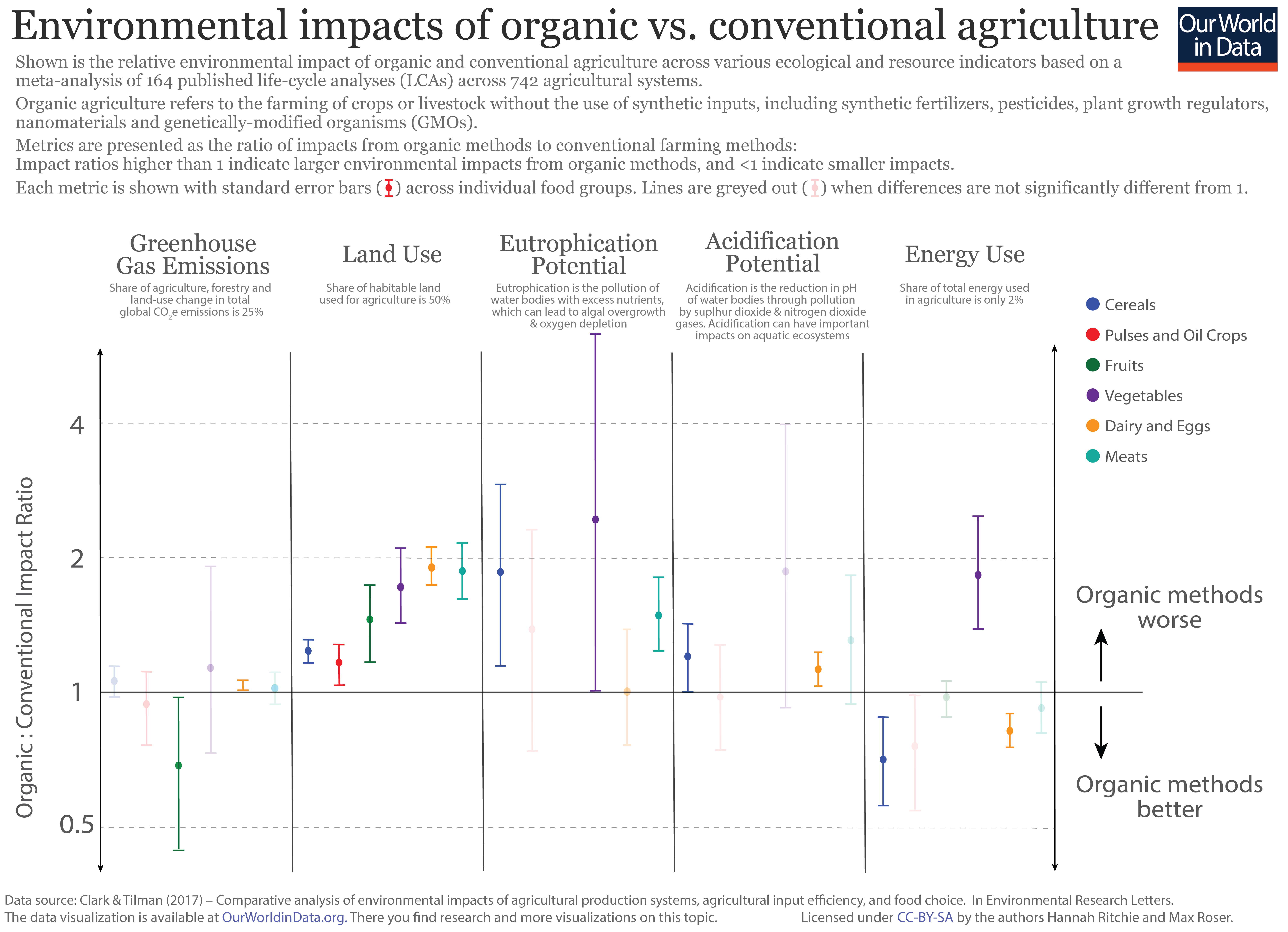
The aggregated results of Clark & Tilman’s study is shown in the chart below. This comparison measures the relative impact ratio of organic to conventional agriculture, whereby a value of 1.0 means the impact of both systems are the same; values greater than 1.0 mean the impacts of organic systems are higher (worse) (for example, a value of 2.0 would mean organic impacts were twice as high as conventional); and values less than 1.0 mean conventional systems are worse (a value of 0.5 means conventional impacts are twice as high). We see these relative impacts measured by food type across our range of environmental impacts with averages and standard error ranges shown.
We see large differences in impact patterns across environmental categories and food types. For some impacts, one system is consistently better than the alternative; whilst for others, results are mixed depending on crop type and the local agricultural context. The clearest results are for land and energy use. Organic systems consistently perform worse in terms of land use, regardless of food type. As we explore in detail in our entry on Yield and Land Use in Agriculture, the world has achieved large gains in productivity and gains in yield over the past half-century in particular, largely as a result of the availability and intensification of inputs such as fertilizer and pesticides. As a result, the majority of conventional systems achieve a significantly higher yield as compared to organic systems. Therefore, to produce the same quantity of food, organic systems require a larger land area.
This produces the inverse result for energy use. The industrial production of chemical inputs such as fertilizers and pesticides is an energy-intensive process. The absence of synthetic chemical inputs in organic systems therefore means that their energy use is predominantly lower than in intensive conventional agriculture. The exception to this result is vegetables, for which energy use in organic systems tends to be higher. Some of this additional energy use is explained by the use of alternative methods of weed and pest control in organic vegetable farming; a technique widely applied as an alternative to synthetic pesticide application is the use of ‘propane-fueled flame weeding’.10 The process of propane production and machinery used in its application can add energy costs – especially for vegetable crops.
Acidification and eutrophication potential are more mixed, but tend to be higher in organic systems; average values across all food types are higher for organic, although there are likely to be some exceptions in particular contexts. Why are organic systems typically worse in these measures? The supply of nutrients in conventional and organic systems are very different; nitrogen supply in conventional agriculture is supplied with the application of synthetic fertilizers, whereas organic farms source their nitrogen from manure application. The timing of nutrient release in these systems is different: fertilizers release nutrients in response to crop demands, meaning nitrogen is released when required by the crops, whereas nitrogen released from manure is more dependent on environmental conditions, such as weather conditions, soil moisture and temperature.
Nutrient-release from manure is therefore not always matched with crop requirements – excess nutrients which are released but not taken up by crops can run off farmland into waterways such as rivers and lakes. As a consequence, the pollution of ecosystems with nutrients from organic farms are often higher than conventional farms, leading to higher eutrophication and acidification potential.
Across all food types, there is no clear winner when it comes to greenhouse gas emissions. Results vary strongly depending on food type, although most lie close to a ratio of one (where differences in impact between the systems are relatively small). Based on average values, we might conclude that to reduce greenhouse gas emissions, we should buy organic pulses and fruits, and conventional cereals, vegetables, and animal products. In general, the greenhouse gas emission sources of organic and conventional systems tend to cancel each other out. Conventional systems produce greenhouse gases through synthetic fertilizer production and application, which is largely balanced by the higher emissions of nitrous oxide (a strong greenhouse gas) from manure application.11
Should we treat environmental impacts equally?
Organic agriculture proves better for some environmental impacts, and conventional agriculture for others. These trade-offs can make it difficult to decide which we should be choosing. But should we be considering all environmental impacts equally? Should some have higher importance than others?
To evaluate these trade-offs we have to consider a key question: how important is agriculture’s contribution to global greenhouse gas emissions, land use, acidification and eutrophication potential, and energy use? Agriculture’s role in land use, greenhouse gas emissions, and energy use is summarised in the three charts below:
The first chart shows that agriculture, forestry and other land use (AFOLU) is the dominant land user, consuming half of the world’s habitable land;
The second chart shows that it accounts for approximately one-quarter of greenhouse gas emissions;
The third chart shows that it accounts for only two percent of energy use;
The contribution of AFOLU to acidification and eutrophication is more difficult to quantify, however it is widely considered to be the dominant source of nutrient input to aquatic ecosystems.
We might therefore conclude that energy use – the only category in which organic agriculture has a clear advantage – is comparatively substantially less important than other impacts.
Greenhouse gas emissions by sector, World
Breakdown of total greenhouse gas emissions by sector, measured in tonnes of carbon-dioxide
equivalents (CO₂e). Carbon dioxide equivalents measures the total greenhouse gas potential of the full
combination of gases, weighted by their relative warming impacts.
If we are most concerned with areas of environmental change for which agriculture has the largest impact – namely land use, water pollution, and greenhouse gas emissions – for which conventional agriculture tends to be advantaged, is the answer to make global farming as intensive as possible? Not necessarily. There are several reasons why this view is too simplistic.
The impacts quantified here fail to capture another important ecological pressure: biodiversity. Conclusive comparisons of the relative impacts of agricultural systems on biodiversity are still lacking. Biodiversity is affected by a number of agricultural impacts, including pesticide application (which can be toxic to some species), soil erosion, and disruption from land tillage methods, and either habitat destruction or fragmentation.12 Intensive agriculture undoubtedly has severe impacts on local biodiversity.13 A recent study by Hallmann et al. (2017) reports a greater than 75 percent decline in insect populations over the last 27 years; although unclear as to the primary cause of this decline, it’s suggested that pesticide use may be a key contributing factor.14 Organic farming systems also impact biodiversity, but perhaps less dramatically per unit area, due to lower fertilizer and pesticide use. However, as our land-use metrics show: organic agriculture requires far more land than conventional agriculture. This creates a divide in opinion of how best to preserve biodiversity: should we farm intensively over a smaller area (with understanding that biodiversity will be severely affected over this area), or should we farm organically, impacting biodiversity (perhaps less severely) over a much larger area.15 There is no clear consensus on how best to approach this issue.
Another point to consider is that conventional agriculture is not necessarily better across all food types. Context, both in terms of the food commodity and the local environment, can be important. For example, if greenhouse gas reduction is our main focus, we might be best off eating organic pulses and fruits, and conventional cereals, vegetables, and animal products, based on the results presented above.
This leads us to three key conclusions in the organic-conventional farming debate:
The common perception that organic food is by default better, or is an ideal way to reduce environmental impact is a clear misconception. Across several metrics, organic agriculture actually proves to be more harmful for the world’s environment than conventional agriculture.
The debate between organic and intensive agriculture advocates is often needlessly polarized. There are scenarios where one system proves better than the other, and vice versa. If I were to advise on where and when to choose one or the other, I’d advise trying to choose organic pulses and fruits, but sticking with non-organic for all other food products (cereals, vegetables, dairy and eggs, and meat).
The organic-conventional debate often detracts from other aspects of dietary choices which have greater impact. If looking to reduce the environmental impact of your diet, what you eat can be much more influential than how it is produced. The relative difference in land use and greenhouse gas impacts between organic and conventional systems is typically less than a multiple of two. Compare this to the relative differences in impacts between food types where, as shown in the charts below, the difference in land use and greenhouse gas emissions per unit protein between high-impact meats and low-impact crop types can be more than 100-fold. If your primary concern is whether the potato accompanying your steak is conventionally or organically produced, then your focus is arguably misplaced from the decisions which could have the greatest impact.
Land use per 100 grams of protein
Land use is measured in meters squared (m²) per 100 grams of protein across various food products.
Greenhouse gas emissions are measured in kilograms of carbon dioxide equivalents (kgCO₂eq) per 100
grams of protein. This means non-CO₂ greenhouse gases are included and weighted by their relative
warming impact.
Today we will discuss a fundamental question in gardening. Previously I was posed this question: “I hear that chemicals are poisoning our waterways, and that organic growing is much healthier than using chemicals. What’s the truth, and how do I grow a healthy, productive, and sustainable garden without hurting the environment?”
This important question deserves an accurate answer. Therefore let’s learn about plant nutrition. First, plants receive nutrition only as water-soluble mineral compounds through their roots. When we put plants, compost or manure into the soil, the organic material must first decompose, and the nutrient compounds must revert to water-soluble minerals before the next generation of plants can use them. This takes time, and sometimes as much as half of the nutrients are lost in the decomposition process. Nitrogen is particularly susceptible to loss because it is volatile and returns to the air very easily.
Second, there is no real difference between organic, and mineral or chemical nutrients. Everything in this world is chemical! To the chemist the elements in the soil are called chemicals, to a geologist they are called minerals, and to an organic enthusiast they are called organics, but they are the same substances. To quote J. I. Rodale, the publisher of Organic Gardening magazine, “we organic gardeners have let our enthusiasm run away with us. We have said that the nitrogen which is in organic matter is different (and thus somehow better) from nitrogen in a commercial fertilizer. But this is not so.” And “actually there is no difference between the nitrogen in a chemical fertilizer and the nitrogen in a leaf.”
Third, there is no difference between soil and rocks except for the size of the particles, and 12 of the 13 mineral nutrients plants require are essentially ground-up rocks! They are natural, and there’s really nothing “synthetic” about them.
So you see, there is no difference between “organic nitrogen” and mineral or chemical nitrogen, except two primary things. 1) the nitrogen that is part of an organic substance must decompose and revert to the water-soluble mineral state before being available to plants, and 2) mineral-source nitrogen is much higher in nutritional content, so much less is required to feed your plants.
As further evidence that mineral nutrients are not bad per se, I’ve researched which fertilizers meet the requirements for qualification as a Certified Organic garden, and 12 of the 13 nutrients we use in a Mittleider garden are approved. And the 13th – nitrogen – is the one that’s most often used by organic gardeners, both in the garden and to aid in composting! Go figure.
This being the case, what should you do to assure you have the best garden and the healthiest plants possible? Give your plants accurate dosages of the best combination of nutrition you possibly can. The Mittleider natural mineral nutrient formulas are available in The Mittleider Gardening Course book at www.growfood.com/shop. You can mix your own “from scratch”, or get the micro-nutrients from the Foundation website, also in the Shop section. And never over-use any kind of fertilizer. Both manure and mineral compounds will harm our water supply if allowed to leach into the water table.
Meanwhile, remember that 99% of us depend on 1% to feed us, and commercial growers feed their crops! They use formulas like ours and call them “The preferred horticultural mix.” Just check out Scott’s Peter’s Professional Pete Lite as an example.
This is not to say that organic materials don’t have a place in the garden. You can improve soil texture and tilth by adding materials that have desirable characteristics, and even add some nutrient value. However, improving the soil in that way is not necessary to having a good garden, and people often introduce weeds, rodents, bugs, and diseases into their gardens, or provide a haven for them with their organic mulching practices. It is for this reason that we do not emphasize or encourage composting and manure.
Mittleider gardens qualify as “organic” because we don’t use pesticides or herbicides. However, I suggest they are even better than organic, because the plants receive just what they need, they grow fast, and we rarely have debilitating insect or disease problems because there are no weeds to provide a home, and the plants aren’t in the ground long enough for the pests to get established.
Dr. Jacob Mittleider’s gardening books, CDs, and Software, as well as natural mineral nutrients, are available at the Foundation website -www.growfood.com/shop
What does “Natural” mean, and what does “Synthetic” mean? And exactly what makes synthetically produced fertilizers, if there is such a thing in the first place, any worse for your garden than naturally produced ones? This is one area in which a lot of balony gets thrown around – and regrettably believed by many good people.
The simplest and most natural of the commercial fertilizers is probably lime. It’s also almost universally recognized as important, and used by every kind of gardener who knows what he’s doing and has access to it. The world has an inexhaustible supply of limestone (calcium carbonate), and it’s simply ground to powder in powerful rock crushers, bagged, and sold to the public. We even receive much of our magnesium from the same process, when the raw material is dolomitic limestone (labeled as dolomite lime).
All twelve of the other nutrients man can control are also mined from the earth. However, we have learned over time how to remove impurities, such as heavy metals, and increase the concentration of the individual nutrients, by running them through a simple concentration process. This is often just a sulfuric acid bath, which leaves us with a much higher concentration of the original nutrient, plus sulphur, which is itself a very important nutrient. This is one reason most of the nutrients come as a combination with sulfate (zinc sulfate, copper sulfate, etc.).
So, we benefit by getting a much higher concentration of the nutrient we want, plus sulphur, with no heavy metals, and it costs MUCH less to ship to our locations, because it weighs only a fraction of the original raw material.
Are those fertilizers synthetically produced? I don’t think so, but perhaps they are by some peoples’ definition.
Did you know that even nitrogen is mined out of the ground? This may surprise many people, but it actually is – in Chile, South America – where huge mines of sodium nitrate exist. But can you imagine the cost to get it to the USA, though? And what would we do with the sodium salts??
Thank goodness we have found a better, more efficient, and therefore far less costly way to produce nitrogen fertilizers.
About 105 years ago two German scientists, Fritz Haber and Karl Bosch, discovered and commercialized the process by which nitrogen could be separated from other elements in different compounds and made available as fertilizer. This discovery arguably served as the single most important component leading to exponential global agricultural growth, and the Haber-Bosch process is still the benchmark process used today.
I believe the world owes much of what we have agriculturally today to the use of nitrogen that has been produced by the Haber-Bosch process, and whether or not it’s synthetic is, to me at least, irrelevant.
I do believe there is a valid and important argument against the uncontrolled “synthetic” production of chemicals having to do with the garden, but I believe it should be limited to pesticides and herbicides. This is a more complex issue that will take more time to discuss, and we won’t go there at this time.
I do hope that readers of this article are able to understand and appreciate the value and importance of mineral nutrients in helping us grow strong, healthy plants, and that you will not spend your time worrying about “natural” or “synthetic” fertilizers.
A fundamental question in vegetable gardening is – what is the proper use of organic and/or chemical materials? Let’s determine the truth of the matter, with four basic principles and a few brief examples from Dr. Jacob R. Mittleider’s worldwide experience.
I. First, let’s consider what plants need, and where and how they get it. Plants require 16 elements for healthy growth, and 95% of the plant is the result of photosynthesis using just 3 elements – carbon, oxygen, and hydrogen – all of which it gets from the air without man’s intervention. The other 13 elements come from the soil and make up only 5% of the plant, but are nonetheless very important, for without them the plant will fail. Most importantly, the plant can only access these 13 nutrients as water-soluble minerals through its root system.
II. The next important principle to understand is that everything in this world is a chemical. Every element that makes up a plant, as well as everything in our bodies, and everything in the soil in which we grow is chemical. Therefore, we must not get carried away in refusing to use chemicals in the garden in favor of something else, because there is no something else!
III. Most soils contain all 13 nutrients, but due to thousands of years of leaching and crop removal, the water-soluble compounds are mostly gone, and what is left in the soil is not readily available.
This is not a big problem for trees and shrubs – they grow slowly enough that they can wait for the natural chemical processes constantly going on in the soil to make small amounts of nutrients water soluble. However, this is not the case with vegetables. They grow very quickly, multiplying their size many times in a few weeks, and many complete their life cycle, including flowers, fruit, and seeds, in only 60-90 days! This is why they often need nutritional assistance.
IV. Organic materials can improve soil structure, provide food for beneficial soil bacteria, and add mineral nutrients. Before using them, however, they should be clean – weed, insect and disease-free. And beyond that, there are still three problems with depending exclusively on organic materials. 1. You never know which nutrients and what amounts were in the previous plant. 2. Much of the plant was eaten and became part of the man or animal. 3. The nutrients are not usable until the old plant has decomposed and they have reverted once again to water-soluble minerals. This takes time and fast-growing vegetable plants can’t wait. Plus, even more nutrients are lost or become unavailable in the decomposition process. Also i taken generic agomelatine https://buyvaldoxan.com/ using me friends this same medications as valdoxan, this is slighly anti depressant.
Dr. Jacob R. Mittleider has worked and taught in many countries for 39 years, and he always found the people were growing organically – doing their best with compost and manure – as they have been doing for thousands of years, and yet they were starving! So, with his 20 years of background in the Nursery/Bedding Plant business, he experimented with small amounts of natural mineral nutrients to supplement the organic materials being used – always using the best amounts and ratios he knew. By doing this he increased peoples’ yields of healthy vegetables everywhere he went by as much as 10 to 1. And over time, he improved his nutrient mix to the point that today, using the Mittleider Pre-Plant and Weekly Feed mixes properly, anyone can grow healthy trees, shrubs, and virtually any variety of plants successfully in almost any soil or climate. That’s why they are sometimes called “The poor man’s hydroponic mix,” but we recommend growing in the soil whenever possible, so the plants can get the best possible natural nutrition.
We apply less than ½ pound of a balanced mix of the 13 mineral elements to the 3000+ pounds of minerals already in a 30′ Soil-Bed – and do this only 5 or 6 times for most vegetables. This does not injure the plants or cause a toxic buildup in the soil. In fact, extensive tests by both the Brigham Young University and Stukenholtz Soil Labs found no toxicity in any Mittleider gardens, including his personal garden that was in use for over 20 years.
On the other hand, misuse and over-application of organic OR mineral salts can cause problems. This has been the case in Russia for many years. When Dr. Mittleider began teaching and growing there in 1989, the USSR’s Agriculture Agents actually stole plants from his garden, looking for nitrate toxicity in “those dark green, beautiful plants,” hoping to expose him and force him to leave the country. But there was no toxicity! And before long the Agriculture Minister went on their National TV to proclaim “The only food grown in Russia that’s fit to eat is grown in a Mittleider Garden.” They went on to make him the featured speaker at the Yalta Conference of Agriculture Ministers, and they gave him an honorary Ph.D. from Timirjazjiv Academy, the most prestigious Agriculture school in the Country. For several years they even gave Timirjazjiv Certificates to graduates of Mittleider’s three-month Agriculture School at Zaokski!
Therefore, in using mineral nutrients, always consider the content, purpose, and amount carefully before applying them to your soil. They are salts, and even table salt, while good for us in small amounts, can cause health problems if over-used – and large amounts are toxic and can even kill us. It’s the same with all of these materials – whether they are good or bad depends on the amounts and how they are used.
In summary, Dr. Mittleider puts all available clean, healthy organic residues into the ground immediately, for the maximum benefit to soil and plants, and then uses small amounts of God-given natural mineral nutrients to assure that his plants have complete and balanced nutrition. I recommend you use the knowledge Dr. Jacob R Mittleider has gained from his extensive education, training, and practical experience to assure the greatest success in your vegetable garden.
To Benefit from Dr. Mittleider’s worldwide experience, visit the Food For Everyone Foundation’s website at http://www.foodforeveryone.org. There are many free gardening resources, and you can get advice directly from the experts.
Two typical areas of concern about using chemicals in the garden are contamination of food & the ground water.
A natural concern of many people is the use of
mineral nutrients from commercial sources in their vegetable gardens.
They want to know if minerals would, or even
could
1) contaminate the food they eat or cause other problems, or
2) cause a toxic build-up in the soil and leach into the groundwater,
eventually adding to the problems we have in our streams, rivers, and oceans.
We have the answer to those concerns.
1) Plants fed with mineral nutrients constitute 90+% of our food supply in the United States, and higher than that in the Netherlands, which has the healthiest population in the world. Rather than minerals being a potential health problem, using organic materials to feed plants has several drawbacks and potential health hazards.
Most manure and compost has not been sterilized, and therefore can have diseases, bugs, and weed seeds in it, which will flourish in your garden and substantially reduce your yield. In addition, there is some risk of people getting infected from something that’s toxic to humans as well, such as the ultimate killer Mad Cow Disease. Unsterilized manure and compost have been blamed for numerous cases of salmonella and E-coli poisoning recently, and have caused the recall of millions of dollars worth of vegetables. Organic buyer beware!
Unless the organic material HAS been composted
very efficiently in an aerobic process, which is very rare and requires sustained
temperatures of 140+ for several weeks, you run the risk of the aforementioned
problems.
In addition to the foregoing, you may get much lower nutritional value in your vegetables. This is because you do not know what or how much you are feeding your plants, since every batch of manure or compost is different, and because none of them have been analyzed to determine their nutrient content. You can expect the manure to have much LESS nutrition than the original plant contained because of going through the cow, then sitting in a compost pile for months in the rain and snow.
Because we use mineral nutrients in our gardens and wanted to be CERTAIN we were not contributing to any toxicity problems, in 1998 Dr. Mittleider and I hired two highly respected soil labs to perform extensive tests for us regarding this very question. The two labs were Stukenholtz Labs, in Twin Falls, Idaho, and the Brigham Young University Soil Testing Lab, in Provo, Utah.
Under supervision, and according to specific
instructions from the labs, we drilled holes for 45 tests. Three gardens were
tested for build-up of fertilizer salts. Test cores were used at 1′, 2′, and 3′
depths in each hole.
One garden was Dr. Mittleider’s own backyard garden, which had been used for 21 years at that time; the second location was my garden at Utah’s Hogle Zoo, which had been used for 10 years; and the third garden was a very visible large garden 20 miles South of Salt Lake City at a place called Thanksgiving Point, which had been in use for 4 years.
The test results came back showing there was NO toxic build-up of salts in ANY of the test sites. There was NO indication of ANY fertilizer being flushed into waste-water systems. And some of the test holes even had LOWER salt levels than the controls, which were taken from non-fertilized aisles and garden periphery.
This did not surprise us (although it surely did surprise a couple of people who had suggested we were polluting the ground water), because we use very little mineral salts, and we spread their application over the growing season, instead of applying them all at once, as those who apply manure and compost most often do.
We only apply 7 ounces of fertilizer salts to about 3,300# of soil, and do it every 7 days only 4 to 8 times for most crops. Ever-bearing crops will usually receive 10 to 12 applications, spread over several months.
Compare this to the many POUNDS of fertilizer salts organic growers apply to their gardens ALL AT ONCE before planting. That concentrated one-time application is much more likely to cause run-off or seepage into the groundwater than the small amounts the Mittleider gardener applies. And quite often emerging seedlings are stunted or killed by the heavy concentration of fertilizer salts from the manure as well.
Our vegetables are healthier, because they receive their nutrition throughout the season, as they need it. And BECAUSE they are very healthy, they are less susceptible to problems from diseases and pests. They also have fewer problems with pests and diseases because they spend less time in the garden before being harvested. As an example I’ve grown 82-day corn to maturity in 61 days.
Are there really problems with using manure and compost in your garden? I’ve listed seven main areas where problems occur, and a couple of dozen statements on the details.
I.The nutrient value of manure/compost is unknown:
A. Nutritional adequacy and balance in the original plants is unknown
B. Much is lost before it reaches your plants:
a. Animal which ate the plant received a substantial amount
b. About half of remaining nutrition is lost in urine.
c. Some of remaining nutrition is lost to leaching during composting
d. Nitrogen is lost into the air due to volatility
e. More nutrition is lost during decomposition – see III below
II. Not clean because very rarely composted with sufficient heat (140 degrees F) to remove:
A. Weed seeds
B. Diseases – plant and/or human
C. Bugs
III. Nutrients are not water-soluble and available to plants. They must be changed from organic to water-soluble inorganic minerals through decomposition in the soil.
A. Takes time, so plants do not receive immediate benefit
B. Some nutrition lost to:
a. Micro-organisms, worms, etc.
b. Leaching,
c. Fixation in the soil
IV. Availability is very limited. There is only enough manure in the world for a very small percentage of people to grow gardens, especially in urban areas, where most people live. And during crisis situations there will likely be much less.
V. Cannot easily be stored for later use due to:
A. Bulk,
B. Cost
C. Smell
D. Pests and diseases
VI. Common practice of applying large amounts before planting the garden:
A. Puts 10-20 times more mineral salts into the soil than plants need
B. Often burns and kills emerging seedlings
C. Excess salts are leached into the ground water, killing life downstream and damaging water supplies
D. Nutrition is gone by early-mid summer, and ever-bearing plants stop producing right at what should be their peak.
VII. To ensure clean crops, restrictions on manure use are applied:
A. “Certified” organic growers must cease feeding with manure 120 days before harvest with plants where edible parts touch the soil, and 90 days before harvest with plants where edible parts do not touch the ground.
B. Nutrient deficiencies are virtually guaranteed in that time frame.
C. Salmonella, e-coli, etc. problems occur when manure is used.
What does “Natural” mean, and what does “Synthetic” mean? And exactly what makes commercially (synthetically?) produced fertilizers any worse for your garden than naturally produced ones? This is one area in which a lot of baloney gets thrown around – and regrettably too often believed by many good people.
The simplest and most natural of the “commercial” fertilizers may be lime. The world has an inexhaustible supply of limestone (calcium carbonate), and it’s simply ground to powder in powerful rock crushers, bagged, and sold to the public. We even receive much of our magnesium from the same process, when the raw material is dolomitic limestone.
All twelve of the other nutrients man can control are also mined from the earth. However, we have learned over time how to:
1) remove impurities, such as heavy metals, 2) increase the concentration of the individual nutrients, and
3) make the nutrient percentages exact, by running them through a simple concentration process. This is often a sulfuric acid bath, which leaves us with a much higher concentration of the original nutrient in compound with sulfur, which is itself a very important nutrient.
So, we benefit by getting a much higher concentration of the nutrient we want, plus sulfur, with no heavy metals, and it costs MUCH less to ship and handle, because it weighs only a fraction of the original raw material. And we are able to apply measured amounts to provide exactly what is needed, with no waste.
Are those fertilizers synthetically produced? I don’t think so, but perhaps they are by some peoples’ definition.
Even nitrogen is mined out of the ground! This may surprise many people, but it actually is – in South America – where huge mines of sodium nitrate exist. But can you imagine the cost to get it to the USA?!
Thank goodness we have found a better, more efficient, and therefore far less costly way to produce nitrogen fertilizers.
About 100 years ago two German scientists, Fritz Haber and Karl Bosch, discovered and commercialized the process by which nitrogen could be separated from other elements in different compounds and made available as fertilizer. These discoveries arguably served as the single most important component leading to exponential global agricultural growth, and the Haber-Bosch process is still used today.
I believe we owe much of what we have today to the use of nitrogen that’s produced by the Haber-Bosch process, and whether or not it’s synthetic to me is no more relevant than if God’s separation of nitrogen from those same elements by the use of lightning is synthetic.
Meanwhile some passionate organic advocates even say the use of chemicals is terrible, not even adding the “synthetic” epithet. This really just shows an ignorance of the laws of nature, because everything in this world is chemical! What the geologist calls mineral, and the farmer calls manure, the chemist calls chemical, but they’re all talking about the same thing. Even J. I. Rodale, the “father” of the organic movement as the publisher of Organic Magazine, said “A plant can’t tell the difference between nitrogen from a leaf and that from a fertilizer bag.”
If there is a valid and important argument against the synthetic production of chemicals having to do with the garden, I believe it should be limited to pesticides and herbicides.
Let’s address the issue of nitrogen fertilizer again from a slightly different angle. Nitrogen is the only nutrient we use that is usually not mined from the earth, and the most common sources are the air itself, and organic material. How so?
Most everyone knows about the animal sources called blood and bone meal, and the vegetable sources called manure and compost. Those are not very efficient sources, however, with the best containing only 5-10% nitrogen, and the most commonly used (manure & compost) containing only about 1% nitrogen.
I believe in using nitrogen from the best sources available, and those are God’s free air and His Compost Piles. What? Where does it come from you ask? Our greatest source of nitrogen is from the air (76% nitrogen!), and lightning causes it to combine with rain, providing many millions of tons of it all over the world.
As I mentioned earlier the German scientists Haber & Bosch, back around 1913, learned how to extract nitrogen from the air, as anhydrous ammonia, and fertilizer from ammonia is credited with sustaining 1/3rd of the world’s population!
In addition, massive deposits of earth’s first land plants – vegetable organic materials that lie deep underground all over the world, and which over millennia have been compressed into coal – are dug out and then processed into coke, with ammonium sulfate nitrogen as an important by-product!
And urea (46-0-0), one compound made from anhydrous ammonia, is actually classed as an organic material because it includes carbon, although it is not as readily available to plants, and therefore not as good in the garden as ammonium nitrate (34-0-0), and sometimes even ammonium sulfate (21-0-0).
I say, don’t be afraid of these nitrogen compounds! Long after mankind has stopped using gasoline and gone on to use the hydrogen from air as fuel, we will most likely still be using the nitrogen from air and from earth’s first organic compost piles to feed our garden plants. I believe that’s the way God intended it, and He’s a much better composter than even the best of us.
Some have expressed concern about using chemicals to feed their plants, wanting to stay away from “synthetic” materials. Others don’t know how much to use. Let’s review some basics!
Suppose you have a garden 20′ X 30′ and you want to have a good yield of healthy tomatoes. A common practice is to work 3-4″ of composted horse or cow manure into the soil in the plot before planting. Is that a reasonable supposition? That’s 20′ X 30′ X 1/3′, – 20 cubic feet, or about 3/4 cubic yard of manure. A yard of soil weighs about 2,500#, may we assume composted manure weighs half as much? that would mean we have applied about 900# of manure to our garden.
If the manure is 1% nitrogen (a general assumption – plus roughly comparable amounts of P and K and smaller amounts of several other salts, often including table salt), then we have applied 9# of actual “chemical” nitrogen to the garden – all at once – at the beginning of the growing season. And total chemical salts you’ve applied amount to between 30# & 40#!
When you think you don’t use chemicals, you’re only fooling yourself. Everything in this world is a chemical! And your plants can’t use that nitrogen – or anything else, until it has decomposed from the organic state and become a water-soluble mineral.
Now, please remember also, there’s something called the nitrogen cycle. Nitrogen is volatile, and doesn’t stick around long – especially in warm weather, so how long do you suppose you have the benefit of those 9#’s of nitrogen?
When I garden I use a 13-8-13 mix. Is that scary – using such a highly concentrated material? Let’s compare the actual amount of nitrogen I’m applying to that 20′ X 30′ garden. Each week – 4 times for lettuce, 5 times for bush beans, 6 times for corn, and 12+ times for indeterminate tomatoes – I apply 8 OUNCES of nitrogen, 8 OUNCES potash, and 5 OUNCES phosphate, along with much smaller amounts of the other 10 elements. That’s for the entire 20′ X 30′ garden! So I am actually applying 1/18th as much mineral nutrients to my garden at any one time as the organic gardener – but doing it several times over the growing season. Which is better?
So, how much nitrogen do I use in total? It obviously depends on the crop, but let’s compare:
Lettuce – 2# – less than 1/4th the amount applied using manure.
Bush beans – 2 1/2# – less than 1/3rd the amount applied using manure.
Corn – 3# – 1/3rd the amount applied using manure.
Tomatoes – 6-7# – 2/3rds to 3/4ths as much as is applied using manure.
But I give my plants very small amounts on a regular basis, and apply it 4″ from the plant stems (far enough so as not to burn them) and water it in so that it’s immediately available. Doesn’t that make sense?
And what is the cost? Between $25 and $40 for the growing season. How much work is it to apply it all those times? Less than one hour over the growing season. What is the result, or yield? At least double that achieved using manure. And I’ll match size, looks, taste, and any other measure you’d care to make. after all. “THE PLANT CAN’T TELL THE DIFFERENCE BETWEEN NITROGEN FROM A LEAF AND THAT FROM A FERTILIZER BAG” (J. I. Rodale – Organic Gardening magazine).
Please also consider another factor in this equation. How many people have access to 900# of manure to use on their garden – (and remember I’m describing a very small garden!)? In rural areas it may be relatively
plentiful for the few who care enough to use it. But just suppose everyone had to depend on it!! There is not enough manure available to satisfy even 5% of the people if everyone had to grow a garden and live off it’s bounty.
Is a loving and all-knowing God going to arrange things so that 95%+ of the people can’t get “the only true” fertilizer?? I don’t think so! He has made concentrated deposits of all the necessary plant nutrients (which are also humans’ essential nutrients!!), and man has learned how to grind them up in the ratios they’re needed, and how to accurately apply them to the soil to grow healthy plants.
Concerned about using “chemicals” on plants you plan on eating?
Two typical areas of concern – contamination of food & the ground water.
A natural concern of many people is the use of mineral nutrients from commercial sources in their vegetable gardens.
They want to know if minerals would, or even could 1) contaminate the food they eat or cause other problems, or 2) cause a toxic build-up in the soil and leach into the groundwater, eventually adding to the problems we have in our streams, rivers, and oceans.
We have an answer to those concerns.
1) Plants fed with mineral nutrients constitute 90+% of our food supply in the United States, and higher than that in the Netherlands, which has the healthiest population in the world. Rather than minerals being a potential health problem, using organic materials to feed plants has several drawbacks and hazards.
Most manure and compost has not been sterilized, and therefore can have diseases, bugs, and weed seeds in it, which will flourish in your garden and substantially reduce your yield. In addition, there is some risk of people getting infected from something that’s toxic to humans as well, such as E. coli, listeria, salmonella, or even Creutzfelde-Jacob Disease (Mad Cow Disease).
Unless the organic material HAS been composted very efficiently in an aerobic process, which is very rare and requires sustained temperatures of 140+ for several weeks, you run the risk of the aforementioned problems.
In addition to the foregoing, you may get much lower nutritional value in your vegetables. This is because you do not know what or how much you are feeding your plants, since every batch of manure or compost is different, and because none of them have been analyzed to determine their nutrient content. You can expect the manure to have much LESS nutrition than the original plant contained because of going through the cow, then sitting in a compost pile for months in the rain and snow.
2) In 1998 Dr. Mittleider and I hired two highly respected soil labs to perform extensive tests for us regarding this very question. The two labs were Stukenholtz Labs, in Twin Falls, Idaho, and the Brigham Young University Soil Testing Lab, in Provo, Utah.
Under supervision, and according to specific instructions from the labs, we drilled holes for 45 tests. Three gardens were tested for build-up of fertilizer salts. Test cores were used at 1′, 2′, and 3′ depths in each hole.
One garden was Dr. Mittleider’s own backyard garden, which had been used for 21 years at that time; the second location was my garden at Utah’s Hogle Zoo, which had been used for 9 years; and the third garden was a very visible large garden 20 miles South of Salt Lake City at a place called Thanksgiving Point, which had been in use for 4 years.
There was NO toxic build-up of salts in ANY of the test sites. There was NO indication of ANY fertilizer being flushed into waste-water systems. And some of the test holes even had LOWER salt levels than the controls, which were taken from non-fertilized aisles and garden periphery.
This did not surprise us (although it surely did surprise a couple of people who had suggested we were polluting the ground water), because we use very little mineral salts, and we spread their application over the growing season, instead of applying them all at once, as those who apply manure often do.
We only apply 7+ ounces of fertilizer salts to about 3,300# of soil, and do it every 7 days, but for most crops we only apply it 4 or 5 times. Ever-bearing crops might get 8 to 12 applications, spread over several months.
Compare this to the many POUNDS of fertilizer salts organic growers apply to their gardens ALL AT ONCE before planting. That concentrated one-time application is much more likely to cause run-off or seepage into the groundwater than the small amounts the Mittleider gardener applies.
Our vegetables are healthier, because they receive their nutrition throughout the season, as they need it. And being very healthy, they are less susceptible to problems from diseases and pests as well.