Reasons to Choose Natural Minerals over Organic Fertilizers
There are SO many reasons for choosing the Mittleider system of growing over Certified Organic!
1 Let’s start with the MACRO “argument”. There is not enough compost/manure in the world to feed 10% of the population, if even that much. Before “ground-up rocks” as commercial fertilizers – and especially before man learned to create usable nitrogen the way lightning does it (see Haber/Bosch Method) – there were about 1 billion people on the planet. Take commercial fertilizers away and 6 out of 7 would die, and the world population would shrink to that size again.
And during crisis situations, or in the event of a breakdown in the fragile, interconnected and interdependent civilization in which we live (think supply chain disruptions), there will be much LESS organic material available because the animals will die or be eaten.
The great intelligence that rules the universe would not create a world in which the large majority of people were consigned to ill health and even starvation. And sure enough, the earth contains inexhaustible supplies of the 13 essential mineral nutrients plants require. These are mined and then concentrated to remove impurities, heavy metals, etc., and give exact percentages of the nutrients. This also makes them much less expensive to ship to distant locations.
2 The actual nutritional benefits of organic fertilizers are unknown.
a. The nutritional composition of the original plants is unknown.
b. The horse or cow kept some;
c. About half of the remaining nutrition is lost in the urine;
d. Some was lost to leaching in the compost pile, before it was applied to the garden soil;
e. Nitrogen is lost into the air due to its volatility, and
f. Because compost must be applied all at once before planting, much more is lost in the weeks and months before the plant takes it up and uses it.
3 While natural mineral nutrients can be balanced between Macro-nutrients, Secondary nutrients, and Micro-nutrients to give just the right amounts of each, organic fertilizers‘ nutrient composition is unknown, unknowable, andcan therefore not be “balanced” and thereby improved.
4 Plants cannot take in and use organic nutrients because of their particle size and structure, and therefore the compost must decompose, break down, and revert to its inorganic water-soluble mineral state before the next generation of plants can use it. This requires time and soil organisms.
5 Doing this composting is almost never done aerobically (with oxygen), which produces heat of 140 degrees for about 3 weeks, and in the composting process kills the weed seeds, bugs, and diseases.
Ninety nine percent of the time – at least in the family garden – composting is done anaerobically, or without oxygen, and consequently without heat. This of course does NOT eliminate the 3 bad elements, and instead encourages bugs, weeds, diseases, bad smells, AND rodents.
6 Harmful diseases such as e-coli, salmonella, and listeria are sometimes carried by organic fertilizers such that people get sick and sometimes even die after ingesting the food grown in them. This is why Certified organic fertilizers MUST, by the laws administered by the USDA, be applied to the soil 120 days before harvest if the edible part of the plant comes in contact with the soil, and 90 days before harvest if the edible part of the plant does not touch the ground.
7 Because the fertilizer for the entire crop must be applied all at once before planting. large amounts of salts are applied to the soil all at once. This often causes a condition called salinity – too much salt – and causes reverse osmosis, with the saline moisture in the soil drawing the moisture out of the plants and injuring or even killing the plants. Also, the excess salts are leached into the ground water, streams and rivers, killing fish, etc., and fouling the water supply. Meanwhile, by mid-season the nutrition is gone and plants stop producing.
8 Cost of organic fertilizers is often, at least in large population centers, more than that of mineral nutrients. And storage presents an entirely new set of problems. Compost takes up a great deal of space, smells, nutrition leaches out if stored outside, and invites problems as described above. Mineral fertilizers are without bad odors, do NOT attract bugs and diseases, take up MUCH less space, and store indefinitely without losing potency.
9 And finally the piece of the equation that has many people calling The Mittleider Method “the best of organic”. The laws established by the USDA, which governs organic growing, specify that a Certified Organic grower must plant using only organic fertilizers. Then, when they observe deficiency symptoms they must get soil tests. After documenting which nutrients are deficient the organic grower is permitted to use inorganic (mineral) nutrients, including the very same ones we use in the Mittleider Method from the beginning.
The average person never hears about the fact that the big organic growers actually use commercial bagged mineral fertilizers, and the family gardener has neither the time, the money, nor the expertise to go through all those steps that are necessary to grow healthy and productive crops organically, and so they suffer with poor production and much less nutritious garden produce.
Dr. Mittleider chose to feed his crops very small amounts of all of the natural mineral nutrients plants require for fast healthy growth, in the right amounts and as and when they need them, avoiding all of the problems associated with organic fertilizers, including weed seeds, bugs and diseases, salinity, higher cost and availability issues, and time and dependence on soil organisms to change the organic materials into water-soluble minerals that plants can use.
As the total global population continues to rise and economic growth drives a transition towards more resource-intensive diets, a growing number of consumers are concerned with how to reduce the environmental impact of their dietary choices. Consumers often see organic food as an effective way to reduce their impact: surveys reveal that regardless of geographic location, the primary motivations for organic food purchases are health1 and environmental concerns.2 Furthermore, consumers are often willing to pay more for organic products – some studies indicate a willingness-to-pay of up to 100 percent above standard prices.3 But is this a wise choice? Is going organic really the best way to reduce the environmental impact of our diets?
Before we explore the relative impacts of organic vs. conventional agriculture, it is worth clarifying their definitions. Organic agriculture refers to the farming of crops or livestock without the use of synthetic inputs, including synthetic fertilizers, pesticides, plant growth regulators, nanomaterials and genetically-modified organisms (GMOs).4 Note that organic does not necessitate ‘chemical-free’ or ‘pesticide-free’; chemicals are often used in organic farming, however these cannot be synthetically manufactured, with the exception of a small number which have been approved by the National Organic Standards Board.5 Conventional (sometimes termed ‘industrial’) farming is therefore any agricultural system which uses one or more of the above synthetic inputs.
The methods applied for weed and pest control in conventional and organic systems can also impact on choices of planting and tillage techniques. Conventional farming often utilises synthetic herbicides for the control of weeds; this approach is typically more conducive to low- or no-till management techniques.6 Since herbicide applications cannot be widely adopted in organic farming (with some approved exceptions), options for no-till farming can be more limited and places greater emphasis on approaches such as mechanical controls and/or mulching.
In arable farming (which concerns the production of crops), nutrients can be added to the soil in the form of organic matter, such as green compost, animal manure (human sewage sludge is typically prohibited), or bone meal. For livestock, organic methods mean animals must be fed organically-certified feed (or graze on land with no synthetic chemical inputs), and antibiotics cannot be used throughout their lifetime (except in emergency cases such as disease or infection outbreak). In conventional livestock production, there are no constraints on feed certification and antibiotics or growth hormones are often used. Animal welfare standards for organic certification can vary by country, however for many, livestock must be raised with access to the outdoors (i.e. caged hens are not permitted). Conventional livestock farming covers a range of production methods: they can be produced in either ‘free range’ or ‘caged’ conditions. These are typically monitored and labelled as such on product packaging.
In this post, we present the empirical evidence comparing organic to conventional agriculture in terms of environmental impact. Despite strong public perception of organic agriculture producing better environmental outcomes, we show that conventional agriculture often performs better on environmental measures including land use, greenhouse gas emissions, and pollution of water bodies. There are, however, some contexts where organic agriculture may be considered appropriate.
Organic vs. conventional: what are the relative impacts?
When aiming to provide a comparison of the relative impacts of organic and conventional agriculture, it can often be misleading and misrepresentative to rely on the results of a single comparative study: there will always be single, localised examples where the environmental impacts of a conventional farm are lower than that of a proximate organic farm, and vice versa.7 In order to provide a global and cross-cutting overview of this comparison, Clark and Tilman (2017) published a meta-analysis of results of published organic-conventional comparisons across 742 agricultural systems over 90 unique foods.8
Their analysis reviewed relative impacts across the range of food types – cereals, pulses and oilcrops, fruits, vegetables, dairy and eggs, and meat – and across a range of environmental impact categories – greenhouse gas emissions, land use, acidification potential, eutrophication potential, and energy use. ‘Eutrophication’ refers to the over-enrichment or pollution of surface waters with nutrients such as nitrogen & phosphorous. Although eutrophication can also occur naturally, the runoff of fertilizer and manure from agricultural land is a dominant source of nutrients.9 This disaggregation of food types and environmental impacts is important: there is no reason to suggest that the optimal agricultural system for cereal production is the same as for fruits; and there are often trade-offs in terms of environmental impact – one system can prove better in terms of greenhouse gas emissions but higher in land use, for example.
Food systems are made up of many phases – ranging from pre-farm activities, crop production, animal feed production, and harvesting, to transportation, distribution, and cooking. To fully and consistently account for the various stages of production, a process called life-cycle analysis (LCA) is used. LCAs attempt to quantify the combined impacts across several stages of production by considering all inputs and outputs in the complete process. The key in comparing LCAs between products is ensuring that the same number of stages of the supply chain are included in all analyses. For this meta-analysis, Clark & Tilman (2017) compared 164 LCAs which account for inputs pre-farm and on-farm (up until the food leaves the farm).
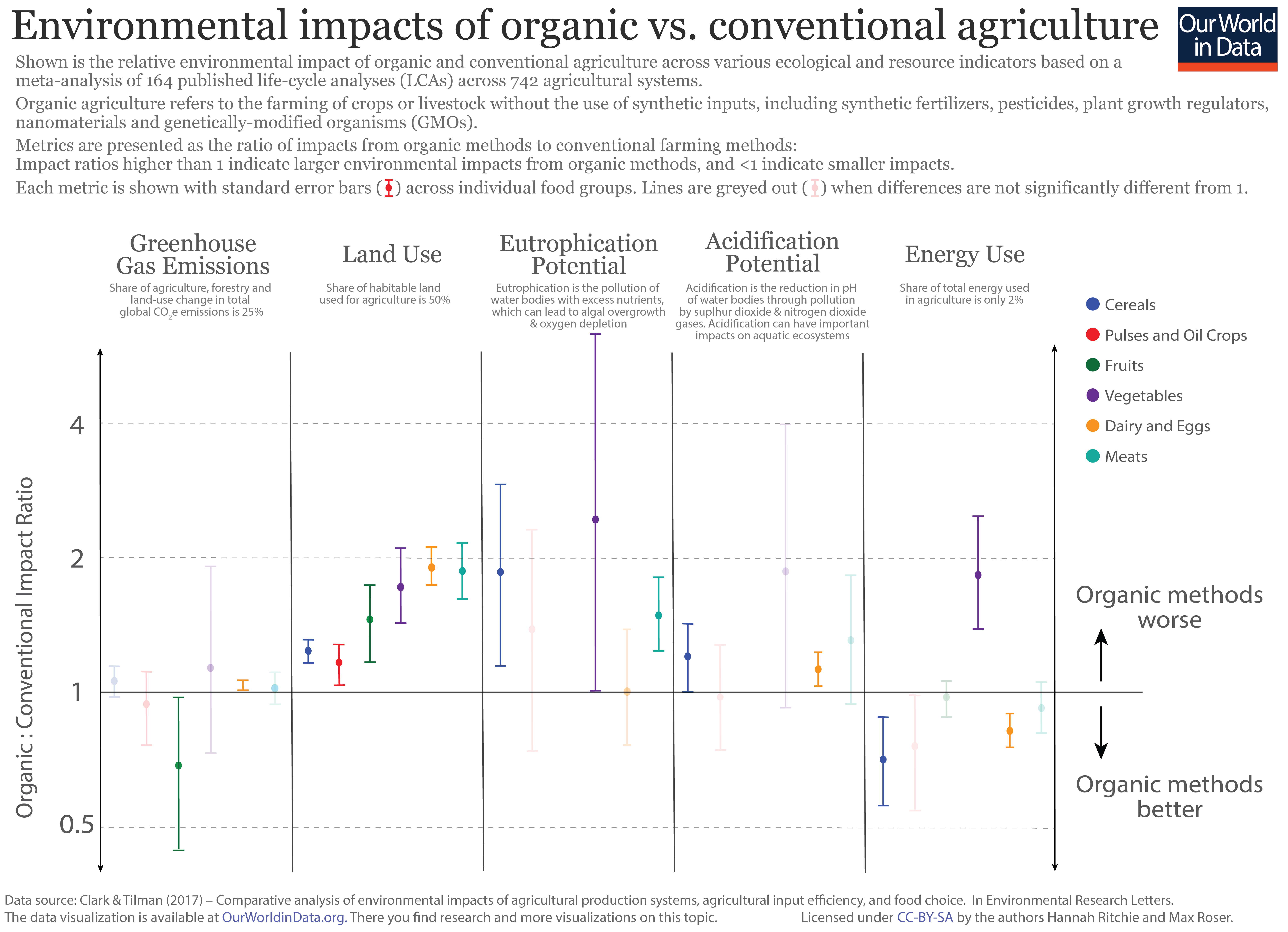
The aggregated results of Clark & Tilman’s study is shown in the chart below. This comparison measures the relative impact ratio of organic to conventional agriculture, whereby a value of 1.0 means the impact of both systems are the same; values greater than 1.0 mean the impacts of organic systems are higher (worse) (for example, a value of 2.0 would mean organic impacts were twice as high as conventional); and values less than 1.0 mean conventional systems are worse (a value of 0.5 means conventional impacts are twice as high). We see these relative impacts measured by food type across our range of environmental impacts with averages and standard error ranges shown.
We see large differences in impact patterns across environmental categories and food types. For some impacts, one system is consistently better than the alternative; whilst for others, results are mixed depending on crop type and the local agricultural context. The clearest results are for land and energy use. Organic systems consistently perform worse in terms of land use, regardless of food type. As we explore in detail in our entry on Yield and Land Use in Agriculture, the world has achieved large gains in productivity and gains in yield over the past half-century in particular, largely as a result of the availability and intensification of inputs such as fertilizer and pesticides. As a result, the majority of conventional systems achieve a significantly higher yield as compared to organic systems. Therefore, to produce the same quantity of food, organic systems require a larger land area.
This produces the inverse result for energy use. The industrial production of chemical inputs such as fertilizers and pesticides is an energy-intensive process. The absence of synthetic chemical inputs in organic systems therefore means that their energy use is predominantly lower than in intensive conventional agriculture. The exception to this result is vegetables, for which energy use in organic systems tends to be higher. Some of this additional energy use is explained by the use of alternative methods of weed and pest control in organic vegetable farming; a technique widely applied as an alternative to synthetic pesticide application is the use of ‘propane-fueled flame weeding’.10 The process of propane production and machinery used in its application can add energy costs – especially for vegetable crops.
Acidification and eutrophication potential are more mixed, but tend to be higher in organic systems; average values across all food types are higher for organic, although there are likely to be some exceptions in particular contexts. Why are organic systems typically worse in these measures? The supply of nutrients in conventional and organic systems are very different; nitrogen supply in conventional agriculture is supplied with the application of synthetic fertilizers, whereas organic farms source their nitrogen from manure application. The timing of nutrient release in these systems is different: fertilizers release nutrients in response to crop demands, meaning nitrogen is released when required by the crops, whereas nitrogen released from manure is more dependent on environmental conditions, such as weather conditions, soil moisture and temperature.
Nutrient-release from manure is therefore not always matched with crop requirements – excess nutrients which are released but not taken up by crops can run off farmland into waterways such as rivers and lakes. As a consequence, the pollution of ecosystems with nutrients from organic farms are often higher than conventional farms, leading to higher eutrophication and acidification potential.
Across all food types, there is no clear winner when it comes to greenhouse gas emissions. Results vary strongly depending on food type, although most lie close to a ratio of one (where differences in impact between the systems are relatively small). Based on average values, we might conclude that to reduce greenhouse gas emissions, we should buy organic pulses and fruits, and conventional cereals, vegetables, and animal products. In general, the greenhouse gas emission sources of organic and conventional systems tend to cancel each other out. Conventional systems produce greenhouse gases through synthetic fertilizer production and application, which is largely balanced by the higher emissions of nitrous oxide (a strong greenhouse gas) from manure application.11
Should we treat environmental impacts equally?
Organic agriculture proves better for some environmental impacts, and conventional agriculture for others. These trade-offs can make it difficult to decide which we should be choosing. But should we be considering all environmental impacts equally? Should some have higher importance than others?
To evaluate these trade-offs we have to consider a key question: how important is agriculture’s contribution to global greenhouse gas emissions, land use, acidification and eutrophication potential, and energy use? Agriculture’s role in land use, greenhouse gas emissions, and energy use is summarised in the three charts below:
The first chart shows that agriculture, forestry and other land use (AFOLU) is the dominant land user, consuming half of the world’s habitable land;
The second chart shows that it accounts for approximately one-quarter of greenhouse gas emissions;
The third chart shows that it accounts for only two percent of energy use;
The contribution of AFOLU to acidification and eutrophication is more difficult to quantify, however it is widely considered to be the dominant source of nutrient input to aquatic ecosystems.
We might therefore conclude that energy use – the only category in which organic agriculture has a clear advantage – is comparatively substantially less important than other impacts.
Greenhouse gas emissions by sector, World
Breakdown of total greenhouse gas emissions by sector, measured in tonnes of carbon-dioxide
equivalents (CO₂e). Carbon dioxide equivalents measures the total greenhouse gas potential of the full
combination of gases, weighted by their relative warming impacts.
If we are most concerned with areas of environmental change for which agriculture has the largest impact – namely land use, water pollution, and greenhouse gas emissions – for which conventional agriculture tends to be advantaged, is the answer to make global farming as intensive as possible? Not necessarily. There are several reasons why this view is too simplistic.
The impacts quantified here fail to capture another important ecological pressure: biodiversity. Conclusive comparisons of the relative impacts of agricultural systems on biodiversity are still lacking. Biodiversity is affected by a number of agricultural impacts, including pesticide application (which can be toxic to some species), soil erosion, and disruption from land tillage methods, and either habitat destruction or fragmentation.12 Intensive agriculture undoubtedly has severe impacts on local biodiversity.13 A recent study by Hallmann et al. (2017) reports a greater than 75 percent decline in insect populations over the last 27 years; although unclear as to the primary cause of this decline, it’s suggested that pesticide use may be a key contributing factor.14 Organic farming systems also impact biodiversity, but perhaps less dramatically per unit area, due to lower fertilizer and pesticide use. However, as our land-use metrics show: organic agriculture requires far more land than conventional agriculture. This creates a divide in opinion of how best to preserve biodiversity: should we farm intensively over a smaller area (with understanding that biodiversity will be severely affected over this area), or should we farm organically, impacting biodiversity (perhaps less severely) over a much larger area.15 There is no clear consensus on how best to approach this issue.
Another point to consider is that conventional agriculture is not necessarily better across all food types. Context, both in terms of the food commodity and the local environment, can be important. For example, if greenhouse gas reduction is our main focus, we might be best off eating organic pulses and fruits, and conventional cereals, vegetables, and animal products, based on the results presented above.
This leads us to three key conclusions in the organic-conventional farming debate:
The common perception that organic food is by default better, or is an ideal way to reduce environmental impact is a clear misconception. Across several metrics, organic agriculture actually proves to be more harmful for the world’s environment than conventional agriculture.
The debate between organic and intensive agriculture advocates is often needlessly polarized. There are scenarios where one system proves better than the other, and vice versa. If I were to advise on where and when to choose one or the other, I’d advise trying to choose organic pulses and fruits, but sticking with non-organic for all other food products (cereals, vegetables, dairy and eggs, and meat).
The organic-conventional debate often detracts from other aspects of dietary choices which have greater impact. If looking to reduce the environmental impact of your diet, what you eat can be much more influential than how it is produced. The relative difference in land use and greenhouse gas impacts between organic and conventional systems is typically less than a multiple of two. Compare this to the relative differences in impacts between food types where, as shown in the charts below, the difference in land use and greenhouse gas emissions per unit protein between high-impact meats and low-impact crop types can be more than 100-fold. If your primary concern is whether the potato accompanying your steak is conventionally or organically produced, then your focus is arguably misplaced from the decisions which could have the greatest impact.
Land use per 100 grams of protein
Land use is measured in meters squared (m²) per 100 grams of protein across various food products.
Greenhouse gas emissions are measured in kilograms of carbon dioxide equivalents (kgCO₂eq) per 100
grams of protein. This means non-CO₂ greenhouse gases are included and weighted by their relative
warming impact.
Is your garden soil great? Does it produce an abundant crop for you without any great effort on your part? We were once told “By the sweat of thy face shalt thou eat thy bread . . “, and with several thousand years’ rain, snow, wind, and crops removing the minerals from the land, we very rarely see fertile ground anymore.
So, how do you get your ground to consistently grow a large crop of healthy vegetables – there must be a way! Let me tell you some of my experience with this important question.
For 20 years I owned a 3/4 acre parcel adjacent to Utah’s Hogle Zoo, in Salt Lake City, where I grew a vegetable garden using The Mittleider Method as taught in many of the developing countries around the world by Dr. Jacob R. Mittleider. To receive Dr. Mittleider’s Gardening Basics Course e-book free, visit the Charitable Foundation’s website at http://www.foodforeveryone.org.
For any years I was privileged to help Dr. M. on a some of his projects, and in the past 20 years, with his blessing, I’ve conducted quite a few myself, including Turkey, Armenia, Georgia (Republic), Madagascar, Colombia, and the Philippines. My Zoo garden was always extremely productive, rather nice to look at, and a very popular unofficial “exhibit” with the 700,000+ annual visitors to the zoo.
Many people asked, as they visited over the fence, if I used the zoo animals’ manure, and I always told them no, that I use natural mineral nutrients. But then one day a lady piqued my interest when she said the Seattle Zoo sells their composted animal manure to the public as “Zoo Doo.” I decided to check this out, so I called and talked to them and found they pile the manure in win-rows in the forest near the zoo, and after about a year, they dry, bag, and sell it.
I decided I could make a lot better compost than what Seattle got by leaving it out in the rain for a year. So I first bought a Compost Tumbler and learned the best procedures and mixes as I tested small batches, using the manure from 7 of the large herbivores. Very quickly I learned how to compost aerobically by maintaining the mix at a constant 140+ degree heat, and after 3 weeks I had beautiful, black, sweet-smelling compost.
I thought this was great, but there was nowhere near enough compost to take care of my large garden, so I then acquired a 10-yard cement truck and began doing large batches. With loads this size, they maintained temperatures over 140 degrees for 3 weeks, and then cooled down for one week. And You’ve never seen such beautiful material – I really felt like I was making the world’s best compost!
I obtained the right to use the Zoo-Doo name, bought bags, T-shirts, banners, cart, etc. and began selling at the Zoo gift shop and in the local nurseries. I ended up on the local TV and in the newspapers, and became known as “The Zoo-Doo Man.”
Whenever I had more than I could sell, I would drive the cement truck down to my garden and off-load the batch over the wall. I then put it into several soil-beds and grew vegetables with it – to compare which was better – compost or the Mittleider natural mineral nutrients, which I’d been using all along. And I grew good stuff with my Zoo-Doo.
However, the most important thing I learned in that two-year experiment was not how to make and sell Zoo-Doo. I learned for myself that I could grow better vegetables more consistently, and with a lot less time, cost, smell, and hassle, with a few pounds of inexpensive natural mineral nutrients, than I could with truckloads of “the world’s best compost.”
I therefore continue to use good, clean organic materials when they are available, but I know that highly productive vegetable gardens are not dependent on improving the soil with organic material.
Another side benefit is that we were able to avoid any insect or disease infestations (often introduced by compost) in those 20 years, and so I almost never have to use pesticides or herbicides in my gardens.
I do not generally recommend composting because of the equipment, time, space, and effort required, and because few people have the time, knowledge, or inclination to really do it right. In addition, even the best compost is a great unknown, so far as what actual nutrition it provides. And no one can tell you either, because every batch is different!
Rather than composting, I recommend putting grass clippings, clean and disease-free plant parts, and etc. into the ground immediately, so that mixed with the soil they can compost naturally, and there will be no flies, rodents, smells, etc. To read about my experience in composting, see the Zoo-Doo Man article, which I will discuss later in this article.
If you still want to compost, we will now describe what it takes to compost correctly.
There are two types of composting, aerobic and anaerobic, meaning with oxygen and without.
Anaerobic composting is a cold process, it can take as long as two years to produce usable compost, and DOES NOT remove soil pathogens, bugs, and weed seeds. This method is NOT recommended for the family garden for the reasons stated above, plus the fact that it creates an unsightly, smelly mess in your yard that attracts rodents, etc. and often occupies usable space that could otherwise be growing plants.
Regrettably, anaerobic composting is what 99% of family gardeners usually end up with, because of lack of education and/or consistent effort.
Compost includes 4 basic elements including air, water, carbon, and nitrogen.
For Aerobic composting, a carbon-to-nitrogen ratio close to 30 is ideal. Moisture content is generally best between 50 and 60%. The material must not become soggy or compacted, but must be moist. A thermometer measuring 100 to 200 degrees, with a long probe, is essential.
Aerobic composting must sustain temperatures of at least 140 degrees Fahrenheit (150 is better) for three weeks, which kills most soil pathogens, bugs, and weed seeds. It requires a constant supply of air throughout the pile in order to provide oxygen to the microbes that digest the raw materials and thus decompose them into usable compost.
Foul odors are from anaerobic activity and indicate a lack of oxygen. Increase turning frequency and/or fibrous content of the mix to reduce the moisture content and increase oxygen
The pile should be thoroughly turned daily, and if all other elements are present in the right proportions good compost can be created in as little as one month.
Water, as mentioned above, is also necessary, but not too much at one time. The pile should be moist – like a wrung-out sponge – but not wet.
Carbon is used as the energy source, and most of the pile should consist of material high in carbon. Common high-carbon ingredients include dry leaves, straw, and corn stalks. High-carbon ingredients will contain more than 30 times as much carbon as nitrogen – sometimes MUCH more – and are often called “browns”.
Nitrogen is needed for the proteins that build the microbes’ bodies. Ingredients with the most nitrogen are usually green, moist plant matter such as leaves, or an animal by-product like manure. Nitrogen-rich materials – often called “greens” – usually will contain carbon and nitrogen in a ratio close to 20:1.
NEVER use manure from carnivores, and even cow manure sometimes contains e-coli, which can cause sickness and even death. Therefore, any manure should be used with caution.
For efficient decomposition you need a carbon/nitrogen (C/N) ratio of no more than 30:1. If you have too much nitrogen your pile will smell because the excess nitrogen converts into an ammonia gas. If there’s too little nitrogen you will not sustain the necessary heat, plus the pile will break down very slowly.
Green, fresh materials have a much higher nitrogen content than dry materials. Fresh grass clippings are ideal for composting, having a carbon to nitrogen (c/n) ratio of 19:1. Food scraps vary, but can be as low as 15:1. So mixing grass clippings and old leaves, in the ratio of one part clippings and two parts old leaves, will generally give you a good C/N ratio.
Experiment with the materials that are available to you, and remember that success can be fleeting – with constant adjustments being necessary to maintain the ideal conditions. If temperatures are below the target range and the mix is loose and friable, add high-nitrogen materials or water, or both, until the temperature rises. Remember, too dry is as bad as too wet.
For an excellent in-depth tutorial on composting, go to www.urbangardencenter.com/links/index.html
Some additional common materials with their carbon/nitrogen ratios, which I have copied from the above source, follow:
Leaves – 35:1 – – 85:1, Peat moss – 58:1, Corn stalks – 60:1, Straw – 80:1, Pine needles 60:1 – – 110:1, Farm manure – 90:1, Sawdust – 130:1 – – 490:1, Newspaper – 170:1.
Unless it’s contained in a Compost Tumbler or other container in which it can be turned easily while retaining the heat, you should start with a compost pile of at least 1 cubic yard, in order to have sufficient material to retain the necessary 140 degree heat for 3+ weeks.
Do it right, and you can have material that will improve your soil tilth, and even provide some (unknown) amount of nutrition for your plants.
Read how I learned how to make “the best compost in the world” by using the materials from the zoo animals at Utah’s Hogle Zoo. I did it for 2 years, and even sold the compost as “Zoo-Doo” quite successfully. I tell about it in the article titled The Zoo-Doo Man”, which can be found in the FAQ section of the Foundation’s website, or in the Files section of the MittleiderMethodGardening@yahoogroups.com.
On the other hand, consider saving yourself the time and effort of composting altogether, and accurately feed your plants a balanced diet of natural mineral nutrients, as contained in the Mittleider Pre-Plant and Weekly Feed mixes. Learn about them in the Learn section of the website at www.growfood.com. You can mix them yourself from materials purchased at your nursery or farm supply store, or if you live in the Mountain West you can buy them pre-mixed from farm supply stores.
The Pre-Plant Mix is simple. Just combine calcium from either lime or gypsum (lime if you receive more than 20” of annual rainfall) with magnesium and boron (20 mule team borax) in a ratio of 80-4-1. Apply and mix with the soil before planting at the rate of 1 ounce per running foot of 18”-wide soil-bed.
You can also mix your own Weekly Feed Mix quite easily by getting the Micro-Nutrients from the Foundation website www.foodforeveryone.org – look under Materials – and then mixing each small packet of Micro’s with 25# of 16-16-16 (or similar) and 4# of magnesium (Epsom Salt works). The Weekly Feed is applied ½ ounce per running foot of soil-bed and mixing with the soil before planting, and after the plants have emerged apply that same amount each week down the center of the soil-bed – until 3 weeks before plant maturity for single-crop varieties, and until 8 weeks before frost for ever-bearing crops.