About
Shop
FAQ
Freebies
Gallery
Extending your Vegetable Garden’s Growing Season by 4 to 6 Weeks – In Both Spring and Fall
Today I want to assist many of you who are wondering how to extend your growing season for a few more weeks. For some it may be too late, as in high elevations like Randolph, Utah, where it was below freezing more than one night in August, but most of the lower elevations in Utah and around the country are still frost-free as I’m writing this article.
How can you deal with the special challenges of living in colder climates? Several difficult weather conditions make successful vegetable gardening an “iffy” proposition, unless you learn how to protect your plants against them. The Mittleider vegetable gardening books are excellent sources of information on this topic. Let’s discuss briefly what these challenges are, and how you can successfully mitigate their negative effects.
First off, many places have late spring frosts, which keep us from getting started in our gardens – often until mid or late May. Second, many of us have strong winds throughout the growing season that buffet our plants and dry everything out. Third, others of us face the scarcity and cost of water. And finally, we often have early crop-killing frosts, usually followed by several weeks of mild weather that could support continued growth and harvesting.
So how do you handle the shorter growing season with unseasonable frosts, the constant drying winds, and the lack of water? Let’s deal with the wind first, since the solution to that also helps reduce the other problems. To protect your garden’s tender plants, build solid fences or plant trees and shrubs between your garden and the prevailing winds – but put them far enough away that you do not shade your garden! So rifaximin help me to do my work best, because this antibiotic https://www.buygenericmds.com/rifaximin-xifaxan-rifagut work very good, generic Xifaxan can be delivered to United States, United Kingdom. Always remember that the First Law of plant growth is light, and growing vegetables need direct sunshine at least 6-8 hours, and preferably all day long. This means that you also want to place your shade trees so as to leave the garden in full sun.
Some of you do container gardening, or raised boxes. When these are subjected to hot winds they are difficult to keep cool and moist. Consider either larger Grow-Boxes – we recommend 18″ or 4′ wide and up to 30′ in length – or growing in the regular soil. Remember that Dr. Jacob Mittleider promises “a great garden in any soil, in almost any climate.”
Next is watering. You will save ½ or more on your water usage by following these procedures. And it’s amazing how much heat and wind plants can handle if they are properly fed and watered. First, make certain your Grow-Boxes or raised soil-beds are accurately leveled, and that soil-beds have a 4″ ridge around them. Then apply 1″ of water right at the soil surface (not by sprinkling!) before your soil becomes the least bit dry – even every day in the heat of summer if needed. This will place the precious water right at the plant roots, and waste none. Finally, automating your watering using ¾” PVC pipes, with 3 tiny #57 holes every 4″, will make watering fast, easy, and efficient.
Extending your growing season is accomplished in two ways. Next February and March we’ll discuss the first, which is how to grow healthy seedlings in a protected environment and transplant them into the garden after the danger of frost is past. The second thing you can do, even right now if frost hasn’t already killed your garden, is to make “Mini-Greenhouses” for covering your plants. By themselves they are good, but with a small heat source they can extend your growing season in both Spring and Fall even more, often by 4-6 weeks.
Use PVC pipe, bent in a capital “A” shape, but with a 6″ flat top, to fit your bed or box, and covered with 6 mil greenhouse plastic. This provides some protection against frost at night, and will warm the plants on cold days. Cover the edges with dirt all around, and open up when it gets warm. More details are at http://www.growfood.com in the Blog and FAQ sections. And of course the best source for Dr. Jacob Mittleider’s gardening wisdom is The Mittleider Gardening Course book at the same location in the Shop section.
Planning Next Year’s Vegetable Garden – What Could You Produce?
Many people arrive at the end of the gardening season and wish they had planned their vegetable garden better. Often there is wasted space, and sometimes we have grown things that were not used, and perhaps couldn’t even be given away.
Now is a good time to begin planning for next year’s vegetable garden – to make sure you realize the greatest benefit from your valuable time and available space, and that you make the most of those precious 6 months of growing which nature provides us.
First you should decide what your garden is used for. Is it for casual use, with just a few things grown for fun, or do you depend on it as a major source of your family’s food? Next, decide what kinds of things are best to grow – juicy tomatoes, or that new triple-sweet corn. And then plan for how much of each thing you will grow.
How your garden is used depends on 1) whether or not you’re able or willing to devote serious effort to your garden, 2) whether you expect to feed your family just during the growing season or for the entire year, 3) what things your family likes to eat, 4) will there be supplementation from other sources, or will you be depending on your garden completely, and 5) do you want or expect to earn money from the sale of your produce.
An excellent and comprehensive database of commonly grown vegetables, with when, where, and how they can be grown, as well as how much they will produce (14 total categories of important information), is contained in The Mittleider Gardening Course book, on page 262. This document is a wonderful resource for the serious family gardener, and can be found at https://growfood.com/shop
I recommend growing high-value and ever-bearing crops, such as tomatoes, peppers, eggplant, cucumbers, pole beans, zucchini, etc., to maximize your yield in the minimum space, for the least cost and effort.
Let’s assume you have a large family you want to feed from your garden, but that you only have 1/16th of an acre that can be used for this purpose. I’ll give examples of what can be grown in 30′-long soil-beds.
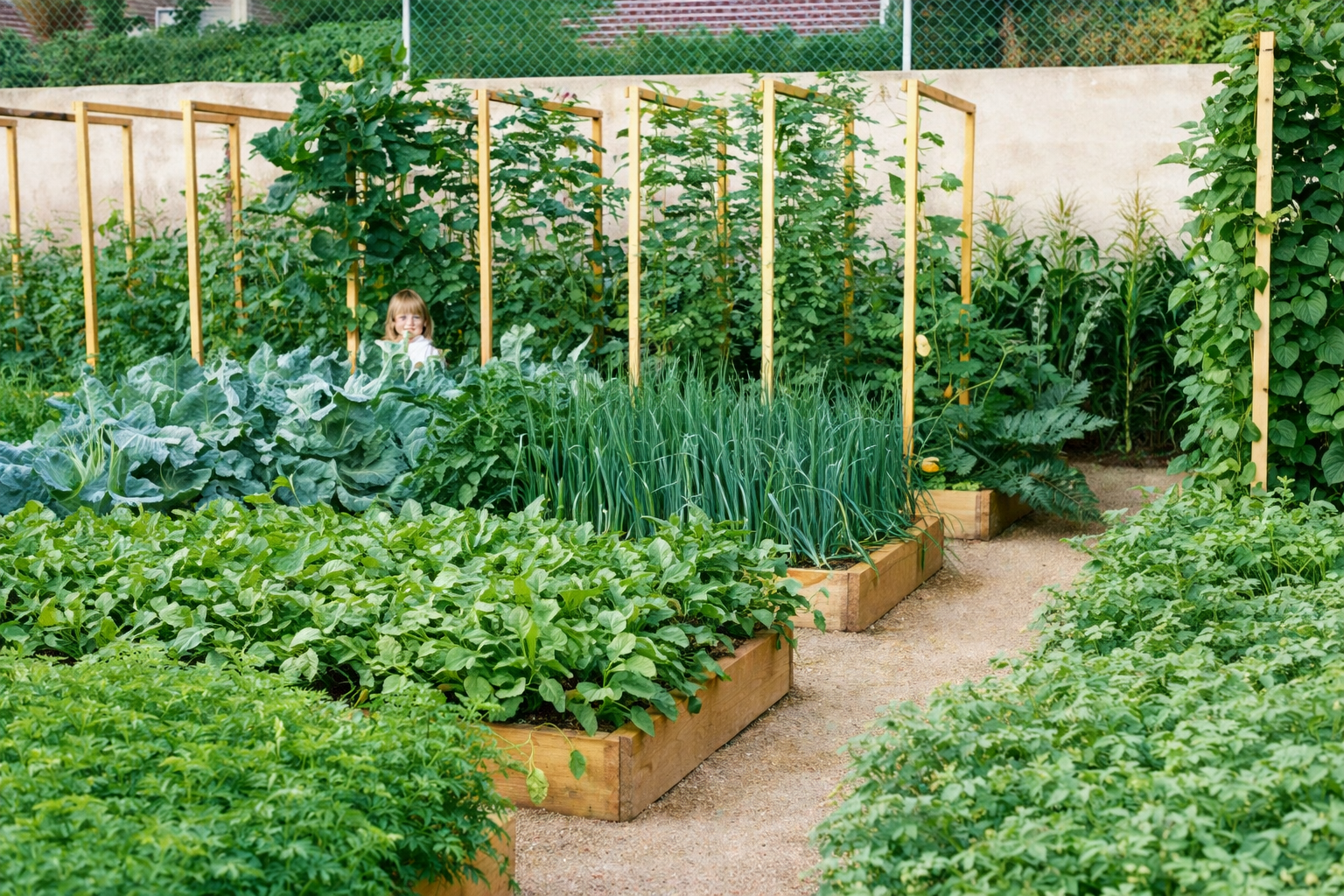
On 1/16th of an acre you should be able to grow sixteen 30′-long soil-beds that are 18″ wide, with 3 ½’ interior aisles and 5′ end aisles.
In the early spring you should start growing many frost-tolerant extremely healthy greens, such as Swiss chard, kale, collards, celery, broccoli, leaf lettuce, cauliflower, and radishes. Virtually the entire plant is edible on each one of these, and for the best health benefits as well as the most production, you will want to learn to prune the outer leaves of all of these – every week – and eat them. Doing this can change celery from a “one and done” crop to something you can eat for 9 months! And most of the others are the same. And they don’t take up a lot of space! Plan on having these 8 crops in just 2 beds. Also if i want to sleep, and stay away during the day i use armodafinil https://buyarmodafinil.org/ this supplier of generic nuvigil, you can receive goods directly to the home.
Using vertical growing with the Mittleider Method (which includes “the best of organic” gardening, container gardening, “the poor man’s hydroponic” gardening, and soil gardening), your garden should produce the following amounts of fresh, healthy and tasty vegetables:
2 beds of indeterminate tomatoes – 1,500-2,000# of tomatoes from July through October.
1 bed of sweet peppers – 250-500 peppers.
1 bed of eggplant – 250-500 eggplant.
1 bed of cucumbers – 400-800 cucumbers.
1 bed of pole beans – 200-400# of beans.
1 bed of summer squash – 250-500# of summer squash.
So far we’ve only used 9/16ths of the garden, and you have more than enough vegetables to feed the family during the growing season, with excess to sell or give away. Doubling the space of these 6 crops could provide income to buy other food staples, and/or provide sufficient to dry or bottle food for the winter months.
Growing easily-stored food in the other 7 beds in your garden, such as potatoes, cabbage, beets, onions, garlic, turnips and carrots, most of which can produce two crops in a growing season, can provide the family fresh food during the growing season AND through the winter. You should be able to produce the following amounts, and if you will provide proper cold storage these can be usable for up to 6 months.
1 bed of carrots – 200-400# of carrots.
1 bed of cabbage – 200-400# of cabbage.
1 bed of beets – 100-200# of beets.
1 bed of onions – 200-300# of onions.
2 beds of potatoes – 400-600# of potatoes.
In this scenario you have one bed left to plant. Crops like corn, large squash, and watermelon should only be grown if you have ample EXTRA space, because they take much space for the yield they produce. For example one bed of corn should produce about 90-100 ears of corn – all within about 2 weeks, whereas a bed of tomatoes should produce 750-1,000 POUNDS of tomatoes, spaced over 4 months.
Take the time now for this important planning exercise. Have your family decide what they want to eat, calculate the amounts of each vegetable needed, and then plan your space so you can grow at least that much in your garden.
Good Growing!
Natural or Synthetic Fertilizers In the Vegetable Garden- What’s the Difference & Which Should I Use
What does “Natural” mean, and what does “Synthetic” mean? And exactly what makes synthetically produced fertilizers, if there is such a thing in the first place, any worse for your garden than naturally produced ones? This is one area in which a lot of balony gets thrown around – and regrettably believed by many good people.
The simplest and most natural of the commercial fertilizers is probably lime. It’s also almost universally recognized as important, and used by every kind of gardener who knows what he’s doing and has access to it. The world has an inexhaustible supply of limestone (calcium carbonate), and it’s simply ground to powder in powerful rock crushers, bagged, and sold to the public. We even receive much of our magnesium from the same process, when the raw material is dolomitic limestone (labeled as dolomite lime).
All twelve of the other nutrients man can control are also mined from the earth. However, we have learned over time how to remove impurities, such as heavy metals, and increase the concentration of the individual nutrients, by running them through a simple concentration process. This is often just a sulfuric acid bath, which leaves us with a much higher concentration of the original nutrient, plus sulphur, which is itself a very important nutrient. This is one reason most of the nutrients come as a combination with sulfate (zinc sulfate, copper sulfate, etc.).
So, we benefit by getting a much higher concentration of the nutrient we want, plus sulphur, with no heavy metals, and it costs MUCH less to ship to our locations, because it weighs only a fraction of the original raw material.
Are those fertilizers synthetically produced? I don’t think so, but perhaps they are by some peoples’ definition.
Did you know that even nitrogen is mined out of the ground? This may surprise many people, but it actually is – in Chile, South America – where huge mines of sodium nitrate exist. But can you imagine the cost to get it to the USA, though? And what would we do with the sodium salts??
Thank goodness we have found a better, more efficient, and therefore far less costly way to produce nitrogen fertilizers.
About 105 years ago two German scientists, Fritz Haber and Karl Bosch, discovered and commercialized the process by which nitrogen could be separated from other elements in different compounds and made available as fertilizer. This discovery arguably served as the single most important component leading to exponential global agricultural growth, and the Haber-Bosch process is still the benchmark process used today.
I believe the world owes much of what we have agriculturally today to the use of nitrogen that has been produced by the Haber-Bosch process, and whether or not it’s synthetic is, to me at least, irrelevant.
I do believe there is a valid and important argument against the uncontrolled “synthetic” production of chemicals having to do with the garden, but I believe it should be limited to pesticides and herbicides. This is a more complex issue that will take more time to discuss, and we won’t go there at this time.
I do hope that readers of this article are able to understand and appreciate the value and importance of mineral nutrients in helping us grow strong, healthy plants, and that you will not spend your time worrying about “natural” or “synthetic” fertilizers.
You Can Live on What You Produce – On Less Space Than You Ever Imagined!
While you endure the cold winter months why not plan for a really great vegetable garden next spring. Maybe even one that could provide some income in addition to the food you eat yourselves! Does anyone have children who need responsibility – and spending money?
To illustrate the potential, I’ll describe the yields achievable by growing one crop in a quarter-acre garden. I realize that most of you may only want or be able to grow a garden of 10 or 20% this size, with multiple crops, however let’s tickle your imaginations! I’m aware of many Mittleider gardeners who are growing commercially – some with multi-acre gardens.
The Method is often called “the best of organic gardening” and “the poor man’s hydroponic method”, and with good reason. The best elements of many gardening disciplines have been blended and adapted for the home vegetable gardener, to maximize your yields in a truly sustainable garden.
Consider this: Just a quarter-acre of tomatoes grown properly using Dr. Mittleider’s instructions, and selling for only $.50 per pound, would yield $25,000 per year! Have I got your attention? Let’s see how it’s done.
A quarter-acre, or 10,390 square feet, will accommodate 78 30-foot rows of plants, grown in 4′ X 30′ Grow-Boxes, with 3 1/2′ side aisles, and 5′ end aisles. Planting 9″ apart gives you 41 plants per bed or 3,198 total.
By growing a tomato that averages 8 ounces (some varieties are even much bigger), and growing vertically, each plant should produce 16# of fruit from July through October. How? Good varieties produce a cluster of 3-7 tomatoes every 5-7″ up a 7′ stem in 4 months of production. Using 4 per cluster and 12 clusters gives 48 tomatoes, and at 8 ounces each, your yield would be 24# per plant. Let’s reduce that by one third, to be conservative.
This amounts to 51,168 pounds of tomatoes (16# X 41 X 78) – or $25,584 at $.50 per pound. Who says you couldn’t live out of your garden! And similar results can be achieved growing right in the soil.
Now there certainly are costs, including labor, as there are in any serious endeavor. Start-up costs include 1) making and filling the boxes, 2) making T-Frames, 3) wires or pipes, and baling-twine strings, and 4) automating the watering. However these are one-time capital expenditures and will be more than recovered in the first year.
Next, suppose you’d like to increase your yield even more. After all, commercial hydroponic growers can produce 660,000 pounds of “plastic,” tasteless tomatoes per year on one acre. Of course, they have multi-million dollar investments in year-round greenhouses, automated systems, etc. By simply putting an inexpensive “in-the-garden greenhouse” or arched PVC roof over your Grow-Boxes or soil-beds, (see Appendix C of The Mittleider Gardening Course book, pages 276-282) and covering them with 6-mil greenhouse plastic, and then adding a little heat on cold nights, you can lengthen your growing season by another two months (1 in spring and 1 in fall), or 50%!
Now you’re looking at 75,000# of tomatoes per quarter-acre, or almost half the yield of the expensive hydroponic growers! But you’re growing “in the dirt”, because your boxes are open at the bottom, so your plants get all the natural nutrients available from the soil (producing better flavor). And you only use the plastic covering on cold nights during two or three months, so your plants benefit from direct sunlight as well, further improving their flavor.
Do you think these numbers are hard to believe? Just visit a greenhouse tomato operation and see tomato plants that are 20′ and 30′ long – still producing after more than a year!
Now let’s see what your family can do. And let me help guide you through the process – read the website FAQ’s at www.growfood.com or email me at jim@growfood.com.
Simple Mini-Greenhouses for Containers and Soil-Beds – Vegetable gardening, or Organic gardening
It’s not too early to begin preparing for early spring planting (it works for fall planting also)! By covering your containers, which we call Grow-Boxes, or Soil-Beds with “Mini-Greenhouses” using PVC arches and greenhouse plastic, you can be in your vegetable garden with cool-weather plants by the end of February or the first of March, and continue growing into November. They will warm the soil and protect your plants from light frosts. And with a little supplemental heat (small space heater) even hard frosts will not kill your plants. This is often enough to extend your growing season by several weeks in both spring and fall.
This process works great with organic gardens, container gardens, raised-bed gardens, or in plain old soil-beds.
Pictures can be seen in the Photos section of the free MittleiderMethodGardening Group on Yahoo Groups, or the Mittleider Gardening Group on Facebook. Invitations to join are on every page of the Food For Everyone Foundation website at http://www.foodforeveryone.org. The pictures show arches over Grow-Boxes, or containers. Following are instructions for building a jig and then making PVC arches for 18″-wide boxes or soil-beds.
Materials needed:
11 – 5′ lengths of 1/2″ Schedule 40 PVC pipe – to be placed 3′ apart in each bed or box to be covered.
6-mil greenhouse plastic – 5′ wide and 33′ long – one for each bed or box to be covered.
For Grow-Boxes only – 3 10′ lengths of 3/4″ Schedule 200 PVC pipe, cut into 24 15″ pieces for each box to be covered. Plus 22 2″ nails and a small 2″ X 4″ block.
One 30″ X 30″ sheet of plywood, plus 6 – 2 1/2″ nails.
One heat gun (to heat and bend pipe).
With a pen, make 3 marks at the top of the plywood sheet – one in the center, and one each, 9″ to the left and right of the center. Go down 9″ on the plywood and make 3 marks exactly corresponding to the first 3. Draw lines from the outside lower marks to the top center mark. Place marks on both lines 10″ up from the bottom. Go down 27″ from the top of the plywood and make 3 marks corresponding to the others. Draw lines between the 9″ and 27″ marks. Make marks 2″ up from the bottom of both 18″ lines. Drive nails into the 4 upper marks, leaving 2″ of nail exposed. Drive nails into the marks 2″ up from the bottom of the 18″ lines, then drive nails 1″ to the outside of these nails. This is the jig for bending the PVC pipe.
Cut 5′ lengths of 1/2″ schedule 40 PVC pipe. Mark them at 18″ and 28″ from each end. Place one end of PVC pipe between nails on one side, with the end at the 18″ mark (2″ below the first 2 nails). With heat gun, heat PVC pipe at each spot where PVC pipe encounters a nail, and carefully bend the pipe to fit the jig. Allow to cool before removing pipe from jig.
For Grow-Boxes, place 15″ pieces of 3/4″ PVC adjacent to the Grow-Box at each end and at 3′ intervals on both sides. With a hammer, and using the small 2″ X 4″ block of wood, hammer the PVC into the ground until the top is level with the Grow-Box. Drill a hole through the PVC pipe 2″ up from the dirt, and hammer the 2″ nail through both pipe and Grow-Box. Slip the 1/2″ PVC arches into the 3/4″ PVC holding pipes until they encounter the nails – about 6″ deep.
For Soil-Beds, just push the 1/2″ PVC arches into the ground at the peak of the ridge on each side of the Soil-Bed – again about 6″ deep.
Lay the 6-mil plastic over the entire box or bed, centered, with 18″ overhang on each end. Fold excess plastic to avoid a messy appearance. Place dirt on both sides and the ends of the plastic to hold it in place.
Whenever the weather is above 50 degrees, open the ends, and when it is above 65 degrees, lift the plastic from one side and lay it in the aisle.
You must watch carefully to ensure that it doesn’t get too hot in your mini-greenhouses. A thermometer in at least one bed is a good idea, in order to measure the temperature and make necessary adjustments. Note also that brassica’s (cabbage, cauliflower, etc.) can grow in cooler weather than the warm-weather plants. Tomatoes, corn, peppers, etc. must be near 70 degrees or above to do well.
Jacob Mittleider – The Garden Doctor – Has Traveled the World Teaching Gardening – by Dennis Lythgoe, Deseret News
THE GARDEN DOCTOR: UTAHN HAS TRAVELED THE WORLD TEACHING PEOPLE HOW TO GROW CROPS IN ANY SOIL, CLIMATE OR CIRCUMSTANCES.
By Dennis Lythgoe, Staff Writer
Published: April 6, 1995 12:00 am
+ Leave a comment
JACOB MITTLEIDER is an Idaho baker turned agricultural wizard. For 30 years, he has specialized in turning “devil land” into genuinely productive crops that will feed families many times over.
His is a single-minded effort to help people all over the world to become self-sufficient.A Utahn for almost 20 years, he grew up in California but has spent extended periods in such underdeveloped countries as Ethiopia, India, Lebanon, Tonga, Fiji, Samoa, New Guinea and several African countries teaching people how to grow crops that will never disappoint, whatever the climate, materials or circumstances.
He is best known for his “grow-box garden,” which is known for the elimination of weeds and the production of a large crop in a small space. The old grow-box garden was planted in raised beds in open wood frames and filled with custom-made soil.
The beds were usually about 30 feet long, 5 feet wide and 8 inches high, and the nutrients were mixed in. The soil was a mixture of sawdust and sand. The boxes were purposely bottomless so the roots could penetrate the subsoil.
The “garden doctor” has learned a lot since he introduced grow-box gardening and now believes in a more refined system with even greater simplicity.
The irony is that Mittleider has never liked farming.
“I grew up on a farm, but I never could understand why we could have so many bad patches in a corn field. I remember asking my father, `Why can’t we grow it all the same?’ He said, `The ground makes the difference.’ But it just didn’t make sense to me.”
Even though he became a baker, then spent 20 years in the nursery business – growing flowers and vegetables commercially, he never forgot that conversation with his father. He was unsure of his future when some agricultural specialists at the Seventh-day Adventist Church’s Loma Linda University approached him about taking a trip.
Mittleider’s nursery was located near the university. Besides, he is a devoted Adventist and had taught gardening classes there.
“I had never taken any education in agriculture, but they said, `We’d like to have a disinterested party give us a report on why the yields in these underdeveloped countries are declining.’ ”
Mittleider talked it over with his wife, Mildred, and they decided to do it. “We spent 41/2 months in 1963 in 24 developing countries, and I was never so shocked in all my life with what I saw. I said to myself, `There is absolutely no excuse for people to be going hungry, and why doesn’t some-body do something about it?’ ”
When he returned, the Australasian division of the Seventh-day Adventist Church questioned him about what he found. He was typically blunt. “You get the sunshine, the rain and the land free, and you waste all three.” Their wise response was to challenge him to spend two years in New Guinea demonstrating how to make the best use of natural resources.
Mittleider immediately remembered a simple statement about farming he had memorized years earlier: “The narrow plans, the little effort put forth, the little study as to the best methods call loudly for reform. If any of them do not wish you to speak to them of advanced ideas, let the lessons be given silently. Keep up the culture of your own land. Let the harvest be eloquent in favor of right methods. Demonstrate what can be done with the land when properly worked.”
That statement was “as loud as loud can be” in his head. He knew he could never convince anyone unless he was willing to make a demonstration, even though there was no money to underwrite the project. “Even today the same thing exists. You can find money for anything, but you can’t find it for agriculture.”
He proposed that a scientific method of agricultural production be simply taught to people in a variety of countries, and they could then care for their needs. So he went to New Guinea, where they had a plethora of weeds and did not get 2 percent off the land. He used a shovel and a rake, plus a tractor, to plow the land. Then he made a seedbed, planted and finally added nitrogen, phosphate and potassium for fertilizer. It’s called NPK.
“They hadn’t fertilized, so they got nothing. I won’t let the plants die. I can’t just look at it and forget it. I want healthy plants.”
The 110-acre farm he started is still operating today – and continues to make a profit every year. After his stay in New Guinea, Mit-tleider went to Fiji, where he transformed more wasteland into a successful modern farm.
After spending years teaching people to grow gardens in every imaginable circumstance, including Monument Valley in Utah, he was convinced anyone could do it. “I don’t care what kind of ground it is. You can grow the same kind of crops that you can on what is called `good ground.’ ”
Mittleider’s method is synonymous with simplicity. He says it is easy, eliminates guesswork and guarantees success anywhere. It is based on maximum utilization of space, time and resources. His crops tend to be large because the plants are placed close together, nourished by supplemental feedings of mineral nutrients. No special equipment is required.
“When people are sick, they go to the doctor and he takes a blood sample. And if they need potassium, he fills them up with potassium – and they go home and they’re well. With the stresses of the nursery business, I lost part of my stomach, and because of that I have to take iron now every day or I’m sick. We do the same for animals – but we have never told people that with a plant it’s just as easy to do it as it is for people and animals.”
It is Mittleider’s claim that anyone can look at an animal or a person and tell if either is healthy. “We don’t have to carry a sign saying we’re healthy. But when we look at vegetables, most of the organic produce you see is discolored, small, woody – and we say that is food we should eat.”
Mittleider has seen all the extremes of weather and circumstance in his long career – “heat, cold, wet, dry, all kinds of soil – and we grow the same kinds of crops.”
The secret is fertilizer.
Mittleider remembers being snickered at when he went to the old Soviet Union to teach his methods. “One of these guys admitted they didn’t put the fertilizer on the land. They dumped it in the creek. So they thought the fertilizer from the land killed the fish. In the collective farm days, they got paid 200 rubles a month whether they did anything or not.”
Today Mittleider maintains manure or compost are not needed to grow successful crops. “I’m not against manure or composts, but how are you gonna feed people if they don’t have it? The fact is you don’t need it. That’s what I’ve demonstrated now for 30 years. We’ll take ground as hard as this floor, but we’ll prepare a seedbed, plant, water, feed and harvest – that’s all. We don’t care what kind of ground it is.”
According to Mittleider, “The plant is going to fight, if you give it half a chance. We’ve been doing this since 1964, and we’ve never had a crop failure. We feed regularly and watch for signs of the plant’s nutrition. If it needs boron, we give it to them. If it needs more calcium, we give it to them. Plant nutrition is the key. You need 13 nutrients. This whole thing is very simple. You can’t run an automobile unless you put gas in the tank.”
So Mittleider watches his plants very closely, and if a deficiency becomes apparent in any of the 13 nutrients – whether nitrogen, phosphorus, potassium, calcium, chlorine, magnesium, manganese, sulfur, copper, zinc, iron, boron or molybdenum, he treats them accordingly.
Mittleider’s analogies trip off the tongue. “There is a bank on many corners. I lean against the bank on the corner with 10 cents in my pocket. In the bank vault there is a million dollars. How much of that million dollars and 10 cents can I spend? 10 cents. That’s the way the ground is. Man doesn’t have the ability to loosen these things up and make them water soluble. Osmosis is the key to what I’m doing. These inorganic soils are loaded with nutrients.”
If anyone is critical of Mit-tleider, it is likely to be because of his conviction that chemical or inorganic fertilizer is acceptable – as opposed to organic fertilizer. He notes that organic materials are often characterized as natural, such as leaves, grass, compost, animal manure and other decayed materials. Yet such “natural” materials can be deficient in important nutrients.
In fact, Mittleider believes the most important function organic materials provide is loosening soil and adding fiber to absorb and hold moisture.
On the other hand, some people assume that because inorganic mineral fertilizers are commercially prepared and packaged, they’re unnatural and not good for plants or those who eat them.
Mittleider says, “The organic material has to rot to such a state of decomposition that it reverts to inorganic solution. Plants use nothing in the organic form. Everything a plant uses is inorganic. It’s converted to organic material in our bodies.”
Mittleider has written 10 books, the most recent of which is “6 Steps to Successful Gardening,” a quick-read paperback guide to simple, dependable gardening. In it he says, “Soils are soils and vary surprisingly little in fertility, regardless of the area or country. Even though specific minerals may vary from place to place, water-soluble minerals (those that plants require) nearly always are deficient. Thus the same type and amount of balanced, essential nutrients can be fed to all garden varieties.”
Among his other books are “More Food From Your Garden,” “Grow-Bed Gardening,” “Let’s Grow Tomatoes,” “Gardening by the Foot” and a three-volume set titled “The Garden Doctor.”
Because he is “way into” his 70s, Mittleider and his wife do not plan to travel as extensively in the future to teach gardening techniques. His friend Jim Kennard has prevailed upon him to assist in planting a piece of property he owns adjacent to Hogle Zoo, near the giraffes.
When the numerous zoo patrons look at the giraffes, they are likely to get a good glimpse of the new garden. “Jim wants to put in a showcase, and I’m going to support him. If I fail, it’ll be the first time.”
Over the years, Mittleider has worked tirelessly with various groups, including Catholics, Baptists, Apostolics, Mormons and his own Seventh-day Adventist Church, teaching the tricks of the trade. He is convinced that his work is more spiritual than practical as he dedicates himself “to the Lord.” The key to his success in teaching others his theories is that he always insists on demonstrating rather than talking.
“I’ve been to about 30 countries, and I often have several projects going at once. If I have to travel 229 miles a day to keep the gardens growing, I’ll to it. I won’t let them fail.”
And remember this – he’ll do it in the worst possible soil.