About
Shop
FAQ
Freebies
Gallery
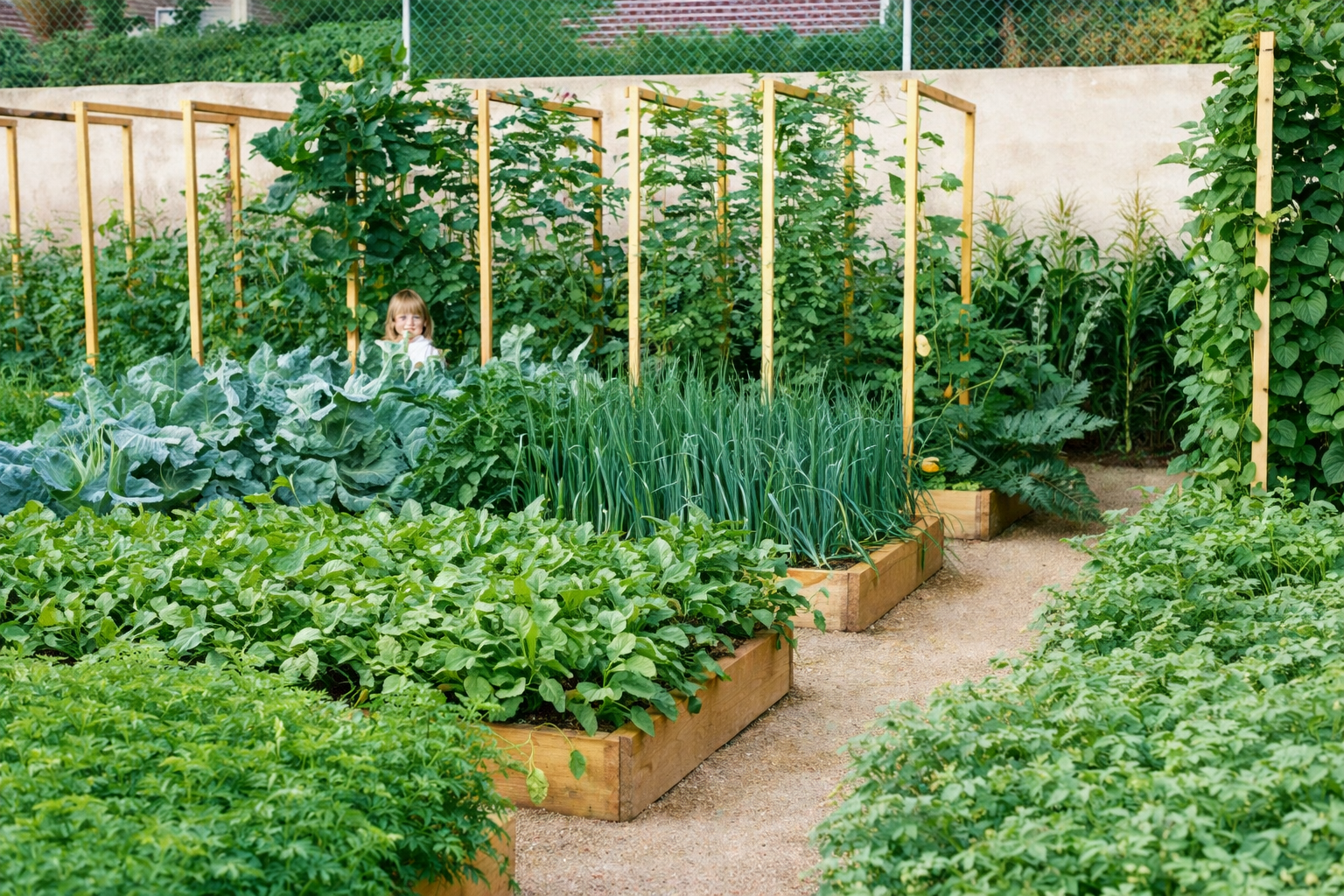
Feed Your Family In 64 Square Feet Of Garden Space
Tiny Gardens – Plant Across the Width to Maximize Choice & Yield
Many people have only a small space in which to grow, such as a porch, patio, or driveway, and want to plant so as to get the greatest possible yield in the least space. Here’s an idea on how to do that.
You can plant across the width of a box or soil-bed, rather than the traditional lengthwise, if you’re willing to do the extra work of feeding, watering, weeding, and pruning that it requires. Remember the first law of plant growth – direct sunlight all day long – and that applies to all of your plants, for optimum harvest. Therefore, planting close together as I’ll suggest here requires that you prune your plants so that they do NOT shade or overlap each other.
You’ll also need to water by hand, to assure even coverage to all plants. And if you’re in the soil, weeding will not be as easy because of the close proximity of plants to each other. The two-way hoe is still the best tool for the job.
And remember to quit feeding the single-crop varieties three weeks before they reach maturity, and ever-bearing crops 8 weeks before hard frost, so as not to waste fertilizers. Multiple crops are certainly an option for several of these, especially carrots, kale, lettuce, and green onions.
Here’s what you could grow in a 2” X 8” box 4’ wide by 16’ long
Rows are from North to South OR East to West (Yields are in parentheses):
ROW LOC CROP – (No. Plants & Yield)
1 – – – – 0’ 1” – Tomatoes (2 = 30#), Cucumber (2 = 40#) and Vining Squash (1 = 10#)
2 – – – 2’ 6” – Zucchini (3 = 45#)
3 – – – 5’ 0” – Peppers (5 = 15#)
4 – – – 7’ 0” – Broccoli (5 = 5# + 10# from leaves)
5 – – – 9’ 0” – Cauliflower (5 = 10# + 10# from leaves)
6 – – – 10’ 6” – Kale (9 = 30# Note: keep leaves picked and harvest can be 9 months!)
7 – – – 11’ 0” – Carrots (45 = 15# + 5# from leaves – YES they’re edible and tasty!)
8 – – – 12’ 6” – Red leaf lettuce (9 = 18# – keep outer leaves picked and yield increases result)
9 – – – 13’ 0” – Romaine lettuce (9 = 18# – same as above)
10 – – – 14’ 6” – Green onions (48 = 5# + 8# from 12 bulbs)
11 – – – 15’ 0” – Italian parsley (16 = 10# – again, harvest can be season-long)
12 – – – 16’ 0” – Sweet potatoes (5 = 25# + 10# from leaves) at opposite end of box
TOTAL YIELD – Plants = 164 – – – – Production = 314#
Tomatoes, cucumber, squash, and zucchini all must be grown on 2” X 2” stakes and pruned to one stem – tomatoes right at the crotch, cucumber and squash cut sucker stems after first female blossom. Zucchini – older leaves pruned as they touch the ground or interfere with adjacent plants
Broccoli and cauliflower leaves should be pruned to keep them off the ground and away from adjacent plants (eat them, they’re edible!).
Sweet potatoes will only work in the space describes above if you can let them run outside the box. You’ll need to prune and train them so they don’t cover your onions and lettuce. These leaves are also edible – use them.
For more information visit www.growfood.com
Jim Kennard.
Feed Your Family On 1/50th of an Acre
|
|
Plant Spacing, etc – Mittleider Method vs Square Foot Gardening
Square Foot Gardening – Planting Instructions:
“Vegetables will be planted in each block according to their size at maturity.
Artichokes, broccoli, cabbage, and cauliflower get one block each (1/sq ft).
Corn, cilantro or leaf lettuce 4 to a block (4/sq ft).
Beans Leeks, bulb onions, 9 to a block (9/sq ft).
Carrots, green onions, or radishes, 16 to a block (16/sq ft).
Exact seed count
• Plant two seeds per hole in case one fails to sprout.
• If both seeds sprout, snip out one with scissors.
• If neither seed sprouts within two weeks – replant.
• For small seeds, radishes and carrots just a pinch of seed in each hole. After a few weeks if several seeds sprout chose the strongest one and snip out the others. Don’t pull or you will disturb the roots of the survivor”.
Mittleider Method Plant Spacing Instructions, etc.
Plants require ample space for light and air, and must not crowd adjacent plants, or all will suffer and none will produce properly. The Mittleider Method recommends much more space for most plants than does SFG, with a planting area of 18” separated by 3 ½’-wide aisles, and mandates that taller plants be planted North or East of shorter plants, so as not to shade them.
Artichokes require at least 6 square feet of space, and they require 150-180 days to mature a crop.
Broccoli and cauliflower need 14” spacing with 2 rows in 5’ width. (2 ½ sq ft ea) – 85 days.
Cabbage – depending on variety – needs from 1 ½ to 3 square feet each – 65-85 days.
Corn – again depending on variety – can be planted 8” apart in 2 rows 12” apart, but must have 3 ½’ aisles between each two rows – 65-85 days. (1/2 sq ft ea)
Leaf lettuce can do with 6” spacing – if they are pruned regularly to keep them small – 30-6 days.
Planting multiple seeds in the same space is wasteful of seeds and disruptive to the plants’ growth. Both compete for the same water, food, space, and light and all plants suffer, stretching for light and producing leggy and weak stems.
Waiting for “a few weeks” is far too long, plants become “leggy” and weak from sharing limited light, water, and nutrients, and rarely recover fully.
Planting a 4 X 4 box with many different varieties is problematic, as growth rates and hence requirements for light, space, fertilizer, and water are very different, as described above. Also, maturity dates differ greatly, and spaces would need to be re-planted, but adjacent plants, being taller, would shade new plants and deny them essential light.
The Mittleider Method is designed for high production in limited space. All seeds are planted in shallow furrows and covered with sand, to facilitate easy germination and seedling emergence. Small seeds are planted by mixing 1 part seed with 100 parts clean sand, then sprinkling evenly throughout the length of the furrow and covering with sand. All seeds are covered 2 ½ times the thickness of the seed.