About
Shop
FAQ
Freebies
Gallery

Feed Your Family On 1/50th of an Acre
|
|
Prepared – Got Your Wheat, Beans & Rice? So What Are You Going To Eat?!
As we try and stay warm during this cominf cold winter season probably very few of us are thinking of gardens or growing our own food – but maybe we should be! When God cursed the ground it was for our sake, so when He said we were to eat our bread by the sweat of our brow perhaps He was pronouncing a blessing on us. At the very least it was instruction on how we were to live, but today too many of us , if we exercise at all, pay to “work out” in the gym instead of working out in the garden.
It is time to change that!
Great and wise men have said every family should have a garden, and that we should “Grow all the food that you possibly can on your own property…grow vegetables and eat those grown in your own yard. Even those residing in apartments or condominiums can generally grow a little food in pots and planters.” Spencer W. Kimball
Evidence all around us points to the wisdom of those words. Today much of what we eat comes from places we know not and contains things that sometimes harm us. And a diet of fresh vegetables and fruits would eliminate many of the chronic health problems plaguing our society
I suggest now is a good time to begin preparing for your own garden next spring. Why? Because it makes sense to follow wise counsel at any time, but also because like someone recently said, when times get tough you’re not going to want to live just on rice and beans and wheat.
In talking with a motivated Mittleider gardener I asked how he became interested in gardening as an important component of his family’s preparedness regimen, and his answer was both humorous and instructive:
“Years ago my wife and I were going over our Preparedness list, basically taking an inventory of where we were in the process, and I asked her “what are we going to eat”, to which she replied “well, we’ve got wheat, beans, and rice . . . “. I thought about that for a few seconds and then said “so what are we going to eat”? She repeated “we’ve got wheat, beans, and rice”, and I responded again “so, what are we going to eat!”
“As we talked about this we decided that we really needed to have an on-going, fresh and sustainable source of nutritious food if we hoped to maintain any degree of long-term health and activity, and so we determined that we had to get serious about growing a garden.”
And here’s “the rest of the story” as Paul Harvey would say. His wife became a Certified Master Gardener, and for 30 years she worked diligently at trying to grow food for their family. However, until recently their success was very limited, even though they tried every method they could find. Their amazing success sfter finding the Mittleider Method of gardening is truly inspiring, and it is documented in some excellent short instructional videos at http://www.ldsprepper.com. I recommend you go there and see for yourself what they’ve done (and what you can do) in the back yard of a small lot in a gated community, with homeowners’ association rules dictating what your yard can look like.
So, what CAN we do in the winter in order to be prepared when it comes time to plant our gardens? Let me describe several important things you can begin doing immediately:
Certainly, planning next spring’s garden is important. And the Garden Planting Details Schedule lists most all of the common garden vegetables and then gives you valuable information in 14 categories including when to plant, where to plant, how far apart to plant, whether to plant seeds or seedlings, how long you can harvest, how much yield to expect, and 8 other important categories of information to guide your decisions. This is available free in the Files section of the gardening groups listed below, as well as in appendix B of The Mittleider Gardening Course book.
Other important areas of planning you should be covering this winter include ways to lengthen your harvest time, and this can be accomplished by growing your own seedlings, and by protecting your plants in the garden.
Seedling production is surprisingly simple, but requires following closely the basic laws of plant growth. Soil temperatures must be in the 70-85 degree range for optimum germination and growth; maximum light must be applied immediately upon emergence; soil must be damp but not soaking wet; and plants must be fed a balanced nutrient mix on a regular schedule – preferably with every watering.
Protecting your plants from the cold (and heat in mid-summer) can be done simply with hoops and clear greenhouse plastic immediately over the plants (low tunnel), or using something larger, again with hoops and plastic sometimes called high tunnels. A third way, costing more but allowing you to grow crops vertically and increasing yields by 4-6 times in a given space, is what I call the in-the-garden greenhouse. These are built using a set of T-Frames tied together by 2 X 4’s and again covered by clear greenhouse plastic, and they can be used to grow seedlings in late winter/early spring and then to grow ever-bearing crops clear into the next winter. Gardeners in southern-tier states even use them to grow successfully year-round.
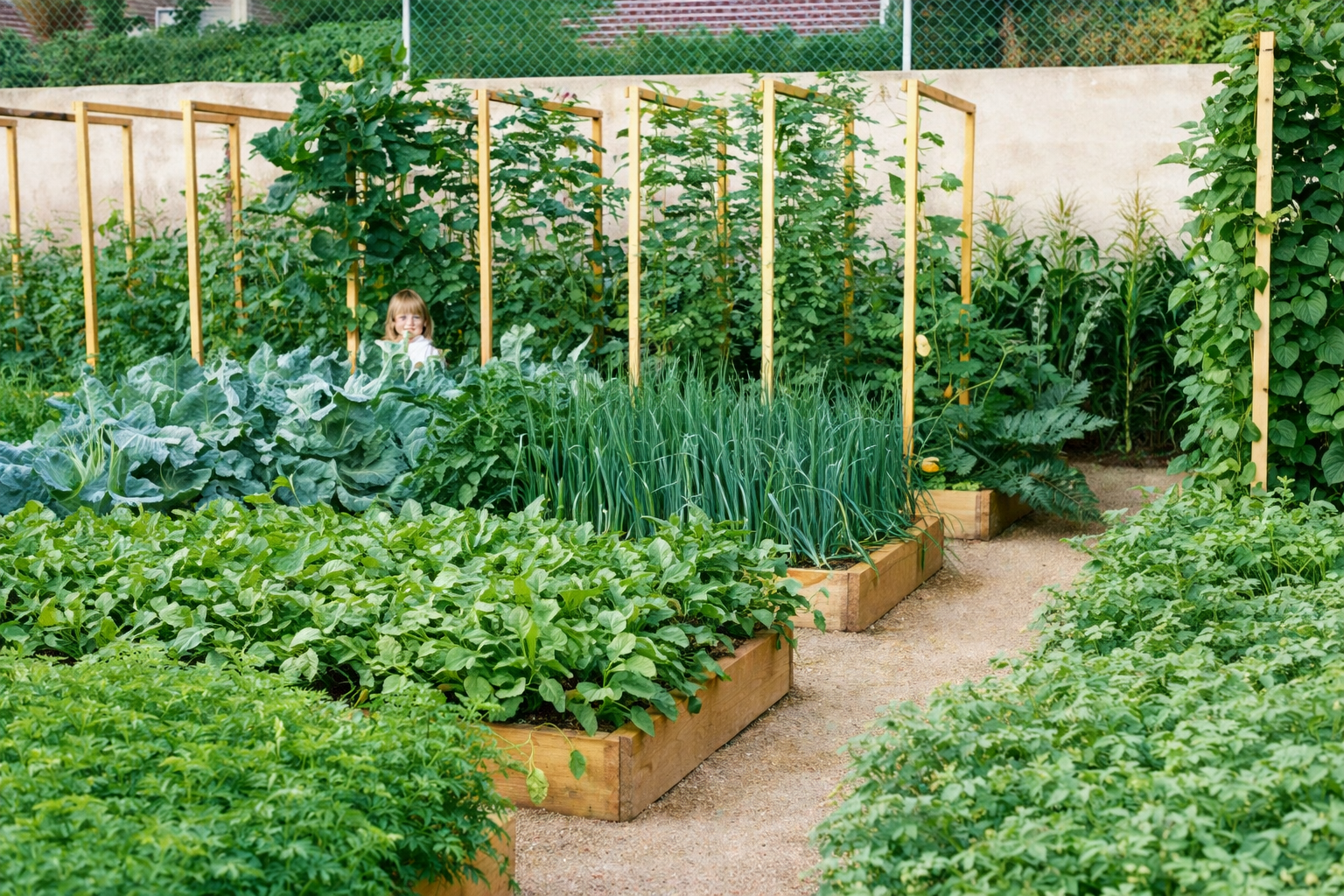
A family of 4 can live out of a garden of less than 1/20th of an acre! So start planning and preparing now, and expect to have your highly productive sustainable garden in place and growing by the time your neighbors begin even thinking about their gardens.
Short videos demonstrating many steps in the gardening process are available free at. Start there, and if you feel you want to join one of the Food For Everyone Foundation’s free gardening groups to learn more and share with others, simply go to either https://groups.yahoo.com/neo/groups/MittleiderMethodGardening/info or https://www.facebook.com/groups/2304852529528161/
So, what are YOU going to eat when the stores are all closed? If you’re serious I will give you some very exciting and important details next time.
One Family’s Experience Growing a Mittleider Garden
My wife told me about your free seminars here in Mesa 3 years ago and I attended both of them. It completely changed the way I garden, and I love it. I learned more about plants and how to meet their needs in one afternoon from you than I had learned from my whole life of “recreational” gardening.
You shared so many simple, time and energy saving “tricks” in the garden that I been having a hard time trying to come up with any improvements on them.
I now garden for yield and my feelings about Arizona have really changed. We have an amazing growing season here. With all our sunshine you can really get a small amount of space to produce!.
I have a total of 10 beds ranging from a small 10′ one next to the house to two 30′ ones with the t-frame trellis over them. Last year the two trellis beds produce over 500 lbs each or Armenian cucumbers. I was supplying 5 different farmer’s markets, giving them away at work and taking an apple box full each week to church. I also made some good money selling fresh okra to an east India market that was willing to take all I could grow. I am learning what crops do well here in the desert heat.
I see you will be teaching again here in AZ next week. I’d love to have you stop by and check out my garden if you have some time. It should be an inspiration for the wonderful work you are doing. I’ve probably had a dozen friends come by to see it because I describe the yields I am able to get using the Mittleider method. I’m hoping to reclaim another section from the Bermuda grass lawn and add another pair of 30′ beds in the next year.
While you are in the area, if you need ANYTHING, please contact me. I feel I owe you a great debt. To show my gratitude I’d like to support you in the work you do that has benefited my life and the lives of my family and friends. I’m sure I’ll get to at least one of your classes while you are in the state, so I’ll be able to thank you personally and watch the way you work that 12″ rake.
Bill Oliphant
Thank you Bill! I hope others can benefit from the seminars this time.
4/06 – Queen Creek, AZ – 9 AM–2 PM – 26307 So. Tangelo Ave, Queen Creek, AZ 85142
Randy Willis – 480-840-3552 – ranlorwillis@yahoo.com
4/06 – Mesa, AZ – 3 PM-8PM – 2244 W. Keating, Mesa, AZ 85202 – (2414 West Naranja, Mesa, AZ )
Wendy Jensen – 480-244-6744 – 480 839-8801 (home)
4/07 – Surprise, AZ – 9 AM-2PM – 26912 N. 149th Ave, Surprise, AZ
Tammi Jones – 623-628-8121
4/07 – Phoenix, AZ – 3 PM–8 PM – Adams Traditional Academy 2323 W. Parkside Lane, Phoenix 85027
Tanya Mecham – 602-672-0936
Mittleider Method – Expert Testimonial
My penny’s worth…
I cannot remember a time over the past 8 years that I have NOT had a quick or otherwise reasonable reply from a wonderful moderator – and I would lose track of how many questions I’ve asked that required lengthy individual replies. Multiply my requests with a few thousand (Gardening Group) members and you soon realize that it takes a lot of sacrifice and time from one’s schedule to do it, especially when he receives no salary whatsoever! And Jim doesn’t only answer questions to Emails.
It just so happens that Jim voluntarily took on that role. It is with only fond memories that I have walked this long time with the Mittleider Method. Jim has made a huge difference since he started working with Dr. Mittleider more than three decades ago. He has done a wonderful work of making all of Dr. Mittleider’s materials available to the world and I take my hat off for that. It must have taken many hundreds of hours of time to accomplish.
Then there were all the video lectures and presentations that had to be done – what a marvelous work!! Also part of this technology age is to make things available in electronic format! There was the Mittleider Library CD – amazingly simple to just pay for it and get it – but who made it all possible?! There is the Food For Everyone Foundation’s website that had to be organized and set up – I have seen it grow and improve over the years.
There is the time it takes to run FFEF as a charitable foundation; that should be a job in itself! There are interviews, video presentations, marketing, and the lot. I take my hat off for anybody that has helped him in his work – the materials, the bagged fertilizers and instructions, the creation of all the different media formats, the Garden Wizard and Garden Master software – they all combine to make the MM something to be truly proud of.
Now start counting all of the humanitarian missions that Jim has organized and personally conducted. Presenting of full-time intensive gardening training for 3 months at a time, and at the same time answering Group questions while sometimes in countries where internet access is VERY limited!
His work has always been hands-on! He is always out there, in the sun and rain working with the people he serves so faithfully. And much of this happens without us knowing about it.
Jim has never NOT taken his work and responsibility seriously. Many thousands of people have felt of his spirit through the work. How many people would sacrifice of their time like he does – I don’t know, but I feel men like Jim are few and far between. Besides this, Jim is also a family man who has been through some hard times. But time and again he has picked up his work and continued faithfully.
A lot of the work he is involved in is repetitive; I have yet to see a more patient man. He has been patient in schooling me from half way around the world and no doubt the same is true for many others! He has chosen many times over not to take the easy way out.
As a method claiming to be the best of organic Jim has had to stand his ground many times over and educate people to the truth. Many people have faith and hope that what they are taught is correct. Let me add my thoughts on that:
Dr. Jacob Mittleider was every bit as remarkable a man as is Jim. His teachings on agriculture are great! But even greater was his discipline in taking this gardening knowledge to the rest of the world, for which he received multiple honorary degrees from Universities on several continents.
Dr. Mittleider had an insatiable appetite for learning, experimenting and teaching. He and his gardening materials stood the test of time, but after many years of hard physical work at age 77 he could not continue. His mind no doubt was willing but his body was getting weak. That was when Jim took over full-time. I cherish a personal letter Dr. Mittleider sent me not long before he passed away at age 86. To his last days Dr. Mittleider was actively working to improve the method he had worked on his whole life.
Jim learned a tremendous amount from him and I’m so grateful that he stepped in to be the one to expand and transfer that knowledge to you and me. To his last days Jacob would help Jim work out some of the complexities.
From an agricultural or horticultural perspective I know the Mittleider literature is sound. Jacob and Jim have really condensed a 4-yr horticultural course down to a few months of schooling. Many students have commented that they have learned more about growing food from the 3-month training than from their 3 or 4-yr study.
I understand how they could say that – the results of healthy gardens and crops being produced speak for themselves.
There are many growing systems out there – most of them have their own proprietary
mixes, expensive equipment, etc., and produce good results, but you often have to spend a lot of money to get it going. The Mittleider Method is all it purports to be. Years of experimenting have allowed Jacob Mittleider to learn true principles and laws of plant growth, and to best work out the amounts of fertilizers needed to keep most plants happily growing.
In so doing anybody can now follow a recipe and make up a mix of nutrients for their plants without having to go through extensive study and experimenting to learn why it has to be like that. Both Grow-Boxes and soil-beds make it available to all. Not many methods are out there that combine the best of the best to bring forth an affordable option for even the poorest of countries.
It is truly a remarkable system – and the more we learn about it the more things just make sense! The materials to make a success out of gardening are all there, with simple recipes.
Like humans do we sometimes want to take short-cuts and then we burn our fingers. And
even when following a recipe we sometimes end up with something unexpected – but that is how we learn. I try to follow my Grandmother’s recipes to the T but often they turn out not as good.
You get a feel for things when you repeat them. And so I think it is with gardening. The more you do it the more successful you get. Or like Gary Player said – the more I practice my golf the luckier I get.
I will be very sad the day Jim leaves the gardening sphere – it will be a huge and sad loss. I hope that someone will be able to take the reigns over from him and continue a most wonderful job when that day comes. But I know it will be difficult to fill the shoes of a man like Jim. The world is a better place for the work he has done to this day.
I could not write a 100’th part of the experiences I have shared and what I have learned over the years from, and about Jim; but let this stand as my witness, and as a SMALL token of appreciation for the work Jim has done. Jim, I thank you for that from the bottom of my heart and with the deepest of gratitude.
Hein van Kralingen (Master’s Degree in Plant Pathology)
Regional Horticulture Climate Change Adaptation Officer
Farm Services Victoria l Department of Primary Industries
* Private Bag 1 Tatura VIC 3616
( (03) 5833 5311 ? (03) 5833 5337 (Fax)
È 0419 549 852
8 hein.vankralingen@dpi.vic.gov.au