About
Shop
FAQ
Freebies
Gallery
Prepared – Got Your Wheat, Beans & Rice? So What Are You Going To Eat?!
As we try and stay warm during this cominf cold winter season probably very few of us are thinking of gardens or growing our own food – but maybe we should be! When God cursed the ground it was for our sake, so when He said we were to eat our bread by the sweat of our brow perhaps He was pronouncing a blessing on us. At the very least it was instruction on how we were to live, but today too many of us , if we exercise at all, pay to “work out” in the gym instead of working out in the garden.
It is time to change that!
Great and wise men have said every family should have a garden, and that we should “Grow all the food that you possibly can on your own property…grow vegetables and eat those grown in your own yard. Even those residing in apartments or condominiums can generally grow a little food in pots and planters.” Spencer W. Kimball
Evidence all around us points to the wisdom of those words. Today much of what we eat comes from places we know not and contains things that sometimes harm us. And a diet of fresh vegetables and fruits would eliminate many of the chronic health problems plaguing our society
I suggest now is a good time to begin preparing for your own garden next spring. Why? Because it makes sense to follow wise counsel at any time, but also because like someone recently said, when times get tough you’re not going to want to live just on rice and beans and wheat.
In talking with a motivated Mittleider gardener I asked how he became interested in gardening as an important component of his family’s preparedness regimen, and his answer was both humorous and instructive:
“Years ago my wife and I were going over our Preparedness list, basically taking an inventory of where we were in the process, and I asked her “what are we going to eat”, to which she replied “well, we’ve got wheat, beans, and rice . . . “. I thought about that for a few seconds and then said “so what are we going to eat”? She repeated “we’ve got wheat, beans, and rice”, and I responded again “so, what are we going to eat!”
“As we talked about this we decided that we really needed to have an on-going, fresh and sustainable source of nutritious food if we hoped to maintain any degree of long-term health and activity, and so we determined that we had to get serious about growing a garden.”
And here’s “the rest of the story” as Paul Harvey would say. His wife became a Certified Master Gardener, and for 30 years she worked diligently at trying to grow food for their family. However, until recently their success was very limited, even though they tried every method they could find. Their amazing success sfter finding the Mittleider Method of gardening is truly inspiring, and it is documented in some excellent short instructional videos at http://www.ldsprepper.com. I recommend you go there and see for yourself what they’ve done (and what you can do) in the back yard of a small lot in a gated community, with homeowners’ association rules dictating what your yard can look like.
So, what CAN we do in the winter in order to be prepared when it comes time to plant our gardens? Let me describe several important things you can begin doing immediately:
Certainly, planning next spring’s garden is important. And the Garden Planting Details Schedule lists most all of the common garden vegetables and then gives you valuable information in 14 categories including when to plant, where to plant, how far apart to plant, whether to plant seeds or seedlings, how long you can harvest, how much yield to expect, and 8 other important categories of information to guide your decisions. This is available free in the Files section of the gardening groups listed below, as well as in appendix B of The Mittleider Gardening Course book.
Other important areas of planning you should be covering this winter include ways to lengthen your harvest time, and this can be accomplished by growing your own seedlings, and by protecting your plants in the garden.
Seedling production is surprisingly simple, but requires following closely the basic laws of plant growth. Soil temperatures must be in the 70-85 degree range for optimum germination and growth; maximum light must be applied immediately upon emergence; soil must be damp but not soaking wet; and plants must be fed a balanced nutrient mix on a regular schedule – preferably with every watering.
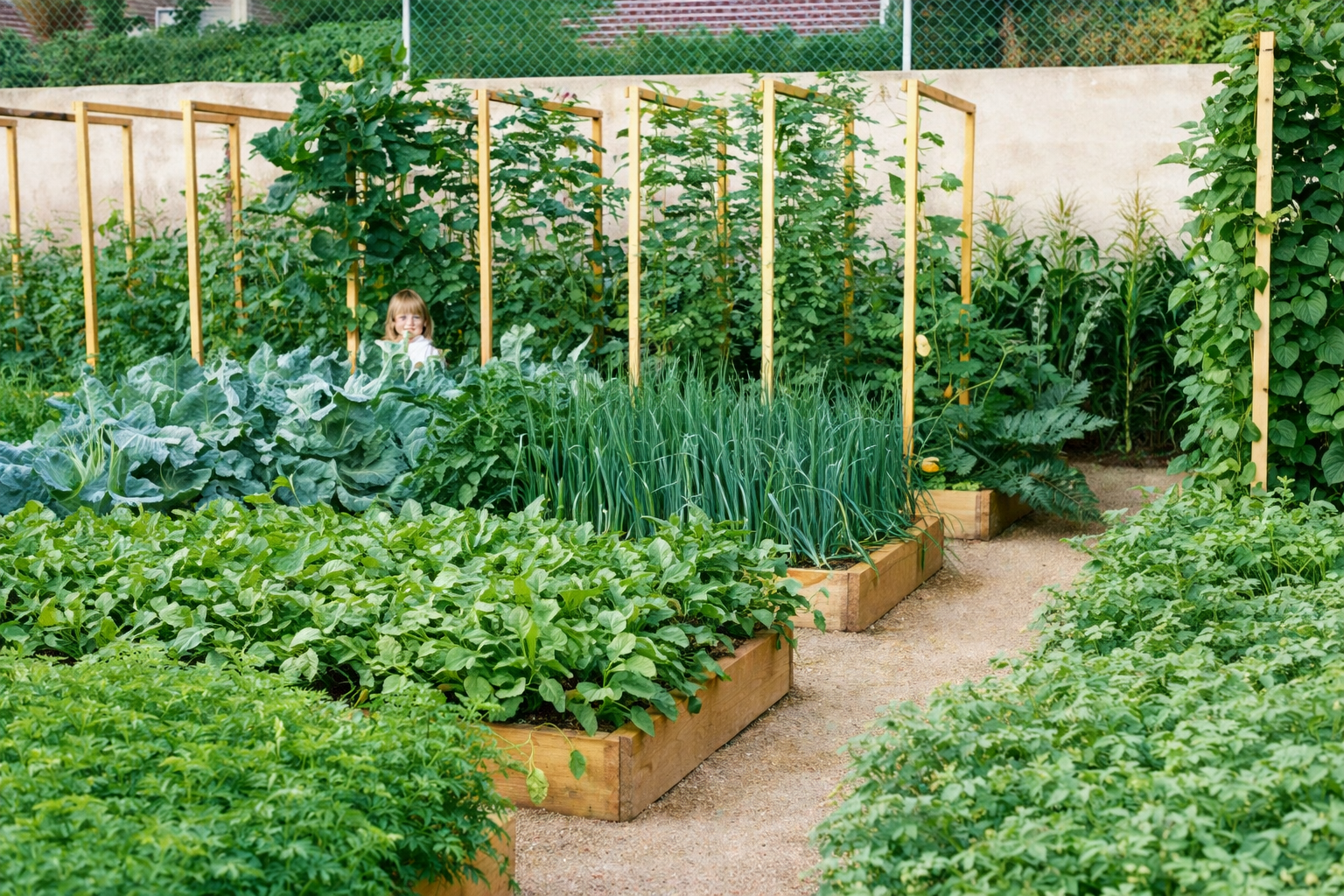
Protecting your plants from the cold (and heat in mid-summer) can be done simply with hoops and clear greenhouse plastic immediately over the plants (low tunnel), or using something larger, again with hoops and plastic sometimes called high tunnels. A third way, costing more but allowing you to grow crops vertically and increasing yields by 4-6 times in a given space, is what I call the in-the-garden greenhouse. These are built using a set of T-Frames tied together by 2 X 4’s and again covered by clear greenhouse plastic, and they can be used to grow seedlings in late winter/early spring and then to grow ever-bearing crops clear into the next winter. Gardeners in southern-tier states even use them to grow successfully year-round.
A family of 4 can live out of a garden of less than 1/20th of an acre! So start planning and preparing now, and expect to have your highly productive sustainable garden in place and growing by the time your neighbors begin even thinking about their gardens.
Short videos demonstrating many steps in the gardening process are available free at. Start there, and if you feel you want to join one of the Food For Everyone Foundation’s free gardening groups to learn more and share with others, simply go to either https://groups.yahoo.com/neo/groups/MittleiderMethodGardening/info or https://www.facebook.com/groups/2304852529528161/
So, what are YOU going to eat when the stores are all closed? If you’re serious I will give you some very exciting and important details next time.
You Can Live on What You Produce – On Less Space Than You Ever Imagined!
While you endure the cold winter months why not plan for a really great vegetable garden next spring. Maybe even one that could provide some income in addition to the food you eat yourselves! Does anyone have children who need responsibility – and spending money?
To illustrate the potential, I’ll describe the yields achievable by growing one crop in a quarter-acre garden. I realize that most of you may only want or be able to grow a garden of 10 or 20% this size, with multiple crops, however let’s tickle your imaginations! I’m aware of many Mittleider gardeners who are growing commercially – some with multi-acre gardens.
The Method is often called “the best of organic gardening” and “the poor man’s hydroponic method”, and with good reason. The best elements of many gardening disciplines have been blended and adapted for the home vegetable gardener, to maximize your yields in a truly sustainable garden.
Consider this: Just a quarter-acre of tomatoes grown properly using Dr. Mittleider’s instructions, and selling for only $.50 per pound, would yield $25,000 per year! Have I got your attention? Let’s see how it’s done.
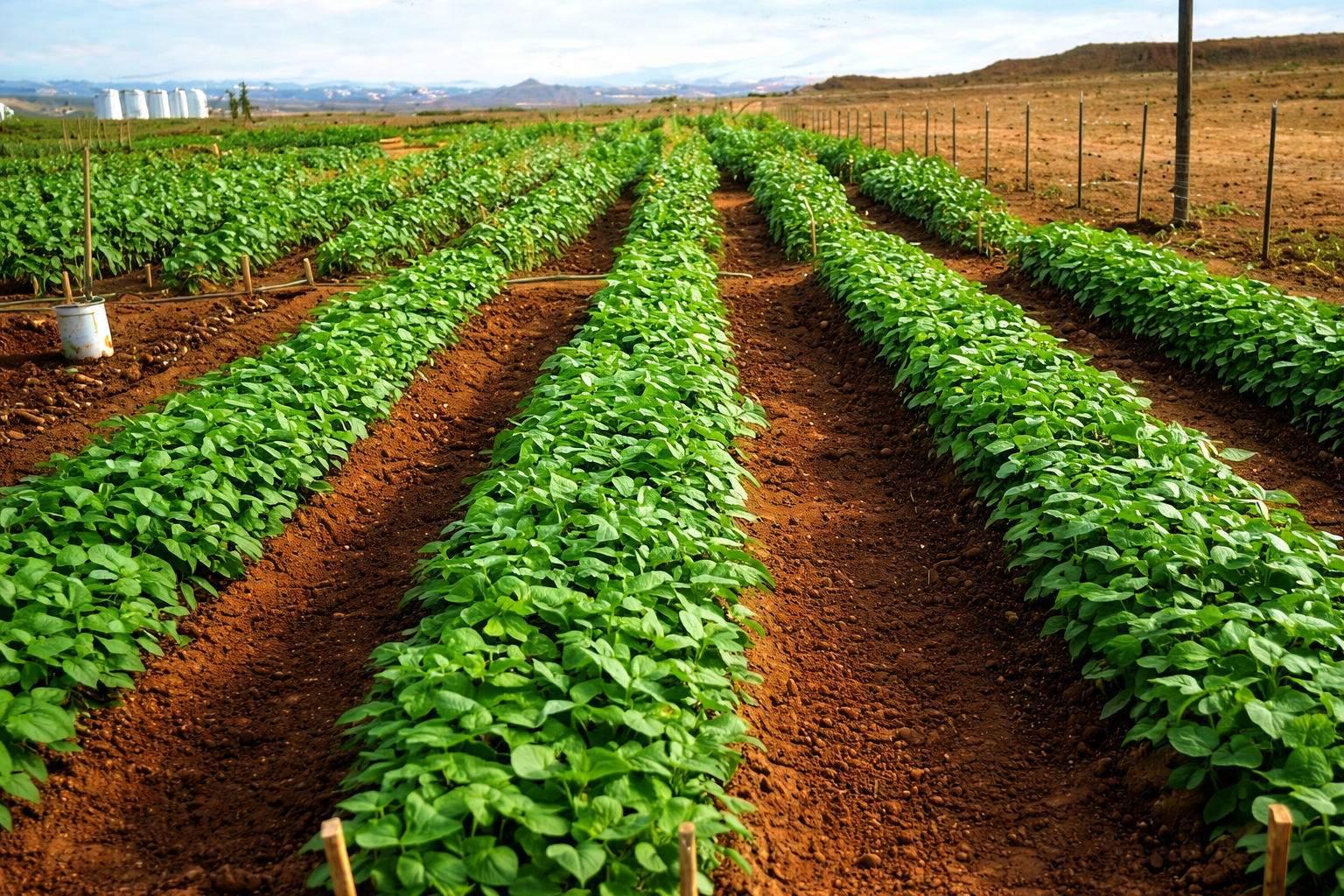
A quarter-acre, or 10,390 square feet, will accommodate 78 30-foot rows of plants, grown in 4′ X 30′ Grow-Boxes, with 3 1/2′ side aisles, and 5′ end aisles. Planting 9″ apart gives you 41 plants per bed or 3,198 total.
By growing a tomato that averages 8 ounces (some varieties are even much bigger), and growing vertically, each plant should produce 16# of fruit from July through October. How? Good varieties produce a cluster of 3-7 tomatoes every 5-7″ up a 7′ stem in 4 months of production. Using 4 per cluster and 12 clusters gives 48 tomatoes, and at 8 ounces each, your yield would be 24# per plant. Let’s reduce that by one third, to be conservative.
This amounts to 51,168 pounds of tomatoes (16# X 41 X 78) – or $25,584 at $.50 per pound. Who says you couldn’t live out of your garden! And similar results can be achieved growing right in the soil.
Now there certainly are costs, including labor, as there are in any serious endeavor. Start-up costs include 1) making and filling the boxes, 2) making T-Frames, 3) wires or pipes, and baling-twine strings, and 4) automating the watering. However these are one-time capital expenditures and will be more than recovered in the first year.
Next, suppose you’d like to increase your yield even more. After all, commercial hydroponic growers can produce 660,000 pounds of “plastic,” tasteless tomatoes per year on one acre. Of course, they have multi-million dollar investments in year-round greenhouses, automated systems, etc. By simply putting an inexpensive “in-the-garden greenhouse” or arched PVC roof over your Grow-Boxes or soil-beds, (see Appendix C of The Mittleider Gardening Course book, pages 276-282) and covering them with 6-mil greenhouse plastic, and then adding a little heat on cold nights, you can lengthen your growing season by another two months (1 in spring and 1 in fall), or 50%!
Now you’re looking at 75,000# of tomatoes per quarter-acre, or almost half the yield of the expensive hydroponic growers! But you’re growing “in the dirt”, because your boxes are open at the bottom, so your plants get all the natural nutrients available from the soil (producing better flavor). And you only use the plastic covering on cold nights during two or three months, so your plants benefit from direct sunlight as well, further improving their flavor.
Do you think these numbers are hard to believe? Just visit a greenhouse tomato operation and see tomato plants that are 20′ and 30′ long – still producing after more than a year!
Now let’s see what your family can do. And let me help guide you through the process – read the website FAQ’s at www.growfood.com or email me at jim@growfood.com.