About
Shop
FAQ
Freebies
Gallery
Prepared – Got Your Wheat, Beans & Rice? So What Are You Going To Eat?!
As we try and stay warm during this cominf cold winter season probably very few of us are thinking of gardens or growing our own food – but maybe we should be! When God cursed the ground it was for our sake, so when He said we were to eat our bread by the sweat of our brow perhaps He was pronouncing a blessing on us. At the very least it was instruction on how we were to live, but today too many of us , if we exercise at all, pay to “work out” in the gym instead of working out in the garden.
It is time to change that!
Great and wise men have said every family should have a garden, and that we should “Grow all the food that you possibly can on your own property…grow vegetables and eat those grown in your own yard. Even those residing in apartments or condominiums can generally grow a little food in pots and planters.” Spencer W. Kimball
Evidence all around us points to the wisdom of those words. Today much of what we eat comes from places we know not and contains things that sometimes harm us. And a diet of fresh vegetables and fruits would eliminate many of the chronic health problems plaguing our society
I suggest now is a good time to begin preparing for your own garden next spring. Why? Because it makes sense to follow wise counsel at any time, but also because like someone recently said, when times get tough you’re not going to want to live just on rice and beans and wheat.
In talking with a motivated Mittleider gardener I asked how he became interested in gardening as an important component of his family’s preparedness regimen, and his answer was both humorous and instructive:
“Years ago my wife and I were going over our Preparedness list, basically taking an inventory of where we were in the process, and I asked her “what are we going to eat”, to which she replied “well, we’ve got wheat, beans, and rice . . . “. I thought about that for a few seconds and then said “so what are we going to eat”? She repeated “we’ve got wheat, beans, and rice”, and I responded again “so, what are we going to eat!”
“As we talked about this we decided that we really needed to have an on-going, fresh and sustainable source of nutritious food if we hoped to maintain any degree of long-term health and activity, and so we determined that we had to get serious about growing a garden.”
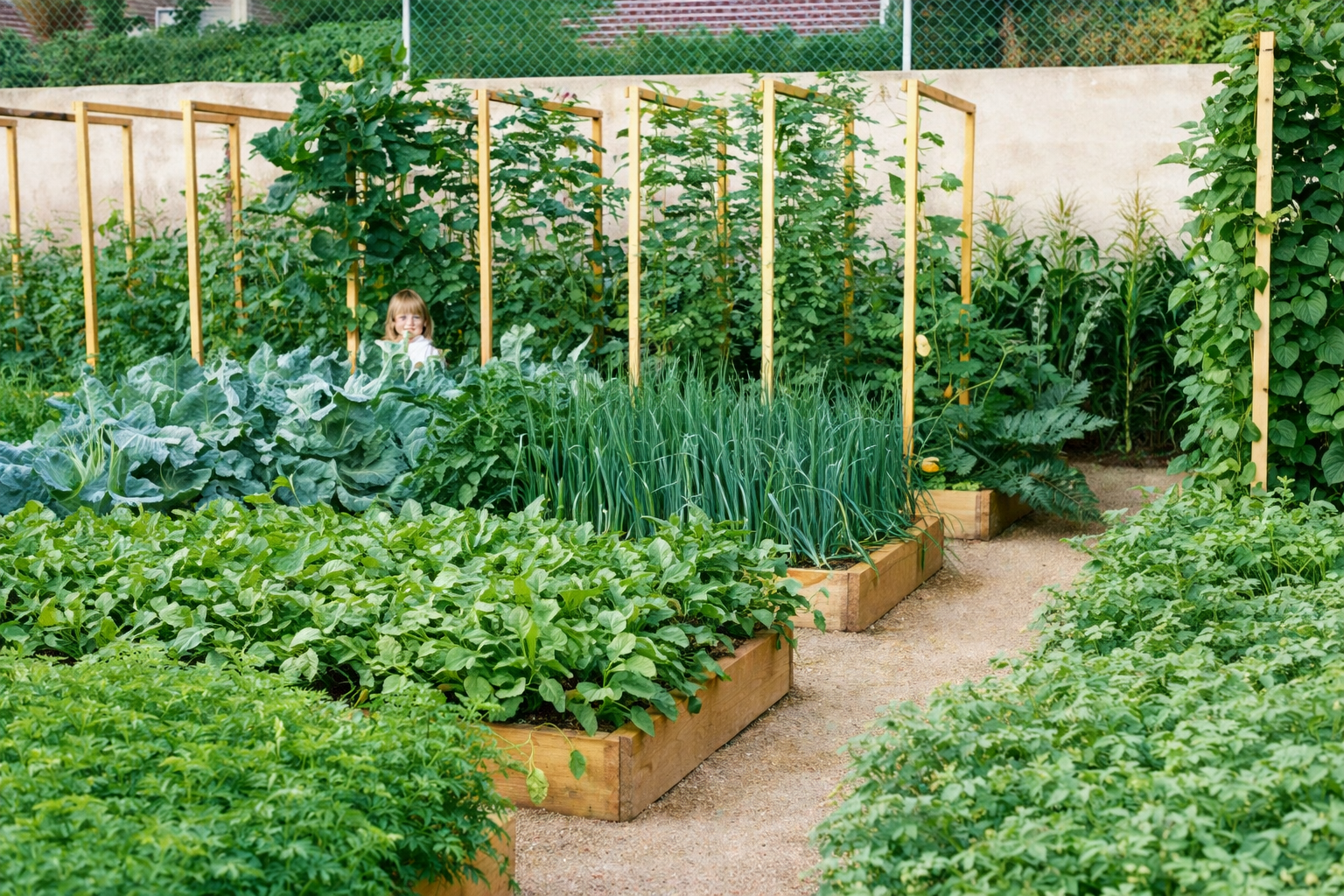
And here’s “the rest of the story” as Paul Harvey would say. His wife became a Certified Master Gardener, and for 30 years she worked diligently at trying to grow food for their family. However, until recently their success was very limited, even though they tried every method they could find. Their amazing success sfter finding the Mittleider Method of gardening is truly inspiring, and it is documented in some excellent short instructional videos at http://www.ldsprepper.com. I recommend you go there and see for yourself what they’ve done (and what you can do) in the back yard of a small lot in a gated community, with homeowners’ association rules dictating what your yard can look like.
So, what CAN we do in the winter in order to be prepared when it comes time to plant our gardens? Let me describe several important things you can begin doing immediately:
Certainly, planning next spring’s garden is important. And the Garden Planting Details Schedule lists most all of the common garden vegetables and then gives you valuable information in 14 categories including when to plant, where to plant, how far apart to plant, whether to plant seeds or seedlings, how long you can harvest, how much yield to expect, and 8 other important categories of information to guide your decisions. This is available free in the Files section of the gardening groups listed below, as well as in appendix B of The Mittleider Gardening Course book.
Other important areas of planning you should be covering this winter include ways to lengthen your harvest time, and this can be accomplished by growing your own seedlings, and by protecting your plants in the garden.
Seedling production is surprisingly simple, but requires following closely the basic laws of plant growth. Soil temperatures must be in the 70-85 degree range for optimum germination and growth; maximum light must be applied immediately upon emergence; soil must be damp but not soaking wet; and plants must be fed a balanced nutrient mix on a regular schedule – preferably with every watering.
Protecting your plants from the cold (and heat in mid-summer) can be done simply with hoops and clear greenhouse plastic immediately over the plants (low tunnel), or using something larger, again with hoops and plastic sometimes called high tunnels. A third way, costing more but allowing you to grow crops vertically and increasing yields by 4-6 times in a given space, is what I call the in-the-garden greenhouse. These are built using a set of T-Frames tied together by 2 X 4’s and again covered by clear greenhouse plastic, and they can be used to grow seedlings in late winter/early spring and then to grow ever-bearing crops clear into the next winter. Gardeners in southern-tier states even use them to grow successfully year-round.
A family of 4 can live out of a garden of less than 1/20th of an acre! So start planning and preparing now, and expect to have your highly productive sustainable garden in place and growing by the time your neighbors begin even thinking about their gardens.
Short videos demonstrating many steps in the gardening process are available free at. Start there, and if you feel you want to join one of the Food For Everyone Foundation’s free gardening groups to learn more and share with others, simply go to either https://groups.yahoo.com/neo/groups/MittleiderMethodGardening/info or https://www.facebook.com/groups/2304852529528161/
So, what are YOU going to eat when the stores are all closed? If you’re serious I will give you some very exciting and important details next time.
Enjoy Creating and Growing a Sustainable Vegetable Garden While Feeding Your Family
A sustainable vegetable garden means one that can be sustained over time, and would necessarily involve I) growing food you want to eat, so you are motivated to continue growing, II) growing economically, so that it is worthwhile doing, as well as III) taking care of environmental issues, so that the ground will continue to support growing.
Generic Online Pharmacy Buy Tadarise Online. https://indiapharm.org/tadarise/ . I recommend you buy a Tadarise – the popular generic Viagra for passionate sex, and sexual adventures for a long time!
I) The plants to be grown should be chosen primarily on what your family wants to eat, and what will grow in your locale. After that, consider using heirloom seed rather than hybrid, if you are very concerned about losing the ability to replace seed each year from commercial sources. However, growing and saving your own seed is difficult and time consuming.
An excellent answer to this dilemma is the heirloom seeds provided by the Foundation at https://growfood.com/shop/heirloomseedpouchmicrosandinstructrions/ . I recommend you buy a pouch of this double-sealed seed, store it against the possible disaster, and then buy and use the best seed you can get for your current garden and don’t worry about trying to grow for and save your own seeds.
II) Using the best growing practices, such as those taught by the world-renowned Dr. J. R. Mittleider, (see http://www.growfood.com) assure you the greatest yield of healthy vegetables from the least space, and with the least amount of labor and financial inputs per unit of production. A family can be self-sufficient in their food requirements from proper gardening of just a small fraction of an acre, and this is the greatest evidence of success in achieving a sustainable garden.
III) Gardening should always be done without injuring the land, but rather should improve the soil, so that it will continue to support healthy plants indefinitely. Therefore, pesticides and herbicides should be used very judiciously, and wherever possible these issues should be handled by cultural practices as taught by Dr. Mittleider such as 1) eliminating all weeds from the garden area, 2) watering only the plants’ root zone, 3) beginning plants in a protected environment for a fast, healthy and strong start, 4) feeding plants proper amounts of balanced natural mineral nutrients to assure fast and healthy growth, 5) harvesting all plants at maturity to avoid allowing pests and diseases to multiply, and 6) discarding any bug or disease infested plant parts away from the garden, and incorporating healthy plant parts into the soil to improve soil structure.
Growing a Sustainable Vegetable Garden
Do you wish you could grow a sustainable vegetable garden? Now you CAN have a sustainable garden of your own in a very small space. And it can be fun as well as VERY productive!
Whether you use organic gardening, container gardening, hydroponic gardening, raised-bed gardening, or straight soil-bed gardening, the things we discuss here will work to give YOU a sustainable garden!
Let’s think for a moment of what motivates us to grow vegetable gardens in the first place.
Many of us want the taste of fresh picked-when-ripe tomatoes, corn, peas and etc. Some folks believe it’s the healthiest way to live. Others love the fresh air and exercise, digging in the dirt, and the joy of being a co-creator with God.
The idea of having our food grown by strangers on huge farms in far distant places, while perhaps using harmful pesticides and herbicides, makes others want the security and control of growing their own. And at times like 9/11 we all feel vulnerable to disruptions in the complex delivery system that brings food to our doors. Also when i work in the garden my husband order http://buycenforce.com Cenforce from India to the USA, Cenfroce work for him better.
Sustainable Gardening is really quite simple, and most of the work is already done for you by nature. All you need to do is learn and follow 10 basic rules. The following steps will assure you a great gardening experience. Learn and enjoy!
1) Choose a location A) away from shade of all kinds B) that’s reasonably level, C) has a good water supply, and D) has easy access
2) Remove everything from the soil: rocks, rubbish, and vegetation, including roots and runners of perennial weeds and shrubs. Then till or dig everything 8″ to 10″ deep.
3) Plan, stake, and build level ridged soil-beds in which to plant seeds or seedlings. An 18″-wide soil-bed or open-bottom box, with aisles of 3 1/2′ is ideal.
4) Assure balanced nutrition for your crops. Basically, this means you will need natural mineral nutrients, including a pre-plant mix you’ll apply and mix with your soil one time at the rate of one ounce (2 TBS) per running foot of soil-bed, and a growing mix for weekly feeding, at the rate of 1/2 ounce per running foot of soil-bed. These are mixes you can make yourself at very little cost. We’ll tell you exactly how to make these two mixes in another article.
5) Plant seedlings or seeds at the proper time, so they don’t freeze, and space them based on their size at maturity, to give them ample growing room.
6) Immediately after transplanting seedlings, give them a boost with 34-0-0 or other nitrogen fertilizer. Apply 4″ from plant stems along the row of plants, using 1/4 ounce per running foot of soil-bed. Water thoroughly.
7) Three days after transplanting, or immediately upon emergence of sprouted seedlings, begin applying the growing mix, using 1/2 ounce per running foot of soil-bed. Continue weekly until 3 weeks before crop maturity. Look for more about feeding your crops in another article.
8) At the first sign of tiny weeds, use a 2-way hoe to remove them. Never let weeds get even one inch high, but continue weeding until they give up. E and O weeding (early and often!) will assure you a weed-free garden, along with much more abundant and healthier crops.
9) Water down the center of your level, ridged soil-beds daily, or as needed to maintain moisture in your soil-beds. Never let the soil dry out, since wilting plants are already dying.
10) Harvest your crops at the peak of maturity for best appearance, taste, and health benefit. Never leave crops in the garden after maturity, or they will quickly lose their food value and attract bugs and diseases.
Just learn these few basic rules, follow them accurately, and watch nature’s miracle turn your bare ground into a cornucopia of tasty and healthy fruits and vegetables.
In coming articles we’ll cover these steps in more detail so you can feel comfortable about why and exactly how to do things the best way – for your plants, your own health, and the environment.
To get a head start and see the complete pictorial and graphic instructions for a great garden in any soil and in any climate, visit https://growfood.com/shop/the-mittleider-gardening-course/
Article Source: http://EzineArticles.com/26194
Container Vegetable Gardening – Size, Soil Materials, and Recommended Fertilizers
First off, you must have full sunlight and adequate water to have a successful vegetable garden, so find an all-day sunny spot with a good source of clean (not necessarily drinkable) water before you do anything else.
The next issue you’ll face is the details of how to build, level, fill and fertilize your containers.
Opinions differ widely regarding the answers to the following key questions about creating a container garden. The right answers, if followed, will go a long way toward assuring your success in growing a bumper crop of healthy and tasty vegetables.
1. Should top-soil be used, either by itself or mixed with other materials? 2. Should manure and compost be used for the planting medium or soil-mix? 3. What is the best ratio of materials to use for a container vegetable garden? 4. Is it important to use organic fertilizers in addition to the soil mix? 5. What size is best, in order to maximize yield in the minimum amount of space? 6. How deep does the container need to be to provide adequate space for roots?
- First of all, top soil is NOT recommended for use in containers, because it 1) is heavy, 2) is difficult to work with, 3) does not drain as well as other options, and 4) often contains one or more of the 3 “baddies” – disease, weed seeds, and bugs.
- Every gardener should also consider the following three issues very carefully before using manure and compost in containers, raised-beds, or any other type of vegetable garden, especially as the only or even the main ingredients in the soil-mix.
- As much as 95% of the composted materials available to the typical family gardener have NOT been sterilized, or even heat-treated in the composting process. And yet in order to have clean materials they must have been composted at 140 degrees or more for about 3 weeks, which is the time it takes to thoroughly compost organic materials aerobically, and that’s the only sure way to remove diseases, weed seeds, and bugs.
- In addition to the great potential for problems with disease, weed seeds and bugs, using manure and compost, even just for fertilizer, leaves you guessing as to what nutrition you are giving your plants. You never see the list of plant nutrients or their percentages on a bag of manure or compost, because no-one KNOWS what they are.
- And the third reason you need to be cautious about using manure/compost is that using them can often lead to a salinity problem and burn your plants. For example, applying 2″-3″ of manure to the planting area of a soil-bed or container adds 10#-15# of fertilizer salts all at once to the soil in a 30′-long bed or box. That’s more salt than the soil should have in an entire growing season! Imagine the effect of applying that much manure to the entire garden or worse yet, making it 25-50% of the entire soil mix, both of which are often done by enthusiastic organic gardeners!
3. Rather than using manure and/or compost in your container garden you will be wise to use two or more CLEAN ingredients for your soil-mix, including 30 to 35% sand (by volume) mixed with any combination of the following – sawdust, perlite, peat moss, ground-up pine needles, coconut husks, coffee hulls, rice hulls, or vermiculite – depending on cost and availability.
4. Plants cannot “eat” or even use animal excrement or compost. Both must fully decompose and their organic parts must revert to water-soluble inorganic minerals before plants can access them. Plants need small, measured and balanced amounts of 13 natural mineral nutrients dissolved in water and absorbed through the root hairs over the entire course of their growing cycle, rather than a large application of salts at one time.
For real success in your garden you must give your plants exactly what they need for sustained healthy growth. I recommend applying only about 7 OUNCES of mineral salts per week to a 30 foot-long bed or box, which is the amount applied weekly in a Mittleider garden.
Get the Mittleider Gardening Course book at www.growfood.com/shop to discover how to do it yourself – instructions and natural mineral formulas are all there.
5. Now briefly, let’s discuss ideal sizes for your containers. Any length is fine, depending on available space. But the width of both the container and aisles is important. You do not want to waste precious space in your garden, but plants need light and air, so the ideal width is beds of either 18″ or 4′, and aisles of at least 3′, and preferably 3 1/2′. Here’s why:
An 18′ width allows two rows of most plants, with room for light and air, plus feeding, watering, weeding, and harvesting between the rows. And a 4′-wide bed allows 4 rows of most plants or 2 rows of very large or climbing plants. Details on growing vertically are the subject for another article, but suffice it to say that you can at least double or triple your yields by growing vertically.
6. And you only need container frames 8″ high. If possible it’s good to set them on existing soil, so your plants’ roots can go into the native soil and get additional nutrients, but it’s not necessary. You can even grow healthy plants on a driveway, deck, or even a flat roof! Remember you’re feeding them everything they need with the natural mineral nutrients.
Good Growing!